Britain at War magazine held its inaugural conference, The Big Debrief, on 6th June. The event was perfectly set in the Royal Armouries Museum in Leeds.
The first speaker at this fascinating event was Jonathan Ferguson, Keeper of Firearms & Artillery at the Royal Armouries, who gave a very engaging talk on the folklore surrounding weapons. This included questions such as whether the Bren light machine gun had been used for sniping, and whether cloth could stop a bullet.
The one that stole the show was ‘tea or wee’. Ferguson quoted a scene from Goodbye to All That by Robert Graves, describing how British tommies would make tea by firing off a belt of ammunition to boil water in the cooling jacket of their Vickers machine gun. There is also a story that, when water was in short supply, Tommies used ‘wee’ to cool the barrel of the machine gun. In both cases, the myths were proven to be true, although the tea was reported to taste a bit greasy.
Next up was Andy Robertshaw, lead historian at the Centre for Experimental Military Archaeology, author, and broadcaster. He gave a moving talk about his work carrying out archaeological digs on WWI battlefields.
When the remains of a soldier were discovered, he was never left alone in case nighthawks ransacked the site. There was an instance when the remains of a soldier had been disturbed to take whatever was beneath him. Robertshaw and his team made every effort to identify the soldiers they found. If they did not, he felt it would be like killing them twice.
When the soldier’s identification disks had not survived, forensic techniques, records, the soldier’s buttons, equipment, and personal items were used to determine who they were.
They had some success, although it did not always have a happy conclusion. One British soldier was found with two wedding rings around his neck. When the team tried to return them to his family, after months of work, they refused to take them. He had been the black sheep of the family, having bankrupted the family business, and they wanted nothing to do with him. The team had more success with the remains of a German soldier who had been killed in 1915. His youngest son (of six children) was still alive, and they were able to give him some closure before he died.
The historian and YouTuber, Dr Alexander Clarke did a great job of waking everyone up on the graveyard shift after lunch, delivering his talk on the Royal Navy’s elite destroyer force of World War II in an energetic, Jeremy Clarkson-esque style.
The destroyer force was both the spear and the shield of the Royal Navy. It had developed a highly aggressive and skilled esprit de corps through the First World War and the inter-war period, which came to the fore during the Second World War.
The classic example of this was in 1940, when HMS Cossack, under the command of Captain Philip Vian (whom Dr Clarke affectionately referred to as insane), rammed the German tanker Altmark. It is the last documented case of Royal Navy sailors swinging ship-to-ship with grappling irons. After hand-to-hand fighting, they freed nearly 300 British prisoners taken by the Graf Spee. Whether or not they used cutlasses is still hotly debated.
The naval theme continued with historian and YouTuber Alexander ‘Drachinifel’ Pocklington, who gave an informative talk on the differing doctrines behind the armoured flight decks of British aircraft carriers and the wooden flight decks favoured by the Americans. The design choices reflected the different conditions each navy expected to encounter. The Royal Navy anticipated facing overwhelming numbers of land-based enemy aircraft in the Mediterranean Sea, so focused on protection. In contrast, the US Navy expected to be fighting other carrier-borne aircraft in the Pacific, and therefore concentrated on the size of the carrier’s strike group.
Both concepts proved effective in surviving within the environments for which they were designed. The Americans were able to match the Japanese numbers and achieve victory, while the armoured flight decks served the Royal Navy well in the Mediterranean, where they were subjected to constant air attacks and did not lose a single carrier to bombing.
However, the armoured flight decks proved to be the better design choice when both navies faced Kamikaze attacks. Several US fleet carriers were severely damaged, and many were permanently put out of action when hit by Kamikaze aircraft, whereas British carriers were operational again just a few hours after being struck.
It was then the RAF’s turn to take centre stage, with Stuart Hadaway, the RAF’s official historian, giving an interesting talk on Tiger Force, Bomber Command’s operation to bring the war to Japan. It was not something I had heard of before, and the scale of the enterprise was staggering. The RAF had to deal with enormous technical and logistical problems, the biggest being the vast distances it would have to fly compared with Europe. Trying to find bases close enough to Japan was extremely challenging. Various experiments were tried to increase the range of the bombers, including inflight refuelling and fitting saddle tanks to a Lancaster. Stuart Hadaway gave an insightful account of how these difficulties were being overcome when the atom bombs were dropped and the Japanese surrendered.
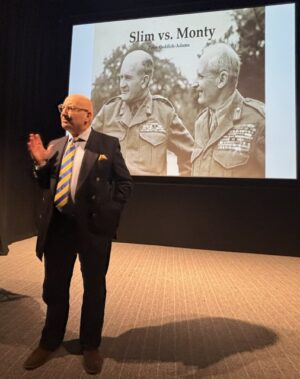
The conference ended with a comparison of Britain’s two leading generals from WWII, Bernard Montgomery, and William Slim, elegantly given by Dr Peter Caddick-Adams, a historian, author and broadcaster. Both generals were born four years apart, in the Birmingham area and both served in the Warwicks and fought in WWI which shaped them and their approach to war. Both were good communicators and both believed in the value of training.
However, the main difference was that Slim was a consummate politician, whereas Monty was not; this was a key factor in their commands, particularly in working with allies and coalition troops within their respective armies. Slim proved to be much more adept at this, especially when compared to Monty’s famously abrasive personality.
The Big Debrief was a wonderful experience, held in a friendly and collegiate atmosphere. I learnt a lot and got a few ideas for books and articles. The speakers were happy to answer questions after their talks and to quote John Ash, Britain at War’s editor and the event organiser, ‘the speakers were the beating heart of the event.’

Alan Bardos is a novelist and the author of Rising Tide.