When I first stumbled across the story of the Women’s Timber Corps more than a decade ago, I was astonished that I had never heard of them. These young women had felled trees, driven timber lorries, worked in dangerous sawmills and helped keep Britain fighting during the war, yet their contribution had almost disappeared from public memory. That discovery changed the course of my life.
Since then, I have travelled across Britain interviewing more than 60 former Lumberjills in their late eighties and nineties, meeting their families and collecting photographs, letters and memories to piece together their forgotten story. Their remarkable experiences have inspired four books, three exhibitions with Forestry England, more than 200 public talks and, most recently, my second historical novel, The Lumberjills Under Suspicion.
Few people realise that, on the eve of the Second World War, Britain imported around 96 per cent of its timber. Yet timber was strategically important during wartime. It was needed for hurricane and mosquito aircraft, ships, telegraph poles, railway sleepers and, most importantly, pit props that kept Britain’s coal mines operating. When war broke out, Britain had only around seven months’ supply of pit props in reserve. If German U-boats cut off overseas timber supplies, there would be a crisis.
The government searched for forestry labour among male dockyard workers, British prisoners, university students and even schoolboys, but disregarded women. Forestry was considered a tough man’s job, which was far too physically demanding for the ‘weaker sex’.
Initially, women were only accepted for “lighter duties”, working in forest nurseries, planting trees or becoming timber measurers responsible for calculating production figures. However, demand for timber soon became so acute that women were needed in every aspect of forestry. In April 1942, during the Battle of the Atlantic, the government established the Women’s Timber Corps. Young women trained at centres including Culford in Suffolk, Wetherby in Yorkshire, Drum Oak in Aberdeenshire and Shandford Lodge near Brechin before being posted across Britain.
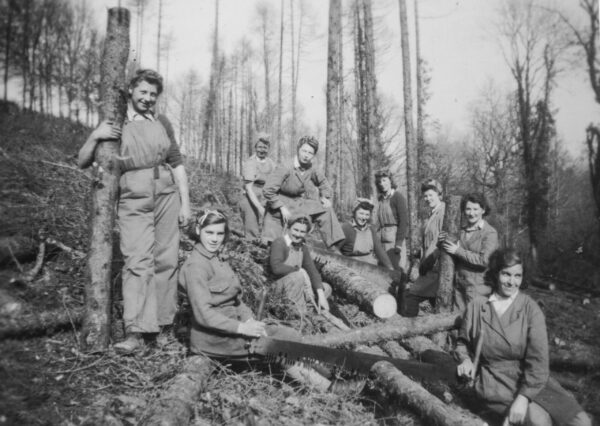
To distinguish themselves from the Women’s Land Army they wore bottle-green berets with pine-tree insignia and crossed axes badge. Soon thousands of women were felling conifers and oaks with axes and six-foot crosscut saws, operating dangerous sawmills, driving huge timber lorries, loading heavy logs by hand and working in all weathers. It was exhausting, highly skilled and often dangerous work.
Many encountered outright hostility. Some foresters refused to believe women were capable of doing the job. Bella Nolan volunteered to work a crosscut saw with a sceptical foreman to prove she was as strong as him. He repeatedly asked if she wanted to stop, but despite her exhaustion she refused. By the end of the day, they had felled 120 trees. Months later another supervisor told her, “I’ve read about you. Your record is in the office.”
Their living conditions were often equally challenging. Many lived in isolated wooden huts or bothies deep within forests, frequently without electricity, running water or proper washing facilities. One Lumberjill said she remembered bathing in icy streams, remarking that they had discovered “the lifestyle of a cavewoman.”
Yet what stayed with me most was not the hardships but the friendships. Many described those wartime years as the happiest of their lives. Living and working together forged lifelong bonds, while the freedom of earning their own wages, working outdoors and proving themselves in traditionally male roles transformed their confidence. These young women brought gender stereotypes crashing down and had redefined what women could achieve.
Between 15,000 and 18,000 women worked in forestry during the war. Some rose to supervisors, forewomen, supervising entire forestry operations and managing male workers. They performed exactly the same jobs as men on less than half the pay.
Home-grown timber increased from just four per cent before the war to sixty per cent during the conflict, with more than 18 million tonnes produced from British forests. By 1946 almost half of Britain’s forests had been felled. Russell Meiggs, the government’s chief labour officer responsible for home timber production said that Britain could not have met its wartime timber targets without these “female Amazons who rivalled men.”
And yet, when peace returned, the women were largely forgotten. Unlike many other women’s wartime organisations, they received no gratuities or benefits. They lost their jobs and could not keep their uniforms. Their employment records were destroyed. For decades they were excluded from Remembrance Day parades because they had not served in the armed forces.
Alongside my history books and novels, I have spoken at literary and history festivals across the country and continue working with families to preserve photographs, diaries and personal stories.
I have also worked with Forestry England to curate exhibitions. Every exhibition brings discoveries as families arrive with photographs and new stories. It has been so rewarding to read visitor comments many of whom are discovering the Lumberjills for the first time: ‘Very slay and low key cool’; ‘Women are very cool ❤️’; ‘Very informative and inspiring, I got quite emotional’; ‘excellent exhibition’; ‘really interesting exhibition about history that should be more widely recognised and celebrated’; ‘True heroes – fascinating!!!’.
My hope is that whether people discover the Lumberjills through my history books, exhibitions or fiction such as The Lumberjills Under Suspicion, the story of the Women’s Timber Corps is never forgotten. I’d love the Lumberjills to become as well-known as that of the Land Girls, codebreakers and factory workers and for them finally to receive the recognition they deserve.
Memorials to the Women’s Timber Corps now stand in Queen Elizabeth Forest Park, Argyll, Scotland, Dalby Forest in the North York Moors and the National Memorial Arboretum in Staffordshire. Their courage, resilience and determination deserve to inspire many generations to come.

Joanna Foat is an historian and the author of several novels and Lumberjills: Britain’s Forgotten Army.