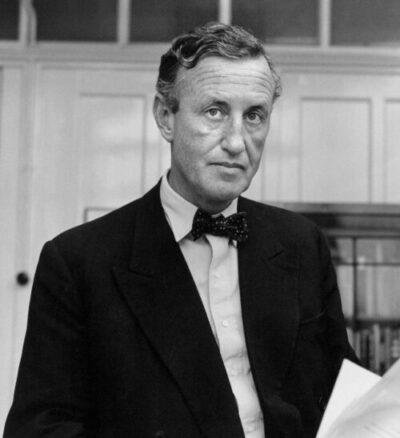
Ian Fleming created the most famous fictional agent in the world, James Bond. However, when he worked for Naval Intelligence during WWII, he made significant contributions to the real world of intelligence. One of his most important contributions was the formation of 30 Commando, a specialist unit that captured enemy intelligence.
After a disastrous debut on the Dieppe raid, 30 Commando had success during Operation Torch when they captured an Abwehr Enigma machine. They continued to make a name for themselves during the invasion of Sicily, where they seized another Enigma machine, radar and radio equipment, along with handbooks, logs and codes.
30 Commando also captured a large haul of sea mines, which were having a devastating impact on the war at sea. Underwater technology became a primary focus for 30 Commando as they expanded their operations into the Bay of Naples. The Italians had made major advances in underwater warfare, especially with regard to human torpedoes and limpet mines. This had enabled their elite naval commandos, the Decima Flottiglia MAS, to pull off some of the most stunning raids of World War II.
When Mussolini’s government fell on 25 July 1943, there was a fear that this research would fall into German hands, and 30 Commando was tasked with getting it first.
They docked at Capri on 12 September 1943 and immediately began securing enemy intelligence material and personnel. Working with the American Office of Strategic Services, the forerunner to the CIA, they discovered that Admiral Eugenio Minisini, Italy’s Head of Underwater Research, was at a torpedo-testing range on San Martino inlet off the Phlegraean Peninsula, southwestern Italy, and that the Germans were planning to take the admiral to Germany.
On the night of 17/18 September 1943, led by Captain Martin-Smith and Lieutenants Berncastle and Glanville, 30 Commando raided San Martino. After making most of the journey in a large Type 249 landing craft, with assistance from Italian torpedo boats, they used a whaler to make a silent landing at the research facility.
They captured an Italian night watchman who directed them to Admiral Minisini’s quarters. 30 Commando roused the admiral and explained that they had been sent to escort him to safety.
Minisini refused to leave and was made a prisoner of war. To expedite the admiral’s cooperation, they agreed to take his wife. Signora Minisini was believed to have strong German loyalties and was therefore a risk to operational security.
To ensure a clean getaway, Captain Martin-Smith assisted Signora Minisini with her packing, speaking to her in fluent German. She believed him to be a German officer. By all accounts, she was charmed by the “young Rhinelander”. 30 Commando then carried Signora Minisini’s 13 pieces of luggage to the waiting boats.
Along with Admiral Minisini and his wife, 30 Commando also took many of the admiral’s blueprints and documents from right under the noses of the Germans.
The admiral fully cooperated when they questioned him back on Capri, and he gave a detailed list of documents concerning his current torpedo research and the progress being made on the construction of an advanced ‘pocket’ submarine.
30 Commando took the bold decision to make a second raid on the research facility to recover the rest of the admiral’s work, even though the Germans were sure to have been alerted by the previous mission.
They returned the next night, 18/19 September, and split into separate patrols. Two former policemen conducted a fingertip search of the admiral’s accommodation and offices before moving on to the torpedo research laboratories, recovering a substantial number of blueprints and documents, while the rest of the raiding party reconnoitred the general layout of the facility.
During the classical period, the Phlegraean Fields were known as the entrance to the underworld and 30 Commando found a massive tunnel complex that connected San Martino to Baia and a torpedo range on Lake Fusaro.
The Germans showed no sign of stirring throughout the whole raid.
Although 30 Commando was able to prevent the Germans from combining Italian underwater research with their own, the Americans took possession of Admiral Minisini and his research. How the British allowed this to happen remains unclear. I give a tongue-in-cheek explanation in my novel Hunter Class.
Nevertheless, the operation demonstrated 30 Commando’s value as a highly effective intelligence-gathering unit at a critical moment in the war, a role in which they would go on to excel in later campaigns.
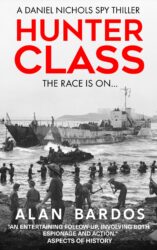
Alan Bardos is the author of historical fiction set around the World Wars. His latest novel is Hunter Class.