Within the pages of Women of SOE, there are many incredible stories reflecting every human trait from heroism to cowardice, bravery to fear, love to betrayal, loyalty to selfishness. The book’s aim is to show these women (and the men they worked with) as human beings, just like us, ordinary, but who somehow came to do the most extraordinary work across Nazi-occupied Europe.
Up until now many of these women’s stories have either remained untold (at least in English) or have been consigned to the footnotes, never having been afforded the time and research that they deserve. Stories from Denmark, the Netherlands and Hungary have largely given way to those from France and SOE’s F section. In this, my second book, I have rectified that imbalance and historical injustice.
There are so many incredible events and women it is hard to choose just one to feature. I could have chosen Olga Jackson, who used her uniform to illegally requisition two motor cars whilst in France and who disappeared, the final words on her file stating that she had been a ‘bloody nuisance ever since liberation.’ Or Jeanne Bohec, SOE’s only female explosives instructor. Or Haviva Reik who ran an escape line Slovakia and was murdered in a massacre whilst wearing her RAF uniform.
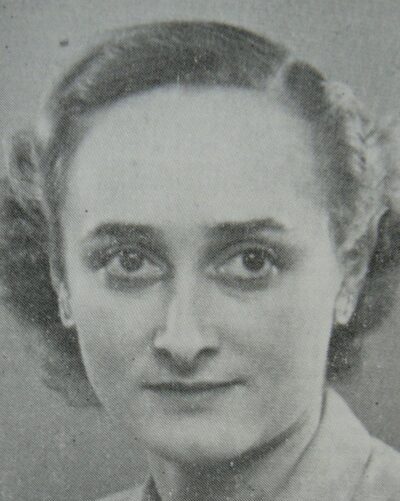
However, I wish to highlight Edith Bonessen whose story was brought to life in various Danish archives through audio recordings, photographs and her coded wireless messages.
In 1942, 31-year-old Edith Bonnesen began working for the Danish resistance group De frie Danske. In a country that had decided to ‘co-operate’ with the Nazis, she was amongst a significant number of Danes who actively wanted to fight back.
Working on an underground newspaper by the same name, Edith was a contributor, she collected material and wrote articles for the magazine, which had a circulation of 20,000 readers.
Any resistance activity was fraught with danger and in 1942 alone she was arrested three times. She always stubbornly denied any wrong-doing and with assistance from the Danish police (who were, in her opinion, ‘always one step ahead of the Germans’) she walked away each time.
Soon Edith crossed paths with a wireless operator named Duus Hansen (an incredible man who reinvented the wireless set so that it was the size of a phone book not a suitcase). Duus needed help as his network had grown beyond the point he could manage it alone. A colleague recommended Edith – at first Duus was not keen, owing to the fact that she was a woman, ‘what can I use her for’ he asked. Upon discovering that she was ‘well connected’ Duus reluctantly agreed to give her a chance.
Codenamed ‘LOTTE’, her first job was to find the locations from which they could broadcast, then she set up a network of over 100 wireless operators, taught them how to use a wireless set, gave them codenames and cover stories and found the money to fund it all.
Edith was arrested again in the summer of 1943. She had gone to collect codes, crystals and messages for Duus. As Edith was picking up the last of her packages there was a heavy pounding on the door. Heavily armed Germans and Danish ‘henchmen’ stormed past them into the room. One of them recognised her – ‘It’s Lotte,’ he yelled, and she was bundled into a car.
As Edith was driven through the familiar streets of Copenhagen, she put her head out of the window in the hope that she would be seen and recognised. When the car stopped, she was taken at gunpoint into the infamous Gestapo HQ at the Shell House.
Taken to the second floor she was left outside an office, as her guards went in and drank liquor round to celebrate their success. Sometime later and two floors up her interrogation began in earnest.
Fuelled by hatred and alcohol, her interrogator told her that they did not believe her story, nor did they need to. She was returned to the second floor and back to the chair in the corridor. The officer disappeared into the office where he began to talk about her to the others – and no doubt started to drink again. She looked around and saw that the corridor was empty.
Getting up she walked down to the next floor, where she saw two civilians – she followed them so closely that she was almost stepping on their heels. Passing the guard at the entrance, the two civilians gallantly stepped aside – ‘Bitte schön’ they said and gestured to let her pass. With that Edith simply walked out of the Shell House.
She eventually made it back to her safe house; however, her ordeal was not over. Senior resistance member ‘Citron’ had said that Edith could not be trusted. She could only have got out of the Shell House safely if she had been turned into a double agent, tasked by the Germans to undertake work on their behalf. She was arrested again – this time by the resistance.
Powerless to fight back, she was dragged into a car and taken to a cottage in a forest. As she was led into the living room, she took a letter that was lying on the hall table and stuffed it into her pocket. Then ‘the all-day interrogation began’ until the men ‘grew weary of the situation’. Edith felt sure she was about to be executed.
She saw her moment and took the letter from her pocket and waved it in their faces. ‘You didn’t see me take this. If I was an informant, I would have saved it for the Germans.’ The two men immediately realised their mistake, and she was released without further questioning or delay. She was given a bunch of pink carnations as an apology.
But too many Germans knew what Edith looked like now and, after four arrests, it was felt that her luck might soon run out. She was ordered to go to Sweden and, somewhat reluctantly, she went. In Sweden, Edith undertook work on the ‘Spaghetti’ (later known as ‘Badminton’) wireless connection on behalf of SOE until the end of the war. Women of SOE is the first time her story has been told in English, and the remarkable story of Edith is just the tip of the iceberg.

Kate Vigurs is an independent historian, lecturer, and the author of Women of SOE: A History of their Secret Missions in Wartime Europe, published by Yale University Press.