
Welcome back to Aspects of History, Jim. You wrote your first novel, The Bratinsky Affair, late in life after a long and successful career. What prompted you to do so?
I am originally from Northern Ireland and studied French and Spanish at Queen’s University Belfast. I always had an urge to write when I was younger and when I finished my degree, my instinct was to study journalism. At that time the only post-graduate course in journalism was at the University of Swansea in Wales. I had no contacts in the business, and it would have been a big gamble, so I settled for the safer waters of teaching. When I moved to Dublin, I worked for a leading advertising agency and then, when I started working for Amnesty International and Front Line Defenders, I became Head of Media. During that time, I met many fascinating and inspirational people, and travelled to countries like India, Western Sahara, Guatemala, and Honduras, which opened my eyes to what life was like for so many people. There were highlights such as when I carried out groundbreaking research to uncover Irish involvement in the international arms trade. I spent a lot of time doing radio interviews, writing reports, press releases and opinion articles and, for some years, this satisfied the yearning to write. However, I gradually got tired of rehashing other people’s ideas and seeing my work appearing under someone else’s byline. When I retired, I decided it was now a question of do or die, and I signed up for a course on creative writing. The shutdown during covid was also the perfect time to focus on something I had always wanted to do but had put off, because other things seemed more important. The lesson is: follow your instincts.
What skills from your career have transferred into your writing?
When you work for an international human rights organisation like Amnesty International, there is a huge emphasis for meticulous research, getting the facts right and deciding on the key issues that people need to know about. The other aspect of that work is deciding how you are going to tell that story. You have to pick the people (characters) who will help the public to understand the essence of the issue, and you have to help those people to tell their story. That was helpful in creating a cast of characters to tell my stories.
The Bratinsky Affair is set in post-revolutionary Russia and in France in the 1920s and 1930s and is very successful. What has tempted you to move your next novel to Syracuse in the 400s BC?
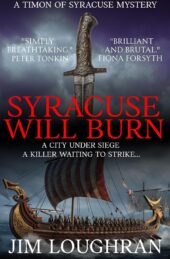
It was a matter of luck. In the summer of 2021, my husband and I were on holiday in Syracuse in Sicily and at the same time I was doing an online writing course. After a day spent climbing around the Greek Amphitheatre and the Archaeological Park, I went back to the apartment to log on for my class. At the end of the class I was given a writing assignment based on the prompt: he turned a corner and went up a hill. That exercise became a short story which won a prize and, in due course, became the basis for Syracuse Will Burn. I credit Apollo with being the inspiration for the novel.
Your chosen period of the 400s BC is not one covered in many easily accessible sources. How did you go about researching it?
Having grown up with the television series I, Claudius and subsequently read Suetonius, there was always the feeling of familiarity with life in ancient Rome. With ancient Greece it was new territory, though at home we did have a copy of Tanglewood Tales by Nathaniel Hawthorn, with its retelling of the legends of Theseus and the Minotaur, and Jason and the Golden Fleece. We also had a set of old encyclopaedias and, at the back of one volume, there was a section of the myths and legends of ancient Greece, but that was not much help in developing a coherent narrative. I tried to immerse myself in the drama and poetry of ancient Greece to try to see the world through the eyes of the ancient Greeks. I read the plays of Euripides and Sophocles and took careful notes while reading Thucydides’ History of the Peloponnesian War. I read Plato’s Seventh Letter and Xenophon on Plato. I even tried to navigate my way through the writings of Diodorus Siculus who, though Sicilian, was writing three hundred years after the events in question. I read endless books on the history of the period, and it quickly became apparent that many of these books were based on the same limited sources. I even read How to Fit All of Ancient Greece in an Elevator, by Theodore Papakostas, but it was more amusing than informative. Bit by bit I pieced together a timeline and, in tandem with that, I tried to work out a career path for Timon. There was a danger of getting bogged down in historical details so, having got my historical outline, I had to simplify it into a structure that would respect the facts but also allow the characters to develop their own personalities. At a certain point I had to say, enough history. It is time to focus on the characters and the story.
And, given that you did research locations, historical times and characters, how did you go about bringing such an air of authenticity to your work?
Syracuse is a four-day city and as we had booked our apartment for three weeks, on the assurance that Syracuse was fabulous, I had plenty of time to explore the city and especially the temples and fortifications on the peninsula of Ortigia. I walked across the bridge onto Ortigia, took photographs from the steps of the Temple of Apollo so I could later describe what Timon would have seen, and walked many times up to the piazza, with the fountain at its centre, which marks the approximate location of the Temple of Demeter. It did become a bit confusing when I discovered that there were in fact two Temples of Demeter. We spent an afternoon in the quarries where the Athenian prisoners were held. We stood in the cave at the bottom of the quarries which is often referred to as the ear of Dionysius, though this has nothing to do with Dionysius, being an 18th-century invention by Caravaggio. I drew out a map of the city as I needed it to be and I plotted the location of the barracks, the house of Hipparinus and the house of the Hight Priestess. In describing the interiors, I based my descriptions on the Villa Kerylos on Cap Ferrat in the south of France. The Villa Kerylos is a reconstruction of a Hellenistic villa from the third century BC and was commissioned by French archaeologist Theodore Reinach in the early 1900’s. In 2025, we went back to Sicily, and this time we visited the Valley of the Temples at Agrigento, known in ancient times as Acragas. This enabled me to walk from the shoreline up to the acropolis and the ruined Temple of Zeus as described in Syracuse Will Burn. A friend who read an early iteration of the book commented that Timon never seemed to eat anything, so I had to rectify that and, as Timon is a handsome and healthy 19-year-old, it was inevitable that sex would raise its ugly head. Having created this visual scenario in my imagination I would close my eyes and try to see the streets and buildings as Timon would have seen them. Setting a story in ancient Greece does lend itself to a certain theatricality but it was important not to overdo this in case it would distract from the human relations which have not changed all that much in 2000 years.
Syracuse Will Burn is the first of a series. Can you give us a hint about what Timon will be up to next?
At the end of Syracuse Will Burn, Timon finds himself in a position of increasing influence. As Evander points out to him, he could become one of the most powerful men in Syracuse. Timon may not want power but, increasingly, he will find himself at the heart of politics in Syracuse. In the next two volumes a lot will depend on the relationship between Timon and Dionysius, as Dionysius consolidates his power. Timon will have to decide whether to throw his lot in with Dionysius or resist him. The question is, what form will that take? Passive resistance or outright rebellion? We will meet Plato, and Dion, who we saw as a small boy playing with a puppy, will begin to emerge as a leading figure in Syracuse. When Dionysius marries two women on the same day life becomes even more complicated.
You attended university at an unusually fruitful place and time. Alexander McCall Smith just joined the Law department, as did Ciaran Hines (briefly); Ciaran Carson, Paul Muldoon and Bernard MacLaverty were writing poetry and prose to international acclaim; Kenneth Branagh was growing up a few streets away and up in Coleraine a young Liam Neeson was making his name in Friel’s Translations. While Seamus Heaney was lecturing in the English department. Do you feel that any of this had an effect upon you and your writing?
I grew up in the small village of Ballygawley where it was a question of up one street and down the same street. I went to school in a small two room school which had no running water and limited electricity, where my mother taught. As it happens, John Montague the poet went to the same school and his poem Like Dolmens Round My Childhood, The Old People, is still one of my favourite poems. At schoo,l history was always my great love and my original plan was to study History and English. In my last year at school, I developed a love for French and decided to take up Spanish. Moving into this world of French and Spanish literature and culture was like a door opening for me, and it nurtured an intense desire to escape from the bigotry and claustrophobia of Northern Ireland. Rather than engage with the cultural life of the university I largely turned my back on what was going on around me in Belfast. That may also have had something to do with being a young gay man only gradually coming to terms with my sexuality. I took every chance to get away. I worked in Spain for the summer, got a job in a factory in England and did summer courses in universities in France and Spain. The last part of that process was the year I spent in Paris after graduation and, after that, I could never really settle back into the routine of life in Northern Ireland.
At the same time, the Troubles were in full flood. Do you think the atmosphere of insecurity and paranoia influenced your creativity at all?
If you had asked me that question a few years ago, I would have said no, but increasingly, as I see more published work appearing, I can see a clear pattern of issues and concerns emerging. Ballygawley was evenly divided between Catholics and Protestants but there was always the feeling that if you were a Catholic you had to fight that much harder to get your rights. At one point, my late brother Aidan wanted to train to be an Agricultural Inspector. He did the preliminary course in Strabane and got very high marks. The next step would have been to go to Greenmount Agricultural College but one of his tutors warned him that his marks were irrelevant as no Catholic had ever succeeded in getting into Greenmount. He ended up doing nursing and went to work in England.
My brother Dermot at one point worked in Harland and Wolf shipyards where the workforce was notoriously anti-catholic. If you were working on a ship, you had to be careful in case someone “accidentally” dropped a spanner on your head from above. One day, there was a riot as a mob of Protestant workers raged through the shipyard, attacking Catholic workers. His foreman put him in the boot of his car, drove him home, and told him not to come back until it was safe. He too ended up going to work in England.
Ballygawley is a small village, yet in the 1970’s we had a series of bomb attacks and bomb warnings as banks and the police station were targeted. All the windows in our house were blown out on several occasions. I remember one night someone came to the front door. My father told me not to switch on the light in the hall as the light behind you would reveal the outline of your body through the glass panels and make you a target. These things lodge in your mind and over time they gradually come to the surface. I can now see the recurring themes of exile, loneliness and loss, and the search for identity in a changing world.
One of my first short stories published by Aspects of History was City of the Damned which focuses on the rebellion, and ultimate defeat, of Hugh O’Neill. Known to history as The Great Earl, O’Neill fought against the repressive policies of the English Government in 17th century Ireland. That theme continued in The Bratinsky Affair where exiled Russian aristocrat Irina has a crisis of identity as revolution strips her of everything she holds dear, including her sense of self. It is a story of exile, loss, and survival. It is also a story of the search for identity, as the other main character, Tom O’Brien, comes to terms with his identity as a young gay man. My new novel, Syracuse Will Burn, takes this theme further. Timon is isolated by his gift of premonition and finds himself drawn into a vicious struggle for power. The question for Timon is whether he will stand with the oppressor, or the oppressed.
Can you describe your writing routine?
After my husband, Nenad, goes to work, I do about an hour of so of social media to build up more of a following. I scan the Guardian, the New York Times and the English edition of Le Monde for anything interesting to do with books, general culture, and history. I cannot keep saying, ‘buy my book’ so I am always on the look out for something interesting to share. Then I review what I have written the previous day and weed out the word just, which I have a tendency to use as a form of punctuation. I take a break at lunchtime to get some exercise and then, come back and soldier on until about five o’clock. That is on a good day. If the words refuse to flow, I may go into the garden and vent my frustration on the weeds in the herbaceous border.
Can you describe your writing routine?
I would repeat the advice of Stephen King: keep reading, keep writing, and keep submitting.

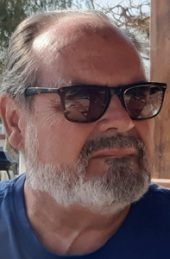
Jim Loughran is a writer of historical fiction and the author of Syracuse Will Burn, the first in the Timon of Syracuse Mystery series, published by Sharpe Books.
Peter Tonkin is the author of over 50 novels including Beware of Greeks, the first of The Trojan Murders series, published by Sharpe Books.