

Welcome back to Aspects of History, Jim. The Bratinsky Affair, our Fiction Book of the Month, combines murder mystery, espionage thriller, and historical fiction. What first inspired the book, and how did the story evolve from that earliest conception?
Serendipity played a large part in the origins of The Bratinsky Affair. In the early 2000s, I attended a lunch in Dublin where I was introduced to a Baron Brian de Breffny and his glamorous wife. It transpired he was a descendant of the distinguished O’Rourke de Breffny family who had fled seventeenth century Ireland to make their fortune in the service of Imperial Russia – hence their title. While his claim to the title of Baron was bogus, the story of the O’Rourke family was real. It struck me that this was like something out of a novel and I stored it away for future reference.
During that time there were regular media reports of various relics of pre-revolutionary Russia that had washed up in Ireland. There was the story of the loan of £20,000 granted to the fledging Russian state by de Valera in the 1920s, on security of part of the Russian crown jewels. In the 20s, both the newly formed Irish Free State and the Soviet Union were struggling for international recognition. Giving a loan to the ‘murderous communist regime’ became controversial and the deal had to be hidden. The civil servant in question did not know where to conceal the jewels so he took them home and hid them in the bottom of a wardrobe, where they remained forgotten for many years.
There were also occasional articles about the socially prominent Count and Countess Kutuzov-Tolstoy. They were living in Wicklow and running a market garden. ‘I gave the count a walk on part in The Bratinsky Affair during which he warns Olga of the presence of Russian spies. ‘Count Tolstoy’ was later revealed to have been a long-term Russian agent and was accused of being responsible for the betrayal of Raoul Wallenberg during his time in Budapest. Earlier, he had been involved in running a language school in County Louth, whose students included the spies Burgess and McLean.
I stumbled upon the Russian Village during a ramble in County Wicklow, during covid time. The Russian Village was built by another Russian exile, Bayan Giltsoff, who had escaped the Russian Revolution and the Blitz to settle in Ireland in 1944, with his Irish wife. He built the twenty houses in a distinctive Russian dacha style. I did an online writing course during covid, and the discovery of the Russian Village became the trigger that resulted in bringing all these Russian elements together in The Bratinsky Affair.
The novel is rooted in the history of Irish families who entered Russian service and became part of the imperial aristocracy. How much of Irina Bratinsky’s story is based on real people and events?
Ascribing a life of crime to Irina was a leap of imagination. I feel I may have done an injustice to the very distinguished O’Rourke de Breffny family, whose story is worthy of a book in its own right. In 1758, John O’Rourke travelled to Russia to join his brother Cornelius who was already serving in the army of Empress Elizabeth. In 1760, during the Seven Years’ War, the newly recognised Count John O’Rourke was presented with a diamond studded sword by Frederick the Great for valour at the siege of Berlin. Later his nephew, Count Joseph Cornelius O’Rourke, helped to defend Moscow against Napoleon and was decorated for his role in the Battle of Leipzig. They were never in desperate enough circumstances to turn to crime.
Irina herself is an absorbing character whose life is shaped by revolution, exile, and war. What drew you to her, and what did she allow you to explore about the human cost of history?
When I worked with Amnesty International, I had to deal with refugees many of whom had to leave everything they had known behind. I remember one man from Sudan. He came from a very distinguished family descended from the Mahdi who had fought against General Gordon. His big regret was leaving his library behind. Here in Ireland that history meant nothing and he was treated as, ‘another beggar.’ That, and other similar stories, informed Irina’s experience of poverty in 1920s Paris. Her old world is gone and an aristocratic title and ancient lineage, has no value without a solid foundation of cash. Her determination to remake herself in the old image is both her great strength and her fatal flaw.
Exile and displacement are central themes in the novel, affecting both Irina and Tom O’Brien. Why were these themes so important to telling the story?
Almost every human story is about the individual struggling to understand who they are and to find their place in the world. Irina’s world has been taken from her by war and revolution, and Tom feels alienated from his background because he is gay in 1970s Ireland. In the second world war alone, an estimated 65 million people were displaced, and, at the moment, Europe is struggling, and failing, to deal with another wave of migration. Every one of those people is faced with the same dilemma. These are the recurring themes of human experience.
Tom is a young journalist coming to terms with his sexuality in 1970s Ireland, all the while pursuing the biggest story of his career. How did you go about creating his character, and does he reflect your own experiences?
A large part of The Bratinsky Affair is set in Paris in 1976. The reason was that I was living in Paris in 1976 and could base the descriptions on first-hand experience. Also, like Tom I was coming to terms with my own sexuality as a young gay man, so that there are elements of autobiography in his story. In my earlier days I had wanted to pursue a career in journalism but that had not worked out, so I projected my journaliste-manqué persona onto him. Of course, I also needed a character who could grow and pursue his investigations in other stories. Making him a journalist was a good option.
The novel moves from revolutionary Russia to occupied France, Cold War Europe, and rural Ireland. Which setting or era proved the most rewarding, or most challenging, to research and write up?
I wanted to develop a strong sense of place and time so that the cities of Paris, Moscow, and Saint Petersburg would function like characters in the novel. So, I did a lot of reading and research. As for Irina, the glamorous Russian aristocrat escaping with a stash of diamonds hidden in their underwear is not exactly new. The challenge was to put a spin on that character that would be interesting to the reader. I had fun writing about Irina’s affair with Suzy Solidor, and introducing Tamara de Lempicka, as well as describing the murder of the corrupt cop Gerard, in wartime Bordeaux.
Readers may be surprised by the depth of the historical connections between Ireland and Russia. What was the most intriguing discovery you made while researching the book?
There were several surprises. I was surprised by the number of exiles who for a variety of reasons ended up in Ireland. I had not known there was a Russian Village in Ireland. When I was reading that wonderful book, Former People by Douglas Smith, there was a footnote referring to the diaries of a Russian Countess. When I googled her I found that her son was buried in a Dublin cemetery. I found that strangely moving. And of course, it was a joy to discover the portrait of Count Joseph Cornelius O’Rourke hanging in the Hermitage Museum.
It has now been around a year since the publication of The Bratinsky Affair. Looking back, how have readers responded to the novel, and have any reactions or interpretations particularly surprised you?
Several readers have said that they loved the sense of place, and that the book was a great form of armchair travel. Others have asked me when the next Tom and Olga adventure was coming out. I was slightly surprised that they saw Tom and Olga as a team. A book club in Belfast said they loved the book and wanted to know when the movie was coming out. I wish I could tell them.
It was your debut novel after a distinguished career in human rights and communications. What has the transition to historical fiction been like, and what can you tell us about your next title, Syracuse Will Burn, which is due to appear imminently this summer?
When you work for an international human rights organisation there is always a new crisis and a new set of demands. Sometimes you feel that whatever you do, it is never enough. At the same time, over the last thirty five years I have travelled to places and met brave and courageous people I would never otherwise have known. While writing is also challenging, and at times frustrating, it at least allows me to focus on ideas and issues that interest me. It may be, that it is because of that experience, that I am interested in the themes of exile, loneliness, and loss.
There are parallels between The Bratinsky Affair and my new novel, Syracuse Will Burn. While Tom O’Brien is alienated from his community because he is gay, Timon of Syracuse is isolated by his gift of premonition. This dangerous gift makes him a pawn in a vicious struggle for power in the Syracuse of 407BC. Syracuse Will Burn is about power: what people will do to get it and the price of losing it. Like Tom, Timon has to find his place in a dangerous world. At the same time, he has to tread carefully as he is increasingly drawn into the power struggle within Syracuse, between the distinguished General Hermocrates and the ruthless Dionysius. All of this is set against the backdrop of the war between Carthage and Syracuse for control of Sicily. In this deadly game of chess Timon must decide where he stands and on whose side. A tale as old as time. Even Homer starts the Odyssey with ‘Tell me the tale of a complicated man’. Timon’s story is nothing if not complicated.
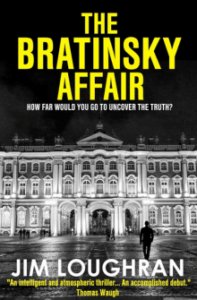
Jim Loughran is a writer of historical fiction and the author of The Bratinsky Affair, published by Sharpe Books.