I have been fascinated by the multi-cultural history of Sicily since I read Kingdom in the Sun by John Julius Norwich. When I first arrived in Sicily fifteen years ago, I was quite literally dazzled by a confusing and exotic mix of architectural styles, languages, and cultures. Palermo is a city of glittering Byzantine mosaics, crumbling baroque palazzos and markets reminiscent of a Moroccan souk. It, and indeed the whole of Sicily, is a palimpsest of the histories of the peoples who have lived there, each of which has left traces of its own cultural DNA. Multi-layered the city may be but, deep beneath the fortifications of the Palazzo Normano, the roots of this city are Carthaginian.
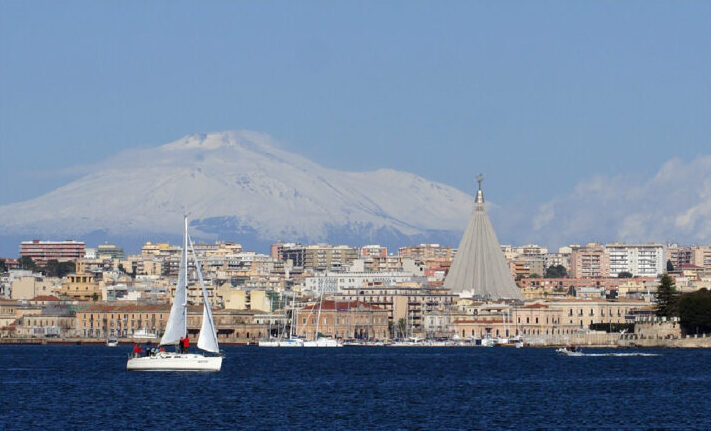
Five years later I crossed the bridge from the city of Syracuse onto the island fortress of Ortigia and walked up a slight slope to the remains of the Temple of Apollo. It was immediately clear that, even though there may be a church on every square, this city is undeniably Greek, and there is an immediate sense of the peeling away of the layers of history. The Cathedral stands on the site of the ancient agora and is built within the walls of the Temple of Athena, the columns of which are still visible. This is a space which has been a place of worship since 590BC, or even earlier.
Across the city the great amphitheatre of Syracuse rises tier upon tier up the side of a hill. At its height, the theatre could seat fifteen thousand people and, at the top, near the remains of the ‘fountain of the nymphs,’ are the remains of a mill built in the time of Spanish rule. That mill morphed into the home of Timon and his family in Syracuse Will Burn. At that time, I was doing an online course on creative writing, and, at the end of each class, our tutor would give us a prompt word or phrase. On that occasion the prompt was, ‘he turned a corner and went up a hill.’ That prompt became a short story, which won a prize, and ultimately became Syracuse Will Burn.
There are unlikely but common themes between my debut novel, The Bratinsky Affair, and Syracuse Will Burn, in that both highlight dilemmas for the main characters, searching to establish their identity in a changing world, and circumstances. As well as the necessity for a new tranche of historical research, writing the book brought up all kinds of questions, not least how similar or different were the historical characters/actors of thousands of years ago.
In Syracuse Will Burn the real focus is on the issue of power struggles– whether it is within families, or in social connections and political structures. At the personal level, Timon is isolated from his family and the broader community by his gift of premonition and the belief that he is the boy who heard the voice of the god. As a result, he is regarded with suspicion, by a father who feels his parental role and authority undermined. When Timon was thirteen he had to fear the rough hand of his father, Anax. In Anax’s world a father’s word is law but somehow Timon has escaped into a world Anax does not know or understand. He resents Timon but also fears him. Timon’s gift of premonition, and especially his growing involvement with the Lady Artemisia, has created a gulf between him and the rest of his family that he no longer knows how to bridge.
Timon’s premonition, warning of the attack by the Athenian fleet saves the city but also takes him directly into the heart of one of the most vicious struggles for control of Syracuse. While some see his premonitions as a gift to the city, others see this ability as a weapon to be used to further their own ruthless ambition.
For the rulers of Syracuse, the threat from Athens has diminished after the disastrous defeat of their Sicilian expedition. But, as Athens retreats behind its walls, Syracuse must face the growing threat of a Carthage intent on conquest. It is against this backdrop, of internal political turmoil and external danger, that Timon must thread his way. He quickly discovers that in the city of Syracuse only two things matter: power and money. Syracuse is a city bitterly divided between the landowning aristocratic elite, like Hermocrates, who think that power is their automatic birthright; rich oligarchs like Kyriakos, who provide the real economic muscle in the city; and the mass of the poor and the slaves, who must always jump to someone else’s order. For a boy from a poor family like Timon, who has no money and no education, this is a dangerous world.
When Timon enters the service of the High Priestess, he finds himself in a dangerous world of secrets and power. He is caught between loyalty to his exiled mentor, General Hermocrates, the influence of the Lady Artemisia, and the threat posed by the rise to power of the ruthless Dionysius. While Timon is struggling to understand what is going on in his own head, he must also contend with the dangers of being drawn into a deadly political intrigue.
Aristotle has said that all ancient tyrants began as demagogues and Dionysius is no different. He is a skilled and courageous fighter. He is also ambitious and he will allow nothing to stand in his way. Like all would be tyrants, Dionysius works to undermine and discredit the opposition while building his social, financial and political power base. When it becomes clear that Dionysius intends to rule, Timon must answer the question: “Whose side are you on?”
Both Dionysius and the citizens of Syracuse face an existential threat in the shape of Hannibal Mago and his successor, Himilco. As the Greek cities of Sicily fall one by one before the might of Carthage, there is the real possibility that Syracuse, jewel of the mediterranean, will end up as another smoking ruin like the recently conquered city of Acragas (Agrigento.) But for Timon, Dionysius and Himilco are opposite sides of the same coin; both are empire builders who see themselves as the centre of the world.
In Syracuse Will Burn, tyrants and demagogues rule. Cities are destroyed, men are killed, women are sold as slaves, and small boats laden with refugees sail for the safety of Syracuse. Change the dates, give Grok the face of Divine Apollo and nothing has changed.
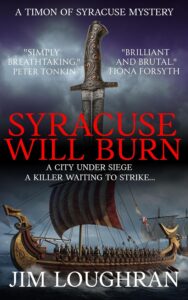
Jim Loughran is a writer of historical fiction and the author of Syracuse Will Burn, published by Sharpe Books.