Congratulations on Iran, We Ran, Garrie! What inspired you to first write this story and how did the idea develop into the novel?
I have, both personally and professionally as a lawyer, always had an interest in migration. My fascination of it stemmed, I believe, from my own ancestors’ migration. They fled eastern Europe in the late 19th century. Despite efforts made by my family, we have been unable to locate where they came from but suspect from a town that is in what is now the country of Ukraine. The ‘urban myth’ my brothers and I always grew up with was that those ancestors got a boat from Odessa destined for the New World. The boat stopped in Liverpool, England and my ancestors and other families making a similar voyage, seeing people in their finery and words that were not in the Cyrillic language, got off the boat believing they had reached the New World. They undoubtedly were relieved to have escaped persecution and even death in their own country so they were very keen to disembark. Generations later, I am writing of their brave adventure. I am a global traveller, have climbed mountains, crossed a desert on camel, visited places that knowledgeable people told me I should not visit but my own opinion is that all I have done pales into insignificance compared to what my ancestors did. They didn’t have Google Maps, SatNat, the internet and it is very likely they spoke minimal to no English. They committed to a journey to a land about which they inevitably knew little, including possibly where that land was actually located.
Their story has inspired me from the time I have known of it. In the words of Bruce Springsteen, hunger is a powerful thing.
My global travels have also led me to conclude that people are the same all around the world. It is the regimes that differ.
After a career in law, what prompted you to become a fiction author?
I have always wanted to be a writer. When I finished school, I wanted to be a journalist but, back in those days, there were only limited opportunities. There were no cable networks, no Sky Channels, commercial stations only had one, maybe two, channels, national broadcasters were equally limited, streaming services were unheard of. I have always believed in the power of the pen (nowadays, the keyboard). My legal work was based on facts and events. There was no place for fiction, speculation or creativity. Following my retirement as a lawyer, I seized the opportunity to write a work of fiction. The journey has been more exciting and rewarding (and challenging) than I had ever expected. I am well-advanced on my second book.
How did your career experience inform the plot or characters of your novel?
I have been to Iran and seen and experienced parts of life there. They are very different to the one standard image of Iran and Iranians that tends to appear in Western media (women dressed in black, chanting anti-US and anti-Israel slogans, the burning of flags etc). I have acted for Iranians, including some who are gay. Homosexuality is generally accepted in most Western countries but could still lead to corporal punishment, or even death, in Iran. Iran has a population of over 90 million people. It has many gays. I am aware of the desperate measures that many people go to when they want to escape to another country.
What do you want the audience to take away from reading this book?
That the desire for migration and the migration process itself is rarely understood amongst the general population. Contemporary reporting tends to focus on negatives – migrants or refugees taking jobs that would otherwise be filled by locals, housing becoming ill-affordable and the like. Migrants also make valuable contributions to society and the challenges and risks behind their journey are not often appreciated. It is most disconcerting because Australia, like other countries, is an immigrant country.
How did you approach writing about what it means to be LGBTQI+ in Iran, and what research informed your portrayal?
I have known and acted for members of the LGBTQI+ community in Iran as well as in other countries. Their repression and persecution are well-known. The regime does not try and hide its stern, ultra-conservative view of homosexuality.
The novel touches on the illegal drug trade and the networks of power surrounding it. What drew you to this aspect of the story, and how did you go about portraying its role in the wider world your characters inhabit?
The illegal drug trade is a universally-known phenomenon. According to the United Nations, the industry has a global value of more than $30 billion but the true figure is no doubt considerably more. It is virtually impossible, any day, not to read or hear about some event involving illegal drugs and their traffickers. They are very much part of contemporary life (and have been for many decades). The narrative in the book draws on real events but left to the imagination and creativity of the author.
Was there a particular moment or scene that you found difficult to write?
Yes. I found it difficult to write about the death of Behrooz. I had created him, I had nurtured him, I had given him a whole new life so it was difficult to kill him off. It was either him or Solayman.
Have you started thinking about or writing your next project? If so, can you share a little about it?
I am well-advanced with my next book. It has, at its core, human trafficking out of a part of the world known for such activities. Drug smuggling and distribution inevitably receive much more scrutiny and attention than human trafficking but human trafficking is still a major industry – and a major problem. According to the United Nations, about 20 million people globally are trafficked, in all of its different forms, each year.

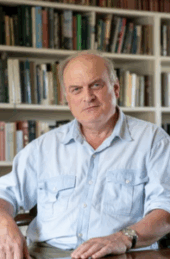
Garrie Boldsmith is the author of Iran, We Ran.
Sophia Kazan is an Editorial Intern at Aspects of History.