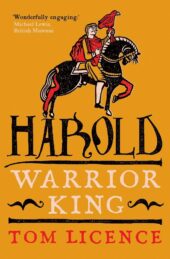

Welcome to Aspects of History, Tom. I feel I should begin by thanking you for Harold: Warrior King. I enjoyed every moment of reading it. (I appreciate that’s not a question, but I just wanted to get that out of the way!)
Thank you, Paul – I’m glad you enjoyed it.
One of the most compelling sections of the book comes towards the end in respect of your rethink of Harold’s movements in September and October 1066. I’m interested to know how you came to your assertion that the ‘forced march’ might be a thing of myth and that Harold may have actually transported most of his troops on ships. Did you go looking for that or did you happen upon it by chance?
When I came to the campaigns of 1066, I thought – right – I must go back to the sources, collect every detail, weigh their accounts and reconstruct Harold’s movements, month by month, day by day. I read the Latin and Old English, guarding against assumptions, and one thing I soon spotted was that the translators of a key text (William of Poitiers) had inserted the idea of the forced march into their translation, when it wasn’t in the Latin. Twice. I then went looking for references to any marching – surely they must be somewhere? No, not at all. There were no references to marching/ riding down from Yorkshire. But there were multiple references to Harold having and using a fleet.
I then began to wonder where the idea of the forced march came from, so I went digging through the early histories of Britain and found it in John Milton (1670). He had got used to soldiers marching around in the Civil War and assumed that Harold had marched. In fact, Harold had chosen to move his army by sea in the Welsh campaign, a couple of years earlier. That, quite logically, was his preferred method of moving troops.
With regard to ‘happening upon these things by chance’, really it’s down to my training. Professional historians are (or should be) trained to question everything. When we do our job, myths get found out.
I’m not normally one for counterfactuals but in Harold’s case, so much of his reputation is encapsulated by the last few years of his life. How do you think modern eyes would judge the man if he had actually won the battle (assuming he had gone on to rule for 20 years or more)?
I always start by asking, what were a person’s goals and how effective was that person in achieving them? Obviously, if Harold had won, we’d judge him as an effective figure – highly effective, in having dealt with both the Viking and the Norman threat. That said, Harold did as well as any general could have done in his position. I cannot confidently fault him. Had he overcome his opponents and ruled for twenty years without major incident, he might have been the most glorious king England had ever known. Still, Harold did have a few traits that would have derailed him. He was sly, for example. People find out that sort of thing in the end. As for his defeat, I see it as a coin toss. William might just as easily have been killed that day. It always bears repeating that Harold died fighting for his country. He did his duty and paid the ultimate price. He deserves a great share of honour.
The way you drew out the relationship between Harold, his father and his siblings reveals a complex web of potentially destructive behaviours (I was reminded of The Sopranos or Succession at times). Harold almost seems like the underdog (with his anarchic older brother, his sister who is married to King Edward and his younger brother who was the king’s favourite). What does it tell us about Harold’s character that he came out on top?
I’m glad you came away with that. Historians have written of ‘the Godwines’ as though they were a united force. They weren’t. They sometimes held together in the face of a common threat. But rivalries and resentments were always simmering. Harold had a very difficult set of family members. He kept his cool, and seldom put a foot wrong. I think he was a perceptive man, good at getting the measure of people. He looked on and watched as his siblings fell victim to their own self-destructive character traits. Canny power-players looked to him for leadership. Whether they trusted him is a separate matter.
Much ink has been spilt (not to mention thread sewn on an embroidery) about Harold’s visit to Normandy in (probably) 1065, where he supposedly swore an oath to support Duke William. What is your take on his motivation for going and what he hoped to achieve? (I presume you have no truck with William of Malmesbury’s ‘fishing trip gone wrong’ idea).
Harold may certainly have been fishing for intelligence. He was an experienced spy, who had toured the northern Frankish principalities before, gathering information on war and politics. I see his trip in 1065 in that context. He may also have been seeking the release of his brother and nephew, whom William was holding hostage. William would not have let Harold go without having obtained some undertaking in return. But the sources give differing accounts of what that undertaking was. I don’t believe that Harold had been sent to confirm a promise of the throne to William. (My opinion will be no surprise to anyone who has read Edward the Confessor: Last of the Royal Blood or my article on The Succession Question from 2016.) Perhaps he promised lands, titles, an alliance by marriage, or all of the above.
It’s mid-October in London. You’re King Harold consulting with his Council. Some of them are urging you to wait for more troops to arrive, others think you should attack with all speed. Leaving hindsight to one side (as far as that is possible), what is your decision and why?
I want to contain William on the Hastings peninsula, so that his army doesn’t break out onto the road network, enabling its rapid movement around the country. I send my fleet (which just bore me back to London) around the south coast, and I advance at the head of a land-army to the pinch point, to bottle William in, hoping that the troops I have sent for will arrive on time. If not, my task is to hold that point and fend off William, if needs be, until reinforcements arrive. Meanwhile, I put out bluster and misinformation, to confuse and intimidate the foe. I am choosing to do everything Harold did, so far.
Does that mean I’m doomed? Maybe it does – the workings of fate are inscrutable. But I suspect that the course of the battle is what determined Harold’s fate. Every year, at Battle Abbey, for the anniversary of 14th October, the battle is staged by re-enactors. History demands that the Normans win, but the English often win the re-match in private, once the visitors have gone and the fighting is free to take its own course.
This book on Harold follows on from your previous work on Edward the Confessor. What challenges (if any) did that present in terms of maintaining a separate and yet consistent narrative?
A good question – one which I addressed for the publisher at the outset. Edward’s story centres on Edward, Harold’s story on Harold, and half of the latter (in the space given in my book) unfolds after Edward’s death. While Edward the Confessor begins with a kingdom attacked by vikings and with an heir in exile, Harold begins with a glance of his family, leading to Harold’s career as an earl, his wars in Wales, and his empire-building. The book (or its first half) overlaps with Edward and sometimes addresses the same problems, but it comes at them from a different perspective. Ultimately, it’s a different man’s story. I decided also to write it in a different style. Edward the Confessor is a meditative book. It immerses readers in the thought-world, riddles and mystery of the age. Harold is punchier.
Having enjoyed both the book and Edward the Confessor, I am keen to know what we can expect from you next. More 11th century or something else entirely?
1066 has gripped me since I was a boy. It’s a time when everything was up in the air, and anything was possible. The raw materials of power could be seized and moulded into something new. The literary and artistic output too is layered, haunting and creative. That century, for me, comes closest to touching the human condition. It’s very real. There’s a lot we still don’t know – a lot of mystery. I will be going deeper into 1066.

Tom Licence is an academic specialising in medieval history and the author of Harold: Warrior King, published by Yale University Press.
Paul Bernardi is the author of The Reckoning, the last volume in the Rebellion Trilogy, published by Sharpe Books.