

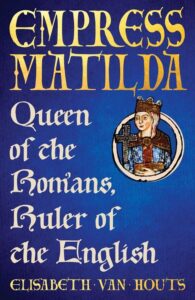
Welcome to Aspects of History, Elizabeth, and congratulations on the release of Empress Matilda: Queen of the Romans, Ruler of the English. Matilda was made regent of northern Italy by her husband, the Holy Roman Emperor, at the age of just sixteen. Do you think this was force of circumstance, or do you think that this shows that her extraordinary capabilities were already being recognised at that young age?
A combination of both. Matilda was Emperor Henry V’s consort and in that role it was common for a queen to replace their husband if he went on a military expedition or was ill or otherwise incapacitated. What was unusual in Empress Matilda’s case was the fact that she had no children as normally queens consort would act as regent for their children rather than for their husbands. Yes, she was young when she began to act as regent but we shouldn’t forget that elite women were educated from a young age to take on such responsibilities at the drop of a hat after they were married at twelve.
In the book you build a clear picture of Matilda’s personality – a brilliant mind, an iron will, a charisma that commanded loyalty – how hard was it to get at her personality using sources that, to the lay reader, often seem pretty dry?
Indeed, very hard. It is not easy to tease out the character of any medieval person, let alone of a woman. First of all, secular women are not described at such great depth as men. Secondly in a patriarchy where on the whole men held the authority at home and in public, women took second place. Thirdly, most sources were written by men who were usually more interested in their fellow men rather than in women. Having said all this, over the last few decades modern scholars have become very interested in the role and place of women in society and they have discovered that women took on responsibilities that we had not realised they had. The main sources for my biography of Empress Matilda are chronicles, which are historical narratives always written from a particular perspective, either in favour, or against or neutral regarding the protagonists. As historians we always have to keep in mind the medieval chronicler’s bias. In Matilda’s case most of them are positive about her except for one, the Gesta Stephani (the Deeds of Stephen) which was very much an apology for Matilda’s rival. Unfortunately, this anonymous chronicler’s comments on Matilda in England as haughty, intransigent and inconsiderate still dominate the modern scholarship on the empress. Yet, the overwhelming majority of narratives throughout her life see her as throneworthy, intelligent and trustworthy. The other category of sources are charters. They are legal documents that record transfer of lands or rights. They are quite formulaic and ‘dry’ but they allow us to trace Matilda’s itinerary and her presence at court sessions. About half of them are records of her own legal transactions and they offer glimpses of her power, her wealth and her personality.
Throughout the book you give examples of other women in positions of power showing that, although Matilda was exceptional, her position as a powerful woman was not all that unusual. I think this may surprise some readers as medieval women are often presented to us as being relatively powerless. Was the degree to which women held power and exerted influence ignored at the time, or is it something we have forgotten, or chosen to ignore, in the centuries since?
We have always known that some women especially in widowhood held power. But what has changed is the interpretation of evidence for other life-cycle stage in elite women’s lives. At royal level women were normally avoided as a queen regnant. What is unusual is to appoint a woman as heir and successor to royal throne as King Henry I did with his sole surviving legitimate child Empress Matilda. What is even more unusual is that from the word go when Matilda married Geoffrey of Anjou there is no evidence that he aspired to be king by her right. The couple seems to have had an understanding that Geoffrey would take the lead in Anjou, his own county, and in Normandy by right of Matilda, and that Matilda would take the throne in England. In a patriarchy for Geoffrey to allow his wife to take the higher position was unusual even though perhaps he didn’t have a choice due to Matilda’s vastly more wealthy inheritance and her experience as ruler in the empire.
Throughout her time in England, Matilda is surrounded by powerful men such as her uncle, King David of Scotland, and her half-brothers, who presumably could have taken advantage of the chaos to mount their own challenges for the English crown. What do you think it tells us about Matilda’s ability as a leader that this didn’t happen?
This is an intriguing question about the contemporary perceptions of the empress. First, for me it certainly signals that the aristocracy surrounding Matilda considered her a viable option and accepted her as their leader. This, I am convinced, is evidence that she was considered an intelligent, astute and strategic leader, happy to take advice and consult her followers. Of course, it does not mean that she always agreed with the advice given, or that she never made counter proposals. Even those chroniclers favourable to her occasionally reveal tensions at her court. But then we must not forget that kings too sometimes fell out with their advisers. So yes, her experience in the empire instilled confidence in her menfolk in Normandy and England. Secondly, men like her half-brother Earl Robert of Gloucester, her uncle David of Scotland and her friend Brian Fitz Count had been protegées of Matilda’s father and they were conscious of the fact that they (including David before he became king) owed their marriages to heiresses as the main source of their wealth, status and power in the Anglo-Norman realm. Thirdly, they also were acutely aware that they had sworn oaths of allegiance to Matilda in the presence of her father.
During her life, Matilda lived in many different places – lands throughout the Holy Roman Empire, Anjou, Normandy, England – do you think she would have had any concept of ‘nationhood’ as we understand it today? In particular, do you think she would have considered herself English?
Empress Matilda was born in England and her determination to acquire the throne of England, promised to her by her father and the nobility certainly strengthened her sense of ‘Englishness’. Yet, any sense of ‘nationality’ was dictated by the circumstances and the stages of her life, not an uncommon situation for an elite woman after two marriages: birth identity faded in the light of identities forged during foreign marriages and then widowhood. In Matilda’s case her identity that was first and foremost royal, imperial and German due to her early life and education in the empire. From the age of eight until her departure aged 23 she was brought up in a German speaking environment. She kept her courtesy title ‘empress’, which derived from her time in Germany/northern Italy as widow of an emperor, throughout her life. The combination of royal and imperial symbolism tells us something about an almost supra-national sense of herself. She is the only uncrowned queen regnant of England to define herself by her identity built up earlier in her life in the empire. Having said all this there is an element of ambiguity in her self-identification. There are elements of her ‘Normanness’ and’ Englishness’ occasionally in her life when she seems to identify herself as granddaughter of William the Conqueror. At the height of her decision to challenge Stephen in 1136 after her father’s death she called her third son William after her paternal grandfather. So, at times she was imperial (German-Italian), English and Norman. However, as Geoffrey of Anjou’s wife or mother of his children she never felt Angevin; that was an identity she avoided.
Ultimately, Matilda didn’t secure the English crown for herself, but her son did become Henry II. Do you think she would have viewed this as a success?
Oh, yes, without a shadow of doubt. From 1148 onwards, after her departure from England she focused all her attention on her son Henry Fitz Empress who at one year of age took over her mission to oust Stephen from the English throne. She guided him for seven years by giving advice, by acting as his regent in Normandy and finally in 1153 she gave her permission for him to do a deal with Stephen when he was accepted as the king’s successor. Henry himself always acknowledged his debt to his mother.
And what’s next? Any new releases anticipated or projects to keep an eye out for?
I will give a big lecture next year in Normandy but haven’t quite decided on the topic. Otherwise, I am busy finishing a book, co-written with colleagues, on Anglo-Dutch relations. Themes such as elite marriages across the North Sea, multilingualism and cultural transfer are ones that were inspired by my book on Empress Matilda’s life and career.
Elisabeth van Houts is a Dutch-born academic, emeritus honorary professor in European medieval history at the University of Cambridge, and the author of Empress Matilda: Queen of the Romans, Ruler of the English from The English Monarchs series, published by Yale University Press.
Adam Staten is the author of Crusader, the most recent instalment of the Honour Bound series, published by Sharpe Books.