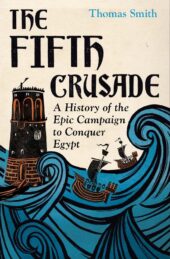

Welcome back to Aspects of History, Thomas. Your new book, The Fifth Crusade, shines a light on one of the least familiar but most consequential expeditions of the Crusading era. What first drew you to this overlooked campaign and what is it exactly that means it has tended to remain in the shadow of the Third Crusade and figures such as Richard the Lionheart and Saladin?
The thing that first drew me to the Fifth Crusade was the incredible setting. It seems so incongruous to have crusaders operating in Egypt, the land of the pyramids. Putting these two things was an opportunity to tell an astonishing story.
I first came across the Fifth Crusade when I was doing my postgraduate work, and all the time I was convinced that this exciting story needed to be brought to a wider audience. It has crocodiles, amphibious warfare on the Nile, nunchucks, medieval napalm, or ‘Greek Fire’, a floating siege engine, and landing craft – the medieval version of the Higgins boats used on D-Day in 1944. It’s an incredible campaign and something very different from what most people will probably have read about before.
The reason the Fifth Crusade has remained in the shadow of the Third Crusade is because of the spectacularly disastrous way that the campaign ended. But my main argument is to look beyond the outcome and to strip away the benefit (or disadvantage) of hindsight to show how important the Fifth Crusade was at the time: the capture of Damietta in 1219 and the establishment, briefly, of a new crusader state in Egypt was a pivotal moment and a hugely disruptive episode in medieval world history.
You make a compelling case that Egypt, rather than Jerusalem, had become key to occupying the Holy Land. How revolutionary was this shift in the thinking of the crusaders, and did the Fifth Crusade ultimately prove that notion right even if the campaign itself failed?
The Egyptian strategy was one that had been debated at the courts of Europe for decades before the Fifth Crusade, finally, put it to the test. Egypt was the breadbasket of the Near East and the richest country in the region. Capturing Egypt would deprive the crusaders’ enemies of their main source of wealth and had the potential to remake completely the geopolitical and military situation of the Middle East.
Although the Fifth Crusade ended suddenly and catastrophically, the main lesson from the campaign was that it proved that the Egyptian strategy was the right way to recover the Holy Land. The Fifth Crusade functioned as a blueprint for later crusades, such as the Seventh Crusade (1248–54), when Louis IX copied the playbook of the Fifth Crusade page for page.
One of the book’s triumphs is your reconstruction of the siege of Damietta, complete with amphibious landings, siege engines and Greek Fire. How much did newly uncovered eyewitness sources alter your understanding of what medieval warfare actually looked and felt like?
What is so fascinating about the Fifth Crusade is that it functioned as a crucible for new military technologies. The crusaders were inventing and encountering weapons that they had never seen, used, or encountered before, especially Greek Fire. The eyewitness sources are incredibly rich in detail about what medieval warfare in the Nile Delta looked like. The most valuable is the account of Oliver of Cologne, who was in the frontline throughout the campaign and describes the warfare first-hand in way that is remarkably direct and humanising.
Oliver of Cologne emerges not only as a useful chronicler but also as an active participant who designed one of the most remarkable military inventions you describe. How did he change your perspective on the campaign?
Oliver of Cologne is such an appealing character as a chronicler. He played a key role in the leadership council on the crusade and in the invention of the floating siege engine used to capture the Chain Tower in the middle of the Nile. But he was also very modest about his role in his text. Ultimately, Oliver’s chronicle made it possible to bring the Egyptian campaign back to life since he wrote so vividly about the military engagements, even down to describing the individual deeds of more humble crusaders, such as Hayo of Fivelgo – the Frisian crusader who stormed the Chain Tower armed with an agricultural flail.
Although the crusaders achieved one of their greatest victories, they end up surrendering everything they had gained. To what extent was the failure of the Fifth Crusade the result of poor leadership rather than military shortcomings?
At the end of the campaign, in summer 1221, the crusaders were in an incredibly strong position, and some of the mistakes at the very end of the crusade can be attributed to an inferior knowledge of the Nile’s hydrography, compared to their opponent, Sultan al-Kamil. Purely militarily, though, the crusaders had repeatedly demonstrated themselves to be the superior force, and the conquest of Damietta was a glittering prize – it was the first conquest of a major, new Muslim city by a western crusade since the capture of Jerusalem on the First Crusade in 1099. This explains why the failure of the expedition came as such a shock to the people of Europe.
Your research draws on a vast range of Christian and Muslim sources, which one imagines haven’t been combined much in past scholarship. How long has this project been in the making, and were there any moments that shifted the narrative you had anticipated writing?
I have been thinking about and working on the Fifth Crusade – on and off – for nearly twenty years now. The key to unlocking the otherwise baffling strategy of the crusaders at the end of the campaign – explaining why they marched to besiege Cairo just as the Nile was about to flood in summer 1221 – is the power of prophecy. We must understand that the crusaders were marching to an apocalyptic timetable and believed that they had to conquer Egypt and recover Jerusalem before 1222, to bring about the Second Coming of Christ. This is something that has not been emphasised before.
The Fifth Crusade was headed by a vast coalition of kings, military orders, clergy and various political interests. Does the campaign offer wider lessons about the difficulties of conducting expeditions on an international scale with competing priorities and distant leadership?
The Fifth Crusade does show the difficulties of conducting a complex military campaign in a distant war zone where you have a coalition of the willing, an alliance of international forces working together. This posed lots of challenges, but the Fifth Crusade shows that these disparate contingents worked together surprisingly well because of the religious devotion to their cause, which bound them together, as well as their belief in the strategic goal of conquering Egypt to recover the Holy Land.
You suggest that historians have been guilty of inheriting several assumptions about the Fifth Crusade from medieval chroniclers themselves. Was it revisiting the evidence that allowed you to challenge these entrenched interpretations of figures such as King John of Jerusalem or the papal leadership?
What I’ve tried to do with the book is to go back and see the crusade through the eyes of participants at the time. I think that too many previous scholars have read backwards from the failure of the crusade and looked to identify scapegoats earlier in the campaign. The main figure in need of rehabilitation is the papal legate, Pelagius, who previously was interpreted as being a pig-headed, inept leader who meddled in military affairs and ultimately doomed the crusade. But if we look at the contemporary evidence that’s written before the failure of the crusade, there is nothing but praise for his conduct.
Finally, now that you have brought this overlooked campaign back into the spotlight, what is next in terms of projects? More episodes of the Crusades in need of a fresh look?
I am currently finishing my next book on Baldwin IV and the fall of Jerusalem; it is going to be the real history behind the film Kingdom of Heaven. Baldwin IV is enjoying a real renaissance in terms of popular interest and – surprisingly – has even become a popular part of internet meme culture! The real history is much more fascinating, and I’m excited to bring Baldwin’s incredible story to a wider audience – look out for it from Yale in 2028.
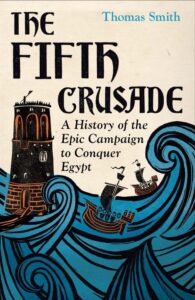
Dr Thomas Smith is a prize-winning historian of the Crusades and the medieval world, and the author of The Fifth Crusade: A History of the Epic Campaign to Conquer Egypt, published by Yale University Press.
Trevor James was the editor of The Historian from 2006 to 2019 and is the author of Patterns in Local History; Five Case Studies.