A few weeks ago I heard Tom Licence speaking on a podcast (part of the promotion of this new work, no doubt) about how King Harold’s famed feat of generalship (marching from London to Stamford Bridge and back again in under two weeks), may not have been a march after all (or at least… not entirely).
It was a simple enough idea, but it really hit home in terms of reminding me what I love about history. That is, the opportunity to revisit what has gone before, to not be afraid of challenging the accepted stance, and the importance of primary sources as a basis on which to posit new theories that can then be tested and critiqued by others. For me, this perfectly demonstrates the application of critical thinking – something that appears to be very much in decline in this, the Social Media age.
Anyway, with my appetite thus whetted, I was delighted to be asked if I would like to review Tom Licence’s new book, Harold: Warrior King. I was not disappointed.
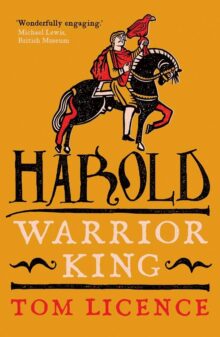
The quote on the delightfully colourful and impactful front cover states “wonderfully engaging” and those two words – in stunning brevity – absolutely sum up the whole book. It was a joy to read from start to finish. Whilst I don’t consume non-fiction books as quickly as fiction, this work was the exception that proves the rule as I bounced through it knowing that the next section would be just as good as the last.
What Tom Licence has given us is a book that not only delves deeply into the narrative arc of the Harold’s life, but one which also tries (with considerable success) to unpick the tangled threads that are weaved around the man’s psyche along with the many different factors that influenced him. What we see, as a result, is a complex man of many layers, twisting and turning throughout his adult life in order to navigate the wind-swept, rock-strewn channels, where any wrong turn might have fatally holed his metaphorical ship.
That is not to say that the Harold portrayed in these pages is not an opportunist driven by his own agenda and by a desire to seek aggrandisement wherever he can; some of the ways in which he appropriated new estates were most definitely not legal, but were possible due to his great power, influence and wealth (not to mention the support of several, carefully nurtured great lords in his corner).
Then there are the intricate relationships Harold had to maintain with King Edward and with his own family. I came away thinking that Harold chose wisely in terms of avoiding too much in the way of association with the car crash that was his older brother, Swegn (surely one of the most fascinating characters of the period who cries out for an HBO miniseries), while the declining relationship with Tostig seems to be a lesson in fraternal jealousy (with Tostig being perceived as the king’s favourite as well as that of his sister, Edith (King Edward’s wife)).
His greatest act of opportunism was, of course, his ‘usurpation’ of the crown in January 1066. I like the way in which Licence makes the point that to say that the country needed a king who was a strong general is somewhat lazy. At that point, neither of the two invasions was anything like a certainty and – to my mind – there is absolutely no reason why Harold could have acted as protector for young Edgar Aetheling, as old King Edward appeared to have desired.
The meat of the last section is (understandably) given over to the events of that fateful year. And it is here that Licence explores the build up of the ‘cult of Harold’ that can be seen to have taken hold in the early modern period before becoming the stuff of legend in the 19th century. A cult which has subsequently forged the thinking of many later historians in their portrayal of the king.
By going back to the original Latin sources, the author is able to build a robust and compelling argument regarding certain long accepted tropes – especially regarding the forced march. With none of the Latin sources specifically using any word that inferred walking, there is no reason not to suppose that Harold might have made use of the plentiful ships of his fleet as well as those of the defeated Norse army, enabling a much swifter transit. He’d done it before in Wales in the 1050s after all.
In conclusion, history books of this period have often left me feeling like I didn’t really know Harold or understand his motivations. Rather, he all too often arrives on the scene in the early to mid-1060s – by when he was in his forties – as a fully-fledged leader. Now – with this magnificently written book – I can say that I know the man much more, and can see how his journey led him to his destiny in October 1066.

Paul Bernardi is the author of The Reckoning, the last volume in the Rebellion Trilogy, published by Sharpe Books.