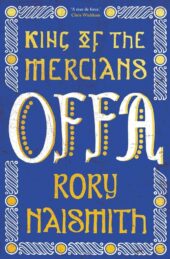

Let me begin, Rory, by offering my congratulations on the publication of Offa: King of the Mercians. A truly magnificent piece of work. The jacket notes refer to this book as a ‘breathtaking piece of historical investigation’ (with which I cannot argue); how would you summarise the nature and scale of the challenges to bring Offa to life?
Thanks! It was a big challenge. Offa lived over 1,200 years ago. We don’t know his exact date or place of birth: just that he became king in AD 757 and died in July AD 796. That’s a long time, 39 years – one of the lengthiest reigns of any Anglo-Saxon king. This was also clearly a king who had a major impact. He reshaped the way different segments of the kingdom fitted together, creating the idea that there could and should be a single king. He transformed the currency. Offa had the ambition of founding a dynasty centred on his own immediate family, though that didn’t pan out because his one son died very soon after the father. There is a huge amount going on, and there are enough administrative sources and letters to give glimpses of it. But while they are often fascinating and sometimes very rich, the sources are the biggest hurdle in understanding Offa.
Northumbria has Bede, Wessex has the Anglo-Saxon Chronicle but Mercia (much like East Anglia) sadly lacks much in the way of any contemporary historical narrative. To what extent does this hamper a detailed study of the kingdom (or any of its rulers) and how did you go about plugging that gap?
That is exactly the problem: sources. Offa’s Mercia is known from a pretty good supply of charters (documents recording transfer of landownership) and coins, and there is of course Offa’s Dyke, but what is missing is a chronicle, history or other extended narrative source that takes a Mercian perspective. Mercia in the age of Offa is therefore known in large part from the critical accounts left by rivals, outsiders or later observers. Some of these are still very useful. Alcuin of York (d. 804) was an expat Northumbrian scholar who spent many years in Charlemagne’s empire, but kept up correspondence with contacts in England, including in Mercia. Many of these letters relate to Offa and his court. Other sources are more problematic, among them some of the most influential ones, such as the Anglo-Saxon Chronicle. It was first written in its surviving form in Wessex under Alfred the Great (871–99), which immediately puts us a century or so after Offa’s death, and in a kingdom that was one of Mercia’s great adversaries. Moreover, the Anglo-Saxon Chronicle’s annals for the time of Offa are based on a lost source from Canterbury in the early ninth century, where Offa’s name was mud. So on two levels Offa is being treated briefly and negatively: the Chronicle only mentions him a few times, and most of those mentions relate to warfare and acts of violence or villainy. But because the Chronicle was so influential in later times, it laid the basis for Offa’s reputation as a bloodthirsty tyrant. I do not think he was a saint either, but the truth probably lies somewhere between these extremes. How does one find the balance? It’s a matter of leaning more on other sources – the coins and charters, Offa’s Dyke, some of Alcuin’s letters, references to Offa’s patronage and gift-giving. I tried to use these to think into how Offa might have been seen from within his own kingdom, but his own subjects. It took many leaps of imagination, but it was worth the effort.
The book makes a compelling case for Offa as a ruler concerned with perception and authority – how consciously do you think he crafted his image, and to what extent can we see this as an early form of political “branding”?
This is one area where I think we can get closer to what Offa was doing. We see a ruler who was very conscious of his image: who commanded that he should be named as king on all his coins and in his charters, usually with the exact same title (and gradually excluded other figures within his kingdom from claiming any royal title). This showed him as a Mercian king, with a prominent family – Offa’s wife and son frequently appear in charters with him, and his wife also appears on the coins (the only Anglo-Saxon queen ever to do so). In other contexts he was very much a Christian king. He probably donated a complete, single-volume bible (a rare and precious gift) to Worcester Cathedral, had active involvements with monasteries across the kingdom and also established a third English archbishopric at Lichfield, representing the Mercian kingdom. This last project was short-lived and is harshly condemned in the Anglo-Saxon Chronicle, but may not have seemed so unreasonable or doomed to failure at the time. There was also a Roman strand to Offa’s presentation of himself as king. When images of Offa were put on his coins, they showed him in the guise of a Roman emperor, with attributes that suggest he was being compared to Constantine the Great, a major patron of the church and a favourite model for early medieval kings. Offa’s Dyke might also have had a Roman element, in that previous barriers from sea to sea had been built by Roman emperors. For Offa – an English king – to defend against the Britons in this way sent a powerful message of who was the symbolic heir of the Romans.
Much is made of the fact that Offa viewed himself as an equal to Charlemagne, though I can’t help feel that the latter might not have agreed. What’s your view? Equals or is Offa punching above his weight?
It’s certainly true that there was a big material disparity between the two kingdoms. Offa ruled about a third to half of modern England, while Charlemagne eventually ruled most of what is now mainland western Europe. In this respect there is no contest. But Offa had a few advantages on his side. He had already been king for a decade when Charlemagne came to the throne, and both had long reigns. It was also difficult for Charlemagne to threaten Offa militarily: the Channel provided strong protection. In general it suited both rulers to maintain a pretence of equality, not entirely unlike in modern diplomacy. They exchanged cordial letters filled with rhetoric about peace and friendship. Yet both rulers were touchy about their status, and the gloves could come off all too easily. At one point around 790, one of Charlemagne’s sons sought to marry a daughter of Offa. In principle that may have been welcome, but Offa’s concern was probably that Frankish princes traditionally married the daughters of favoured subordinates, and he did not want to be put in that category. So he said the marriage could only go ahead if his son could also marry one of Charlemagne’s daughters, which was a very different proposition. The Frankish king was so affronted by this that he halted all cross-Channel traffic. Eventually the situation was defused through the good offices of a Frankish abbot, but the real dynamic had been made all too apparent.
The one thing that most people will have heard of regarding Offa is the Dyke running along most of the border between England and Wales. Was this simply a defensive measure to keep the unruly Welsh in their place or is there more to it than that?
I think Offa’s Dyke was intended to do several things. It was partly a statement of power on Offa’s part: a way of showing who was the dominant force in Britain. Recent research on the Dyke has reinforced this symbolic aspect of its construction. It probably did stretch from sea to sea, as it was said to do in the first written reference to the dyke a century after Offa. It was also carefully constructed so as to appear especially imposing from the west – from the Welsh side. Offa and his men built it with shock and awe in mind.
None of this would rule out a defensive role. The Dyke would have been a significant deterrent and impediment. It reflects the general approach Offa took to the Welsh, which was quite different to how he viewed his English neighbours. The latter were absorbed into a single kingdom where possible, and dealt with directly via either warfare or diplomacy if they were too big to take over. The Welsh were instead kept at arm’s length: the Dyke showed that Offa wanted to keep them in their place, but also that he wanted to dominate rather than conquer.
Coins, charters, and correspondence all feature prominently in your study – was there a particular discovery or detail you can recall that changed your understanding of Offa as a biographical subject?
Offa remains very difficult as a strictly biographical subject. There is little information about him as a person, and most of what there is comes from his last fifteen or so years as king. But there are several ways of casting him in a new light. One was to approach him as the Mercians might have seen him, as far as possible. For example, Offa was very much a family man: his wife and children were central to his kingship. That in itself is not exceptional, but it is a departure from the bloodthirsty, violent king portrayed in most later chronicles.
130 years after Offa’s death. Æthelstan would become the first king of what we would recognise as England. What, if any, are the similarities between the two men in terms of their vision, their achievements, and their legacy?
Both succeeded in expanding their territory and imposing their will on other rulers. Both were careful in how they crafted their image as king, with a strongly unified vision. Offa has sometimes in the past been criticised for framing his kingship as rule over the Mercians rather than the English, but it is not appropriate to measure him by the yardstick of the 10th century: in the context of the 8th, he was putting together a new kind of kingdom with a single king. Arguably, Offa’s approach paved the way for Æthelstan’s.
Finally, Rory, I must confess that this is the first one of your books that I have read. Now I have done so, I need to know what future works might be in the pipeline.
I’ve got a few projects going on. There are two big edited volumes, and also two new editions of books I wrote a few years ago. Another new book I have on the horizon is a study of society and economy in the 10th and 11th centuries, as seen through the lens of sources from the monasteries of Ely, Ramsey and their neighbours.
Rory Naismith is an academic, numismatist and the author of Offa: King of the Mercians, published by Yale University Press.
Paul Bernardi is the author of The Reckoning, the last volume in the Rebellion Trilogy, published by Sharpe Books.