Most people, especially in today’s world, would think it was bad enough and they were unfortunate enough to be caught up in a pogrom. To then be caught up as well in a revolution invokes serious questions including those of fairness and justice. To then be caught up as well in a world war prompts some extreme questions including those of divine existence.
Despite the brutality and horror of pogroms, revolutions and any war, these situations have befallen large numbers of Jews yet their communities have survived and prospered. This article addresses the Jews who lived and suffered in the Russian territories and who chose to flee from their homeland to China and, following upheaval there and the end of World War II, they then fled further south to the safety of the great land down under, Australia. They survived despite the odds stacked against them.
***
Jewish history is replete with rejection, persecution, torture and death – to name but a few, the exodus of Jews from the tyrannical Pharaoh in Egypt; the expulsion of Jews from southern Spain (unless they were willing to convert to Catholicism) and the ultimate act of evil, the mass murder by the Nazis of some 6 million people for simply having a religion that did not match their leader’s beliefs.
Their history helps explain why the State of Israel is so important to the Jewish people, regardless of whether they are Zionists, orthodox, practising or where they come from. It is equally as important to Sephardic Jews as well as Ashkenazi Jews (or any of the other minority Jewish groups). After some 5,000 years, they were, until 1948 when the State of Israel was created, fed up with having no homeland to call their own.
***
There has been a Jewish presence in the Russian territories for well more than 1,000 years. Those territories broadly comprise the countries now known as Russia, Poland, Ukraine, Belarus, Moldova, and Lithuania. The Jewish population increased significantly in the late 18th century when Imperial Russia acquired large parts of what are now known as Poland and Lithuania.
Persecution of the Jews in Russia became patent in the second half of the 16th century under the rule of the first Tsar of (all) Russia, unaffectionately known as Ivan The Terrible (a richly deserved epithet). He openly barred Jews from entering certain areas.
Between 1821 and 1881, there were some pogroms that tended to be more localised rather than national. That situation escalated enormously following the assassination in March 1881 of Tsar Alexander II. As has happened throughout history, Jews have been blamed for that assassination even though there is no evidence that any Jewish group was in any way involved. The Tsar was assassinated by a revolutionary.
The most serious pogroms occurred in Warsaw, Odessa and Kiev. Hundreds of thousands were estimated to have been killed. Large numbers of those who survived decided to migrate. It was a case of survival. They fled to the United States and Western Europe with small numbers heading south to China.
For those who hesitated and remained in Russia, any hesitation was removed when the Bolshevik Revolution succeeded in 1917. Living under this new political ideology of communism, or even its smaller brother socialism, was an anathema to many Jews. They left heading south into China.
The challenges and dislocations were enormous. They would have to uproot their entire lives to move to another country, especially one where they spoke a very different language, and had different customs and practices.
***
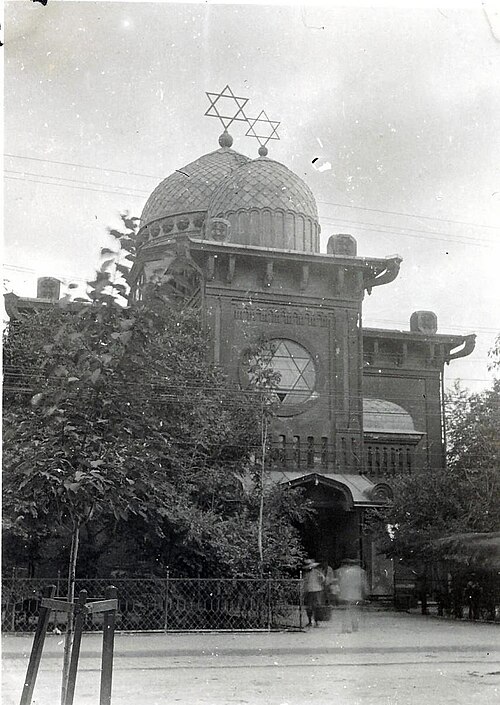
Most Jews fled to Harbin, where many remained although others continued their journey further south to Shanghai. They were able to reach Harbin via the Trans-Siberian Railway and its Manchurian branch, the Chinese Eastern Railway. Russian-language speakers were welcome particularly if they worked in railways and to boost development in the region following the Russo-Japanese War that had decimated those parts of the country at the beginning of the 20th century.
The Qing Dynasty ruled China until 1912. After its downfall, China was ruled by various individuals under the umbrella of being a republic. They generally treated Jewish refugees with openness, empathy and benevolence. They allowed refugees to build synagogues, schools, and banks without state interference or political protest. There was no protest from the Chinese population or the government regarding their numbers. The Chinese Government went so far as to decree Shanghai as an open port requiring no entry visas and some 25,000 European Jews were able to safely relocate there. Sadly for the Jews, as World War II wore on and under considerable pressure from the Nazis, the Government hardened its approach to the Jewish migrants. The Nazis wanted them to be included as part of the “final solution.” During the last two years of the war, most were interned in ghettos including in what was known as the “Shanghai Ghetto” and were only released after the war had ended.
The events in China unsettled many of the Jews who had moved there from Russia. The Chinese Communists showed signs they would defeat the Chinese Nationalists, as they did in 1949. Despite they or their ancestors having lived in China for a relatively small period of time of about 50 years, it was time for them to move on again. They had no desire to return to what had become the Soviet Union or to go to anywhere in a devastated Europe. They chose what had just become or was about to become the State of Israel, the US, Canada and Australia.
Australia was a highly attractive destination for the émigrés not only because of its well-known qualities (good weather, abundance of land, beautiful seas, rivers and lakes, vibrant wildlife, forests and parks) but, most importantly, because of its far distance from any theatres of war, past or likely in the future. It was the sanctuary the émigrés needed. It was regarded as a super-safe country. Australia welcomed Holocaust survivors and refugees from Europe and China, laying the groundwork for a substantial expansion of the local Australian Jewish community.

Garrie Boldsmith is the author of Iran, We Ran.