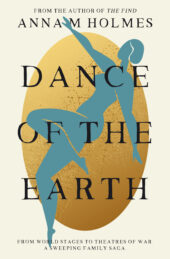
Anna M Holmes – great to have the opportunity to chat about Dance of the Earth on behalf of Aspects of History. One of your characters, Rose begins life abandoned at a stage door – a very dramatic and symbolic entrance into the world of performance. What does it mean to you that she is literally born into theatre without choosing it?
The Prelude, introducing both Rose and the Alhambra Theatre, bookends the Coda, when the Sleeping Beauty (or Sleeping Princess, as Diaghilev titled it) is staged at that same theatre 46 years later. Dance of the Earth’s opening reflects the well-known fairy tale celebrating a baby’s birth.
At the Alhambra (as was programmed in November 1875) The Flower Queen ballet plays, and ballerina, Giovannini Pitteri, in her Queen Snowdrop costume, is rather like the Lilac (good) Fairy wanting to gift the foundling with her own name.
Although seamstress, Molly, unofficially adopts Rose, it’s the Alhambra that envelops Rose and keeps her safe. I even suggest a little of The Flower Queen ballet’s on-stage magic seeps backstage to protect the newborn babe.
Maybe the theatre chooses Rose. I’d be interested to know what readers think?
Rose’s dancing dreams effectively die when her twins are born backstage at the theatre. Was it a deliberate choice to make the stage both the place where life begins and where her ambitions end?
The Alhambra just had to be central to key parts of Rose’s life: birth/baptism, courting days, becoming a mother. When labour commences Rose is at her Whitechapel flat, but she makes her way to the theatre – her real home. With Nina born, and finding there’s a second baby on its way, it’s very Rose to imagine things dramatically with the stage curtain dropping and stage trap door opening. While the world of performance is torn from her, this is where the Alhambra enters the bloodstream of Nina.
Nina and Walter are separated as infants, raised in strikingly different environments – how did writing their parallel journeys challenge you as a novelist?
Character is everything, Whereas Rose is sentimental and somewhat simple in outlook, Nina is a gingery character. She’s given a lot of personal freedom to roam London as Molly and Rose are busy, and she experiences new freer dance forms (corsetless, barefooted Isadora Duncan) and women pushing for suffrage. Walter is a dreamer, initially drawn to compositions that are flowing and romantic, but as he travels from childhood to manhood, his tastes change. No young man living at that time could avoid the First World War, so Walter’s character arc is the stronger of the siblings.
Setting aside her desire to be a Sylph, Rose becomes grounded and I associate her with the element of Earth and earthly delights. She has caramel-coloured eyes, describes herself as salt of the earth. Nina is Fire. Her opening sentence describes her as blazing through the street. Walter is associated with Air. He has a recurring floating dream, sky-blue eyes. Hooks such as these helped me shape scenes and dialogue.
I could use my own experience of dance to write about Nina, but Walter was different. On a public open day, I visited St John’s School Leatherhead, where I have Walter boarding. Being there helped give a good understanding of that environment. Visiting Northern France locations where the East Surrey Regiment battled helped me write war scenes as the lie of the land was made real to me.
Walter grapples with his attraction to his own sex in a society that made little room for queerness, while Nina navigates racial prejudice through her relationship with Charlie, a Black American musician. How important was it to weave these themes into a historical novel?
Before I began writing, I had outlined my plot and three main characters: Rose, Nina and Walter. Molly had always been in my story, but I gave her more space when editors and Beta readers wanted to know more about her. Other characters simply walked into a scene and I thought ‘Oh, who are you?’ I honestly hadn’t planned for Charlie to turn up, but when he did, that would be so Nina to be attracted to him. I knew Walter was attracted to his own sex from the outset but the men he loves revealed their characters to me.
Historical novels must speak to contemporary readers. Weaving these themes in was instinctive to me as a person and a writer. The period I write about saw huge changes in arts and in society, so without making a big thing of it, these elements crept into my story.
Your novels are typified by deep research with personal stories set within broad political, social, and economic contexts. What was the most surprising thing you discovered while researching this particular period?
Dance history gives shape to the plot – as in structuring the beginning, middle and end – but I had to learn about things that aren’t my specialism such a war and military history – particularly the London Home Front and where the East Surrey Regiment fought in France. And in writing about Charlie, I learnt about the beginning of what would become the jazz scene in London. My story ends when this is just beginning. Edith is another character I hadn’t planned to play a central role. Her left-leaning politics meant I needed to find out about Labour and trade union activities.
You recreate pivotal moments in dance history, including the notorious Paris première of Le Sacre du printemps. How did you decide where the line between historical fact and fictional invention should fall?
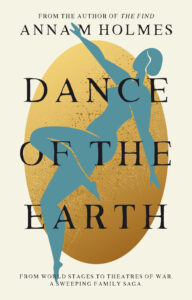
The premiere of Le Sacre du printemps /The Rite of Spring is central to my story. It is in the middle of the book – a fulcrum to what comes before and after – and is the point in ballet history where I began structuring my story. I knew the premiere of this ballet would be Nina and Walter’s 18th birthday and worked back from there, to find out what was on stage the evening of May 29th 1895 at the Alhambra, then figure how old I wanted Rose to be. My title, Dance of the Earth, is from a section of Stravinsky’s score. From the outset I imagined The Rite of Spring scenes with Nina on stage with The Ballets Russes and Walter experiencing his own rite of passage. I hope I have inserted Nina and Walter into this historical event in a compelling, and near accurate, way. I enjoyed writing those scenes!
The novel argues that art is essential even in times of devastation. Do you think that message feels more urgent today than when you started writing?
Towards the end of my story Rose insists pretend worlds are as important as the real world, and I agree with her. Art can uplift and heal and is fundamental to civilisation. Wouldn’t it be lovely if certain world leaders read my book.
What is next for you in terms of writing projects
This leads on nicely from your previous question. Last year I attended a performance of the musical Come from Away, set in Gander, Canada, during the 9/11 terrorist crisis when planes were diverted from US airspace to this emergency airport and the small community rallied to look after the thousands that descended on them. I left the theatre moved by the goodness and community spirit in the piece deciding I too wanted to write something uplifting. Then I remembered I have an (unrealised) screenplay that fits the bill, AND it has dance at the heart of the story. What can be better?
This new project set in 1970 is ‘research light’ as the research is done. Dance of the Earth took four years to think, plan, draft, edit, rewrite and see through to publication. This will be a much smaller project.
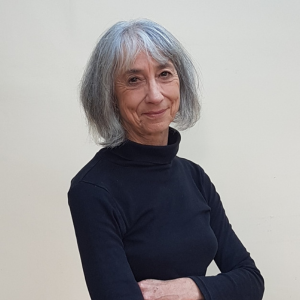
Anna M Holmes has a lifelong involvement with dance as a practitioner, teacher, and arts administrator. Visit www.annamholmes.com to find out more about Dance of the Earth.
Lara Bentley is an Editorial Intern at Aspects of History.