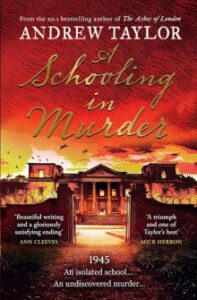

Andrew Taylor, A Schooling in Murder, sees you revisit to the 20th century, the dying embers of WW2 and a rural setting. Give us a brief outline of your most recent book.
It’s a Golden Age whodunit set in a third-rate girls’ boarding school in the closing months of World War II. It’s narrated by the murder victim, a teacher named Annabel Warnock. The school has been evacuated to a decaying mansion on the borders of England and Wales. In many ways the novel is a parody of the classic country-house murder with a closed circle of suspects.
The novel is set between VE Day and VJ Day, those transitory months where much still seemed in-the-air and epoch-defining events were just around the corner – do you think this heightens the uncertainty and isolation that enshrouds the murder of the title?
The historical timeframe is integral to the book’s structure. The war still affects all aspects of lie. Peace is still an unreal prospect.
Did you rely on any sources or archive material from the period when you were researching for the book? As a writer of historical crime fiction, do you find the research process bolsters you before the writing begins or puts limits on what you feel you can write?
The backfiles of newspapers were a valuable resource, as was Whitaker’s Almanac. Social history, Mass Observation files, maps, old films and novels, family letters – it all seeps into the brain somehow, generally in a shockingly unsystematic way.
I do a good deal of preliminary research, plus more while writing. Research reveals possibilities rather than imposes limits. I write fiction but I’m enough of a historian to respect the record rather than kick against it.
The action is related by a supernatural interlocutor, the victim of the murder herself, Annabel Warnock. What was the motivation behind a narrative approach like that?
I wrote a good third of the first draft of A Schooling in Murder before I decided my victim should also be my narrator. To be honest I didn’t have much choice in the matter. She just elbowed herself into the story and that was that. I enjoyed exploring the possibilities of her point of view.
Her replacement and the person she can communicate with is Alec Shaw, both a teacher and an aspiring writer – a man after my own heart… Was the inclusion of an amateur crime writer a move to ground the book within some of the traditions you admire in the genre?
Alec Shaw’s attempts to be write detective fiction struck me as a useful extension to the Golden Age shape of the murder mystery. And also as a way to poke a little gentle fun at the genre.
You’ve discussed the importance of time and place and the site of Piercefield near Chepstow being the basis for Monkshill Park, which you have returned to over twenty years since the release of The American Boy. Once you have your setting fixed, how do you go about building sufficient atmosphere and intrigue or, in the case of A Schooling in Murder, claustrophobia amid the isolation?
That’s the real mystery, isn’t it? For me, the setting (both time and place), character and plot are all threads in the same piece of cloth. I can’t untangle them without damaging the whole. Atmosphere, intrigue, etc., are their mysterious by-products.
Schools are rife for underhandedness, rumour, secrets and whispers – has it always been a mise en scène you have intended to explore and did you bring any of your memories of the classroom and corridors?
I don’t think I consciously thought beforehand of using a school setting at some point in the future. But perhaps it was inevitable! Memories of school lie deeply embedded in all of us, for good or ill.
What’s next for you? Are there any plans afoot to continue the Marwood and Lovett series set in the Restoration period? Or could this the beginning of a new sequence of novels?
A Schooling in Murder was always going to be a standalone – a sort of palate cleanser for me after writing six Marwood and Lovett novels. But in my next novel, Treason, I am returning to seventeenth century. Yes, it’s a Marwood and Lovett novel but in another sense it’s the start of a brand-new series – one set during among the tumultuous upheavals of the Glorious Revolution, nearly twenty years after the events of the previous novel, The Shadows of London. Time has moved on, and so have James Marwood and Cat Lovett…