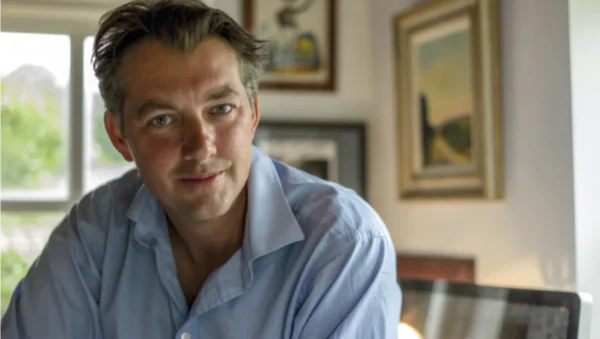

Welcome back, Giles – we’re exactly two years on from the release of The Stalin Affair, and that question of the nature of diplomacy between allies seems ever more relevant in recent weeks and months in 2026. The ‘impossible alliance’ you discuss between Franklin D. Roosevelt, Winston Churchill and Joseph Stalin during the Second World War required plenty of diplomatic care – do you find those few years between towards the end of the war an even more staggering historical event in light of the fractious state the world finds itself today?
One of Winston Churchill’s famous wartime quotes was: ‘There is only one thing worse than fighting with allies, and that is fighting without them.” His alliance with Stalin, which Roosevelt joined in 1941, was the ultimate marriage of convenience. Churchill had hated Stalin and his political beliefs for his entire political career. He had even sent British troops and munitions to Russia in the aftermath of the 1917 revolution in an attempt to destroy the new Bolshevik regime at birth. But Churchill and Stalin were both pragmatists. They realised that they needed each other if they were to defeat Hitler. Both were also aware that they could not defeat the Nazis without American military hardware. This triumph of pragmatism ensured that the ‘Big Three’ relationship would endure the war, but it is telling that it fell apart within weeks of the fighting coming to an end. The alliance had been, from the very start, an exercise in realpolitik.
Winston Churchill’s willingness to ally with Joseph Stalin despite their plain ideological opposition was a reflection of realpolitik – but would you agree that geopolitical stage of the last few years shows that getting around a table with your perceived enemies is in fact an impossibility now?
There was a very strange element of personal chemistry in the relationship between Churchill and Stalin. As noted above, Churchill and Stalin had started the war as sworn enemies. Churchill was an old-school aristocrat – the very model of everything Stalin despised. Stalin had even established the Comintern, whose explicit goal was to destroy Western democratic systems.
Yet the two men developed a begrudging respect for one another, and this would develop into something approaching friendship. Britain’s ambassador to the Soviet Union, Archie Clark Kerr, was both fascinated and perplexed by their relationship. He said that each man had a desperate need to be liked and admired by the other.
Could such a relationship exist in our current fractious world? I could certainly imagine President Trump negotiating face-to-face with America’s perceived enemies: he has already met with Putin and Kim Jong Un. But I find it inconceivable to imagine any European leaders sitting down with Vladimir Putin, for the diplomatic gulf is far too wide to be breached by negotiations. Iran is a different matter: Europe’s leaders would prefer negotiation to war.
Stalin looms as a hugely complicated figure throughout the book, both in his role as brutal dictator, a brilliant negotiator, but also in the more whimsical, avuncular moments of drunkenness and warmth as retold by Averell and Kathleen Harriman and Archie Clark Kerr – did your three protagonists have any choice but to engage in this way with the Soviet leader and his entourage? Was there any other option on arrival in Moscow?
Stalin, in 1941, was an unknown quantity in both America and Western Europe. He had not been seen in public for years and Britain’s ambassador to the Soviet Union, Sir Stafford Cripps, had never met him. Stalin was known, if at all, as a brutal mass murderer who had liquidated millions of his own people.
My protagonists were therefore surprised to discover that Stalin was a human chameleon – a mass murderer who could be both charming and engaging. He was also extremely well informed and had a remarkable memory for facts and figures – especially when it came to munitions. At one point, during a meeting with President Roosevelt, he delivered a lecture on the caste system in India – an impressive achievement for someone who had virtually never left the Soviet Union.
All three of my characters warned their masters in Whitehall and Washington not to underestimate Stalin. They also warned that Stalin was a devious manipulator who disguised his malevolence with a veneer of charm. Unfortunately, their warnings fell on deaf ears.
The book and those three characters glimmer with personality and demonstrate that informal relationships did contribute to global outcomes – do you reckon diplomacy on an individual level still can be successful in this era of institutions and multilateral frameworks (even if they may seem redundant…!)? Might one argue we need that now more than ever?
Both Averell Harriman and Archie Clark Kerr were wise choices as ambassadors to Joseph Stalin. Although Harriman had no experience in diplomacy, he was one of America’s most successful businessmen (he ran the Union Pacific Railroad) and knew how to deliver.
He was also a close friend of Roosevelt, which enabled him to get things done. If Stalin requested weaponry, for example, Harriman could telephone Roosevelt and set the process in motion in a matter of hours.
Archie Clark Kerr came with a different set of skills. Personable, charming and capable, he was sent to Moscow with the task (as Churchill put it) of making friends with Stalin. He was successful in this and was able to send a wealth of vital information back to London.
Archie Clark Kerr was also instrumental in saving the Big Three relationship from collapse in 1942, when Churchill travelled to Moscow and was insulted by Stalin. Clark Kerr dissuaded Churchill from tearing up the allied partnership and flying back to London.
Although we now live in a world of global institutions, human relationships are as important as ever. The West needs to invest time and money into training a new generation of diplomats who can use their communication skills bring us back from the brink, just as Archie Clark Kerr did in 1942.
The contrast between outward rhetoric and private negotiation and discussion is stark in the book – do you reckon we as political audiences today differ in having ‘more’ of an idea, or even mere scepticism, of that divergence between public statement and behind-the-scenes diplomacy? Was it easier for the Harrimans and Kerr to conceal that from public view?
In wartime it is always easier to conceal the truth from public view. The press is censored, news is ‘spun’, and propaganda abounds. Throughout World War Two, the British press was encouraged to depict Stalin as friendly ‘Uncle Joe’, an avuncular figure whose murderous past was constantly swept under the carpet.
In our modern age of social media and transparency it is hard to see how such a pretence could be made to stick. But there is a flip side to this. While it is these days far harder to conceal the truth, it is also easier to spin a conspiracy and thereby obfuscate the truth. In the current climate, an objective media is more important than ever.
A fair amount of your sources came from correspondence – we even featured Kathleen Harriman’s Wartime Letters, edited by Geoffrey Roberts, earlier this year – and the book highlights how uncomfortable realities can be erased from official records, particularly in the case of Churchill’s redacted letter divvying up Europe in the autumn of 1944. Now, more than ever, he is a divisive figure even within Britain – can what or how we read into that ever change?
Some historians seem hell bent on knocking Churchill from his pedestal, using selective evidence in order to tarnish his reputation. Churchill, of course, made many mistakes. His judgement was often faulty and he was certainly below par at the great wartime conferences, when even his aides were in despair. His proposal to Stalin in 1944, in which he suggested they carve up Europe between them, is particularly shocking. Neither the British parliament, nor the peoples of Eastern and Central Europe, had been consulted about such a plan.
In all of this, it is important to remind ourselves that Churchill was a product of his time: he was an aristocrat and imperialist whose overriding goal was to safeguard the future of the British Empire. While he failed to achieve this goal, he oversaw the most successful wartime alliance in history, enabling Britain and the West to triumph in their existential fight against the Nazis.
Finally, the alliance with Stalin and the Soviets was justified as necessary to defeat a greater evil – how do we define that ‘greater threat’ today, and who should be able to decide?
There are countless ‘great threats’ facing us today. America’s threatened withdrawal from NATO endangers European security and we are hopelessly ill-equipped to deal with an attack, whether conventional or cyber.
It is becoming abundantly clear that Europe can no longer rely on its former ally on the far side of the Atlantic and needs to urgently address the issue of its own security. The one glimmer of good news is the extraordinary success of Ukraine in fighting against Russia. The Ukrainians have transformed the art of warfare and will be an invaluable ally for western democracies in the years to come.
And, excitingly, you have a new title on the way. Give us a bit of insight on what to expect from this upcoming September release?
My upcoming book, Empire at the Edge of the World, tells the exhilarating story of a celebrity explorer named Vilhjalmur Stefansson who tried to claim the Arctic region for the British Empire in the 1920s.
Stefansson knew that for his claim to have any validity in international law, he needed to settle colonists on the lands he had discovered. And this is where his entire project began to unravel.
My book focusses on Stefansson’s colony on Wrangel Island, a remote speck of rock in the Siberian Arctic. What unfolded here was a catastrophe of starvation, madness, and geopolitical risk. As winter locked the island in ice, and rescue ships failed to arrive, the colonists spiralled towards despair. While diplomats sparred and warships were made ready, Stefansson’s settlers were left to endure scurvy, polar bears and abandonment. At the centre of it all stood one unlikely survivor – a young indigenous seamstress who would outlast them all.

Giles Milton is a bestselling historian and the author of The Stalin Affair: The Impossible Alliance that Won the War.
Zeb Baker-Smith is a Classics teacher based in Malawi, a freelance journalist and Editor at Aspects of History.