

As I understand it, Blood Feud is the first book in your second trilogy (Rebellion). Set the scene for us.
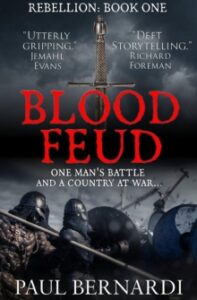
That’s right. We begin in a small village (Acum or Acomb as it is today) in the far north of England, situated close to Hadrian’s Wall and the River Tyne. The story takes place a couple of years after Hastings, but that is all but irrelevant at the outset as – in that part of the country – they had little interest in or interaction with the affairs of the south. As such, it is doubtful whether news of William’s coronation would have reached Acum or – if it had – whether it sparked much interest. That will change over the course of the book / trilogy, largely down to William’s desire to stamp his authority over the whole island. But for now, our protagonist, Thegn Oslac, is far more concerned about the generations-old feud with the Danish Lord of Hexham which lies just a mile or two away on the south side of the Tyne. Though dormant for several years, that feud is about to explode into bloody life once again.
I note that this new series is set in a similar time-frame to your first (The Huscarl Chronicles) – i.e. in the years around and after the Battle of Hastings. What is it about this period that inspires you?
I guess it has been a number of things going all the way back to the Ladybird book on William the Conqueror. For those of you old enough to remember, I can still visualise almost every picture in that book, from a young William being chased up a castle tower by would-be assassins, to his falling to his knees on Pevensey beach but then grabbing handfuls of sand to claim to have taken hold of England, to his coronation in the snow on Christmas Day, 1066. (Disappointingly, however, I don’t recall a picture of his corpse bursting open in 1087 when the monks tried to shove his bloated carcass into a stone sarcophagus that was several sizes too small). As I grew older – helped by my studies at university – I came to have a much wider appreciation of the era, especially in terms of the Anglo-Saxons. Seen from their eyes, the conquest must have been a cataclysmic event. Not only did it presage wholesale change in terms of the land-owning ruling class, but even Unferth out ploughing his Sussex field would not have been unaffected at least in some small way.
In short, it is one of the most impactful and important events in the history of this nation and one that still generates huge interest among scholars and the public alike (witness the buzz around the Bayeux Tapestry finally coming to England). My only disappointment is that it fails to excite serious investment on the part of the entertainment industry or – when it does – the makers decide to make wholesale and unnecessary changes to the story. Given that the actual events are riddled with mindbogglingly tense twists and turns, it is hard to fathom their purpose.
How do you prepare for writing a new book? Is it hours of research and planning before putting finger to keyboard?
When I set out writing historical fiction, that was my intention, but I soon found it wasn’t really me. I am lucky in that my lifelong interest in history – along with my studies – have furnished me with a solid grasp of the era. What I now tend to do is to pick an historical start and end point and then allow the story to meander pretty much wherever it wants to go between those two points (in keeping with the character traits I have in mind). One of the joys (for me) of the period is that so much is unknown, allowing the writer much scope to fill in the blanks as they see fit. In short, I guess I am just too impatient to wait before moving into the fun stuff – the writing.
What sort of feedback has the book received?
Judging by the reviews, what seems to go down best with my readers is a combination of factors. They appreciate the fast pace at which the story moves along with the gritty realism. I think that’s important in historical fiction, the feeling of being transported to a different time and place, and feeling comfortable in that milieu. Added to that realistic environment is a recognition that the characters remain relatable. That’s always been important to me. For readers to make a connection with a character who lived over 1,000 years ago, that character needs to have traits that they can recognise and identify with – i.e. similar hopes, fears, ambitions and emotions. I was particularly pleased with one review which stated: ‘I particularly like that the hero is not one step removed from Superman but a fairly ordinary bloke fighting for his family and beliefs.’ Bingo!
Finally, with the final part of the trilogy, The Reckoning, released earlier this year, what’s next for you?
I’m actually taking a break from the 11th century, but I’m not going far. Just over 100 years further back to the reign of King Aethelstan, in fact. I’m hoping to craft a new series focussing on a group of warriors who unwittingly become embroiled in Aethelstan’s rise to become England’s first king.
Paul Bernardi is the author the Rebellion Trilogy, published by Sharpe Books.