
Welcome, Steven, to Aspects of History. What was it that first led you into the study of architecture and cultural history? Which came first?
I was always fascinated by British history and British architecture from my earliest years, though I’m not sure why: no-one in my family was ever involved with (or even interested in) heritage or history. I was definitely smitten by historic buildings since my early teens, when my sister and I visited all the churches and cathedrals we could and pasted their pictures and descriptions into bulging folders. I studied architectural history as part of my history degree at Oxford University, helping me to link developments in the historic environment and social history with architecture. And while my doctorate looked specifically at 18th-century architectural practice, ever since my first book, Regency Style, was published in 1992, I have always tried to encourage readers to think of Britain’s architecture in the relevant social, political and technological context of its time and place.
What exactly planted the idea for Building Britannia? From my reading of it, this is a book which you have been waiting for years to write? The culmination of years of thought, experience and work?
I have always been interested in the social aspects of historic buildings; not just how they were built, but why, and for whom. My enthusiasm was piqued when I appeared as a presenter on the eight episodes of Simon Thurley’s Channel 5 series Buildings That Shaped Britain of 2005, whose scope spanned the whole gamut of British history from the Ancient Britons to today. After filming that, I began to think which buildings I would select to represent British history: not necessarily the best buildings in the country, but those which best reflected the historical and social context of their town, or of the nation as a whole. Many of the early candidates I considered were ultimately discarded as, though they may have been fine buildings in their own right, they did not say enough about the British people, either then or now.
What do you, personally, see as the future of architecture?
Architecture always seems to find itself at a fascinating crossroads. Today that’s particularly true: while much commercial designs seems, disappointingly, to have gone backwards to the 1960s in its return to a bland, minimalist corporate aesthetic, housing seems increasingly to be looking forward, embracing environmental concerns and recognising the need to improve living standards and access to transport while simultaneously recognising that homeowners want to live in a place which reflects their own needs and aspirations rather than just a developer’s cost-efficient algorithm. At the same time, it’s encouraging to see traditional building methods making a comeback: tried-and-trusted materials, from earthen walls and ceramic tiles to timber windows and roofing slates, which are kinder to the environment, look more appealing, offer better energy efficiency and last much longer than so many short-term modern ‘solutions’.
And do you think the nation’s architecture will end up mirror our increasingly fraught history?
That’s the absorbing appeal of architecture: it always reflects the ups and downs of the age from which it comes. While Chepstow Castle, for example, incarnates the violence, rapacious annexation and class engineering of the Norman era, while Cheshire’s Little Moreton Hall the social aspirations and wildly fluctuating fortunes of the landed gentry of the Early Modern era, our time is likely to be remembered for the increasing disparity between the very rich and the bulk of the population – as illustrated, say, in the ludicrously dramatic contrast between the depressingly wretched ‘temporary’ dwellings which house most of the populations of the world’s megacities and the soap-opera neoclassicism of Donald Trump’s much-vaunted yet wholly unnecessary White House ballroom.
What lessons are there to be learned from both the mistakes and the glories of this set of islands’ architectural past?
The key lessons, I believe, are to think of your audience and to think long-term. Who is actually going to live and work in your building, and what do they need and want? And how will the building adjust to changing priorities in this fast-paced world? Architecture should be adaptable, to be able to support new roles and purposes in the future as well as being fit for the purpose for which it was originally envisaged. Lincoln Cathedral, Oxford’s Sheldonian Theatre and London’s Paddington Station, to take three highly contrasting examples, are still fulfilling the same function for which they were built centuries ago, albeit with some contemporary accretions, while architectural icons from our industrial and commercial past, familiar landmarks such as Halifax’s astonishing Georgian marketplace, Piece Hall, Slough’s Edwardian Horlicks Factory and Perivale’s much-loved Art Deco Hoover Building have all been successfully concerted to new uses; yet the misplaced utopian modernism of Leeds’ Quarry Hill housing estate and the overweening brutalism of Owen Luder’s Tricorn Shopping Centre in Portsmouth both lasted only forty years.
What is your personal favourite of all the buildings you describe in the book?
It’s so difficult to choose one – it’s a bit like asking you to pick your favourite child. They are all so different, and yet all have their particular charm and appeal. But since you ask, I think I’ll go for the Royal William Yard in Plymouth. The world’s biggest naval victualling yard when it was built between 1824 and 1833, it is a marvellous architectural composition as well as a testament to the central role the Royal Navy has played in our history: a lesson in how to combine functions and services with a confident, monumental classicism and an outstanding physical setting. Yet it was only made accessible to the public in 2006, having been finally closed in 1992, and it is still very little known outside the city. Reassuringly, it is now a poster child for the successful and imaginative re-use of even the largest and most complex examples of our industrial heritage.
What would be your pick of the great architectural works around the world? And what do those examples say about their time and place?
Again, it’s so difficult – there’s so much to choose from. But off the top of my head, I’ll pick three very different sites. Firstly, the church of Santa Maria della Salute in Venice, begun in 1631 to the designs of architect Baldassare Longhena: an outstanding, compact design that’s as much sculpture as architecture and dominates yet complements the Venetian waterfront and takes us back to a time when populations believed that dedicating buildings to God would save them from the plague. Secondly, Grand Central Station in New York of 1910-13: brilliantly planned and confidently executed, it is a wonderfully assured expression from a time when the railway was king and there were no greedy developers eyeing up a landmark building’s air rights. And lastly, I would definitely pick something by Santiago Calatrava – let’s say his Bilbao Airport of the 1990s – as he’s done so much to make travel, and indeed the whole modern world, romantic and exhilarating again.
And what can we expect from your next release or project?
Thanks for asking. Well, I’ve currently got two socio-architectural books in production: A Grand Tour of Georgian Britain, which explores the building types which are so often ignored by mainstream histories, and Trafalgar Square: The Biography, which looks at Britain’s history through the prism of the buildings and sculptures of what is effectively the vibrant, democratic heart of the nation. And I’m currently writing a general history of Regency Britain – covering everything from art to civil rights and from organised sport to prison reform.
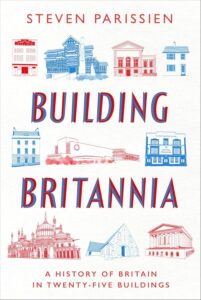
Steven Parissien is an academic, cultural historian and the author of Building Britannia: A History of Britain in Twenty-Five Buildings, published by Head of Zeus.
Paul Strathern is a historian and the author of Ten Cities that Led the World: From Ancient Foundations to Modern Powerhouses.