The Italian Navy’s elite Decima Flottiglia MAS (10th Torpedo-Armed Motorboat Flotilla) was one of the most successful commando units of WWII, carrying out spectacular raids against Allied shipping. I have attempted to weave their skill and daring into my novel Hunter Class through my character Lieutenant Giacomo Moretti, a former frogman in the Decima MAS.
The unit is most famous for its underwater attacks on Alexandria and Gibraltar, pioneering the use of frogmen and human torpedoes to devastating effect.
On 19 December 1941, the Decima MAS, under the overall command of Prince Junio Valerio Borghese, carried out an audacious assault on Alexandria Harbour in Egypt with three human torpedoes launched from the submarine Sciré.
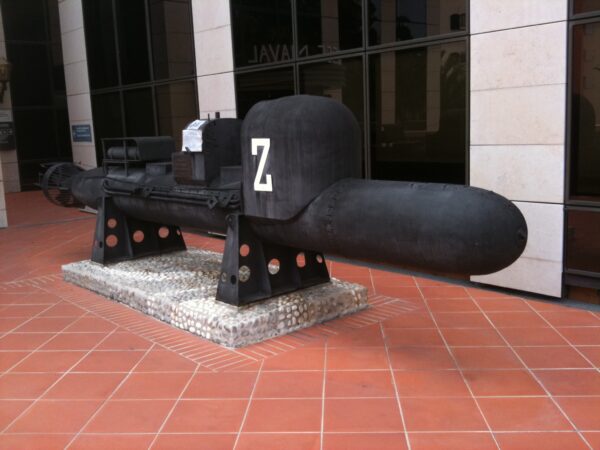
The human torpedo known as Siluro a Lunga Corsa (SLC), or “long-running torpedo”, was crewed by a pilot and a diver and could carry a 230–260 kg warhead approximately 15 nautical miles. The SLCs were notorious for their poor handling and were affectionately called maiali (“pigs”) by their crews.
Despite this, the three SLCs from Sciré managed to infiltrate the Royal Navy’s base at Alexandria and place explosive charges beneath the battleships HMS Valiant and HMS Queen Elizabeth. The resulting explosions crippled Britain’s two most powerful Mediterranean battleships, temporarily shifting the balance of naval power in the eastern Mediterranean and marking one of the most effective raids of the Second World War.
The Decima MAS also launched nine attacks on Gibraltar in three phases. In the first phase, the Italians continued to employ SLCs launched from Sciré. Four attacks were attempted in this manner: the first three failed, but on the fourth attempt, Lieutenant Licio Visintini led three SLCs into Gibraltar harbour on 19 September 1941.
Visintini took his SLC beneath the nets protecting the inner harbour and placed his charge beneath the fully laden tanker SS Denbydale, severely damaging her. The other two crews were able to destroy the oiling hulk Fiona Shell and the steamship SS Durham.
In the second phase of the Decima MAS’s attacks against Gibraltar’s shipping, the unit employed Gamma swimmers to strike at merchant ships anchored off the Spanish coast.
On 13th July 1942, twelve Gamma swimmers launched an assault, damaging four steamers. However, the charges were not large enough to sink the merchantmen, and the ships were salvaged and returned to service. The Italians launched another attack on 14 September 1942 and succeeded in sinking the 1,787-ton steamer SS Ravenspoint.
In the third phase, the Decima MAS launched SLC attacks from a secret base built into the tanker Olterra, which had been interned at the port of Algeciras in neutral Spain, across the bay from Gibraltar. This enabled the Italian commandos to launch human torpedoes through a trapdoor below Olterra’s waterline for strikes on shipping at Gibraltar.
After a disastrous attempt on 7th December 1942, three SLC crews carried out a further raid on 7 May 1943, successfully mining three ships. The merchantmen’s crews, however, heroically managed to save their ships. The Decima MAS made their final attack on Gibraltar on 3 August 1943, when Lieutenant Ernesto Notari led three SLCs into the bay, mining four ships.
The base aboard Olterra was never discovered, although some members of the Royal Navy suspected that the tanker served as a forward launching site for the Italians.
Ian Fleming, the creator of James Bond and wartime personal assistant to the Director of Naval Intelligence, drew on many of the Decima MAS’s exploits. In Ian Fleming’s War: The Inspiration for 007, Mark Simmons suggests that Emilio Largo, the Italian villain in Thunderball, could have been inspired by Prince Junio Valerio Borghese. A trapdoor similar to the Olterra’s also appears in Thunderball, aboard Largo’s yacht, Disco Volante.
The Decima MAS frogmen showed superb skill and guts, executing complex operations while braving extremely difficult conditions and achieving tremendous success.
The danger the Italians posed forced the Allies to divert substantial personnel and equipment to harbour defences at a time when operations in the Mediterranean were stretching the Allies’ resources.
In so doing, the Decima MAS demonstrated that a small, highly specialised force could punch above its weight, having an impact out of all proportion to its numbers and living up to its motto: Memento Audere Semper (“Remember Always to Be Bold”).
Alan Bardos is the author of historical fiction set around the World Wars. His latest novel is Hunter Class.