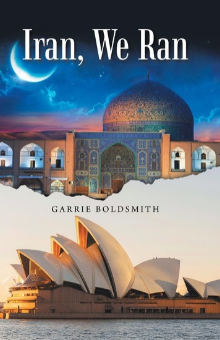
In Iran, We Ran, Garrie Boldsmith weaves together the stories of two Iranian men whose very different circumstances lead them to the same conclusion: they must leave their home country if they are going to have a future. Set against the backdrop of modern day Iran and Australia, the novel explores the intersection of politics, identity, organised crime and survival.
Boldsmith is a retired Australian lawyer who worked with people migrating to Australia. His extensive travels throughout the Middle East have also informed his understanding of the region. These experiences are evident in this novel that seeks to look beyond the headlines, examining the personal consequences of political repression and displacement.
The story begins with Behrooz Alidazeh, an educated interior designer from Tehran, and Solayman Ahmadi, the youngest son of a farming family in a rural village in eastern Iran. Behrooz’s carefully constructed life is threatened when he is caught by Iran’s morality police at a private gay nightclub in Tehran. Solayman, meanwhile, becomes involved in drug trafficking across the Afghan border. When his dealings lead him into increasingly dangerous territory, he finds himself caught between criminal networks and the threat of the Taliban. For both men, remaining in Iran is no longer a viable option, and each must find a way to escape.
Their journeys eventually take them to Australia, where their paths cross in unexpected ways. The novel also includes the storylines of Maryam Halousim, an Iranian-born Israeli woman working for Mossad, and Julian Kosolowski, a more peripheral character whose connections help bring the different strands of the story together.
One of the novel’s strengths is its structure. Boldsmith gradually connects the characters’ otherwise separate experiences, creating a growing sense that their lives are being shaped by forces beyond their control. The early stages of the novel establish the distinct circumstances of Behrooz and Solayman before bringing them together during their journey to Australia. As the plot progresses, the significance of their encounters becomes clearer, and the tension builds towards the eventual convergence of the storylines. The result is an engaging narrative that rewards readers’ attention to the connections between its characters.
Neither man’s circumstances fit neatly into a simple narrative of victimhood or personal responsibility. Instead, Boldsmith explores the compromises people make when their choices are constrained by circumstances they did not choose. Their developing friendship provides an emotional centre to the novel, even as the reader becomes increasingly aware of the risks surrounding them.
Iran, We Ran offers an informative account of Iranian history and the political circumstances that shape its characters’ lives. The historical background provides useful context, while the sections depicting the men’s attempts to leave Iran create some of its most tense moments. Their encounters with border control are particularly effective in conveying the uncertainty of migration, when a single decision or unexpected obstacle can jeopardise an entire journey.
Boldsmith’s novel is timely in its treatment of displacement and the risks people face in pursuit of a safer life. Its exploration of the drug trade introduces a darker dimension to the story, connecting individual choices to wider criminal networks and their consequences. Ultimately, Iran, We Ran, is an accessible, suspenseful novel that combines historical and political context with an interconnected cast of characters. It offers an engaging exploration of survival, belonging and the price of starting again.

Sophia Kazan is an Editorial Intern at Aspects of History.