
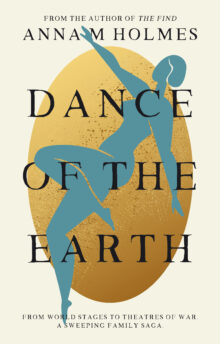
There are novels that inform you, and there are novels that transport you. Anna M Holmes‘s Dance of the Earth does both with rare confidence, depositing the reader into the smoky gaslight of a Victorian music hall and then sweeping them forward, through the revolution of the Ballets Russes and the devastation of the First World War, before setting them down, blinking, nearly half a century later.
The story begins in 1875 at London’s Alhambra Theatre, where a newborn is abandoned at the stage door. That foundling, christened Rose, grows up in the warmth of a seamstress named Molly, learns the rhythms of theatre life almost before she can walk, and eventually rises to become a music hall dancer herself. When an ill-fated love affair derails her career and leaves her the mother of twins, the novel broadens its canvas considerably. Nina and Walter, separated in infancy and raised in very different worlds, become the beating twin hearts of the story’s second half.
What Holmes has constructed here is genuinely ambitious. This is a multi-generational saga, a work of meticulous historical research, and an intimate character study, all held together with an assured, unhurried hand. The author holds an MA in Dance Studies and spent years working in arts management as a specialist dance & theatre officer, and that deep expertise is felt on every page. Yet it never tips into the academic or the dry. Holmes wears her knowledge lightly, using it to conjure texture rather than deliver lectures. Whether she is rendering the anarchic premiere of Stravinsky’s The Rite of Spring, with audience members in uproar and Nijinsky shouting from the wings, or stitching the quieter details of backstage life, the world she conjures feels lived-in and true.
The novel’s thematic concerns are equally rich. Gender and opportunity, racial prejudice, queerness, trauma, and survival weave through the narrative without ever feeling tacked on or contemporary in a clumsy way. Nina’s ambitions collide with the expectations placed on women of her era, while Walter’s harrowing experiences in the trenches and his struggle to find belonging in a society with little tolerance for his identity give the novel real emotional heft. Their stories reflect one another and reflect their mother’s before them.
It is worth noting, too, how skilfully Holmes handles the novel’s blend of fact and fiction. Historical figures move through the story alongside invented characters with a naturalness that is harder to achieve than it looks. The Ballets Russes sequences in particular demonstrate a writer who has not only done her homework but has genuinely fallen in love with her subject matter. Readers who arrive knowing little of Diaghilev‘s world will leave curious to learn more, and those who arrive already familiar with it will find much to savour in the details Holmes has chosen to illuminate.
Dance of the Earth is, at its heart, a book about the necessity of art; its power to carry people through hardship, to build identity, and to give meaning to otherwise difficult lives. Holmes clearly believes this to her core, and that conviction is infectious.
For lovers of historical fiction, dance, or simply a deeply researched and emotionally generous novel, this comes warmly recommended.
Lara Bentley is an Editorial Intern at Aspects of History.