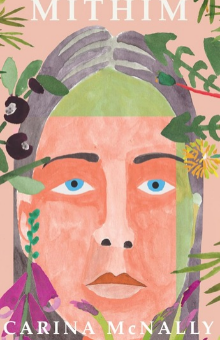
In this admirable debut, Carina McNally finds her foothold in that precarious and productive gap between fact and fiction, history and mythology. From it she draws out the forthright voice of Mithim, who demands her country’s history be remembered. The novel opens amid fire and shrieking birds as we plunge into 1649 and Cromwell’s bloody invasion of Ireland. Mithim’s family is slaughtered and her home, Killenea Castle, burned to the ground. Cromwell’s occupation seeks to erase Ireland’s historic nobility, language and religion but McNally has other ideas. She does the opposite, the active work of remembering, resurrecting a heady, spirited Mithim from the marginalia of history.
Fast-forward eight years, we find Mithim living alone in Wexford Forest, a quasi-magical figure, reminiscent of Agnes in Maggie O’Farrell’s Hamnet. She is gifted in apothecary and possesses a second sight, dhá shealladh, granting her access to other women’s interiority. McNally’s magnetic prose summons the vividity of forest life; crackling undergrowth, dried mushrooms ground to powder, salmon crisping over the fire, circling sparrowhawks and dandelion stout.
The Celtic tree calendar tracks the year across thirteen lunar cycles, each tied to a sacred tree said to shape the personality and fate of those born under it. McNally exhumes this ancient, prophetic practice, folding each chapter of Mithim around a different detail of the forest to offer the reader a fortune telling of their own. The effect is a vision of history untethered to a linear timeline of violent colonialism, attuned instead to the gentle undulations of the seasons, changing foliage and shuttling cycles of the moon.
Glossaries of plants and Irish words preface the book and McNally layers a kind of herbal over the text, a botanical handbook equally ripe for wish-making or healing boils and broken bones. The Irish language gleams throughout, a reminder of the importance of preserving native tongues. I think of the Irish saying, tír gan teanga, tír gan anam, a country without a language is a country without a soul. McNally’s seamless weaving of Irish words into her prose, imbues them with a lyrical, transcendent quality and they shimmer off the page like runes and incantations.
In the wake of her loss, Mithim sets out on a hero’s journey to track down any family who may have survived. Her path takes her from Wexford forest to the servant quarters of her lover Diarmuid’s home, through the dark alleyways of Cork and along the rugged wilds of the Beara Peninsula. McNally produces a Dinnseanchas, a diary of the landscape that unearths the myths and history bound up in Irish placenames, as Mithim maps out her own vision of Ireland.
Just as the Oak tree, An Dair, stands wise and immovable, its branches twisting supportively through the novel, Mithim holds fast to her beliefs. Her wisdom, connection to the natural world and insistence on the past offer a model for being that feels startling relevant today. A resistance to the erasure of culture, language or memory. Towards the end of the novel, McNally writes, ‘it seems there is only truth in trees’, and perhaps this is why she keeps returning to them, because they remind us to stay rooted to the past while still growing, still reaching forward.

Sadie Souter is an Editorial Intern at Aspects of History