
What was it like to have your house requisitioned during the war? To share your home with occupiers, whether Land Girls, POWs, soldiers, or spies? What compensation did families receive for the loss of their homes? And how did it all work? These were the questions I initially wanted answered when I began The Country House at War.
The idea for writing a book on requisitioned country houses during World War II came because I couldn’t find a book that answered them. There were memoirs of course, and wonderful architectural histories of individual houses, but as a social historian, I wanted to find patterns in lived experience. And as someone who had written about upper-class women and their houses in the 18th and 19th centuries, I was well-positioned to do so. I just had to enter a new time zone.
Familiarising myself with 20th-century scholarship was difficult enough, but maintaining intellectual balance when writing about the more recent past turned out to be my biggest challenge. The class issue is both a historic and a personal one. It became essential to place this story in the larger context of British history.
The impetus for my curiosity came from two very different experiences. One of my colleagues in American history had asked me if the British had a legal definition of “home”. I knew vaguely, on the periphery of my imagination, that country houses had been requisitioned by the British government during the two world wars, and I thought that might be a good place to start. Given the role of domesticity in English culture, I was surprised to discover that, legally, the government made no distinction between family homes and other forms of built structures. Only material losses were compensated. And as a historian of gender, I took note.
The full significance of that only came to me after visiting Audley End, a palatial and exquisitely beautiful country house in Essex. I learned that that house, like many others, had been occupied during the war by the Special Operations Executive (SOE). The resident family and most of their staff were evicted. The Dowager Lady Braybrooke, whose husband had died only two weeks before the requisition, had to leave. Her two teenaged sons were at the front, both of whom would be killed in action. Her teenaged daughter, Catherine, also joined the uniformed services. So Lady Braybrooke and the nanny fled, searching for a safe place to stay, apparently chased around the south of England, trying to stay one step ahead of the requisitioners. At the same time, traditional aristocratic legal practice also deprived Lady Braybrooke of her home. Audley End had been entailed on a cousin, who came into his inheritance following the wartime deaths of her husband and sons. Lady Braybrooke and her daughter Catherine would never live there again.
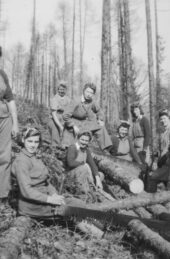
But it was not only the “upstairs” families whose lives were upended by requisition. Country houses also had large staffs, many of whom were subject to conscription. Those left at home to deal with occupiers were young women with small children and the elderly. The number of people available to do housework declined, but the workload, with rationing, blackouts, and the presence of refugees and occupiers, increased. Moreover, many large old houses, like Audley End, had never been modernized with central heat or electricity. “You went up to bed with your candle,” Catherine Neville recalled of her prewar Audley End upbringing, “and if you were lucky, there was a fire in your bedroom, depending upon the weather.” The house had been built with the expectation that there would always be a large staff available. But that was no longer true.
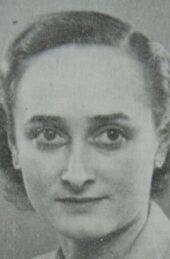
Perhaps the most interesting staff member I encountered was Elise Lesser, who worked at Gorhambury House. Her story is a sobering one. The difficulties of adequate staff recruitment was known by the employer class as “the servant problem”. At the same time, many Europeans, including those like Elise, of Jewish descent, were desperately trying to flee the Nazi juggernaut. The British government responded to these twin problems by issuing visas to continental women willing to do housework, as long as their sponsors agreed to pay annual wages of £36 or more. Lesser was hired in 1936 as a housemaid “direct from Wuppertal-Barmen”, though she had never done housework professionally before. By 1939, she had been promoted to housekeeper at Gorhambury.
But once war had been declared on 3rd September, she was regarded by the government as “an enemy alien”, and as such, was required to appear before the Aliens Tribunal at Hatfield. Her employer Lord Verulam wrote to the tribunal on her behalf. He recommended that she be exempted from any restrictions. Nevertheless, she soon disappeared from his household budget.
The war experience effectively nationalised a great many houses. Of those I wrote about in The Country House at War, some are today owned and operated by English Heritage or the National Trust. Others are owned by municipalities for the benefit of their communities. Some buildings survived the war but now have totally non-domestic functions. And finally, some are still owned and inhabited by their wartime families, though they often survive as tourist attractions and film sets.

Judith S. Lewis is a professor at the University of Oklahoma, and the author of The Country House at War: A Story of Loss, Reinvention and the Birth of a New Britain, published by Yale University Press.