
The International Settlement of Shanghai was a city within a city, an island of Western lifestyle dominated by the British and American concessions, which were ruled by an Anglo-American council. South of the settlement was the French Concession, where many wealthy ‘Shanghailanders’ lived in luxury and palatial houses.
Surrounding the settlement was the Chinese nation controlled by the Chinese central government in Nanking but recently occupied by the Japanese. So it was only a matter of time before they would over-run the ‘Pearl of the Orient’ – the international settlement of Shanghai, and the wealthy centre of trade in the Far East. The British Government declared the International Settlement indefensible in 1940 and withdrew the army, and the Americans followed suit shortly after. However, thousands of defenceless British and American citizens such as Theo in my novel The Enemy’s Wife continued to live and work in Shanghai.
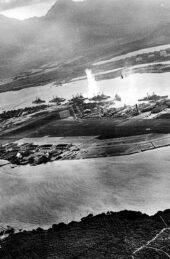
The Japanese attacked Pearl Harbour on 7th December 1941, declaring war on Britain at the same time. Many European and American businessmen in Shanghai found themselves trapped in the International Settlement, the enclave of Western-controlled Shanghai. Immediately after, anyone over 14 had to report to the Japanese police at Hamilton House to register and receive ID numbers, though the Japanese took their time in sending ‘enemy nationals’ to camps.
Initially people of other nations were forced to wear distinctive armbands, and were dispossessed of their control of finances, business and housing. Starting from October 1942, all citizens of Allied nations had to wear red armbands with a letter to show their nationality. B for British, A for American, N for Dutch and X for other enemy nationals. Armband wearers were forbidden from cinemas, theatres, dance halls, and racecourses, in fact anywhere where large numbers could gather.
Those trapped in the International Settlement struggled on, supervised by the Swiss consulate who distributed a monthly allowance, since normal businesses were no longer operating in the same way. It was not until January 1943 that the Japanese Army established internment camps for enemy foreign nationals in and around Shanghai. These camps operated for almost three years and eventually held more than six thousand detainees from ten countries, including Britain and the United States.
Many residents were sent to the camp at Lunghwa just outside the city, an unused school which had been heavily damaged during the second Sino-Japanese War. Named a ‘Civil Assembly Centre’ by the Japanese, the camp consisted of seven concrete buildings, three large wooden barracks (formerly stables), and numerous outbuildings. There were fifty-nine dormitories as well as rooms for families. The Japanese captors were uncompromising about obedience to their rules, and inmates suffered from harsh treatment, starvation, and excessive unreasonable violence.
Within the camp there were many family units, and so order was soon brought to bear to create a routine for schooling and leisure activities. The establishment of a timetable and the sharing of chores made the primitive and crowded conditions bearable. British schoolteachers ran a full syllabus, and there being little else to do, many children received an excellent education, despite the lack of textbooks.
‘Many of the classroom windows had been broken by the fighting in 1937, and in winter they let in an icy wind. These had to be patched with pieces of cloth treated with melted candle wax.’
- G. Ballard, author of Empire of the Sun, an autobiographical novel detailing his life in the camp.
Food and water in camp were the main concerns, and both were in short supply. Water arrived in trucks and had to be boiled. Internees were given three meagre meals a day. A typical breakfast was congee, white rice gruel, with a cup of green tea. The other two meals were often identical: brown rice with stew. Rations were estimated at about 500-600 calories per person per day, so lack of protein made people ill and weak. Ways had to be found to try to eke out rations or find other sources of food, including growing things and bartering with those outside or within the camp. Internees devised stoves made from old petrol cans to secretly cook anything they could glean.
Despite the dangers, local Chinese villagers outside the camp, who also resented the Japanese invasion, risked their lives to form a “black market” that allowed people in the camp to trade some of their belongings for food, such as chicken meat and eggs. Both the suppliers and the handlers were in grave danger of being shot by the Japanese guards.
Because of weakness and the poor diet, malaria was ever-present and hard to recover from. Edouard Egle, the compassionate Swiss representative of the Red Cross provided parcels of medical and dental supplies, including quinine, although Japanese guards often looted the packets. Other goods could be bought for a price by local Chinese, who risking their lives, would also bring news about the course of the war. Newspapers were smuggled into camp, but owning a radio was punishable by death.
‘We wondered what was happening in Europe. And what would happen to us. The winters were cold and we bought fleece-lined, ugly brown tops and bottoms brought in to the camp. We called them Dire Needs. Spring was short and summer long and very hot. The worse thing, particularly for families, was the uncertainty — the not knowing.’
Paul King and Heather Burch about Lunghwa from ‘WW2 People’s War’
Surprisingly, despite the armed guards, watchtowers and electrified wire, people did escape. The camp held American Marines captured at Wake Island, with strict prohibitions enforced by the guards against escape. These prisoners were subjected to brutal treatment. The Japanese attitude to their captives was based on bushido, an ideology that taught blind loyalty to the emperor. Japanese soldiers were taught a soldier should die before surrendering. The American Marines, having been captured, were therefore the lowest of the low, to be treated as slaves, and inmates were forced to sign pledges that they would not try to escape, under penalty of torture or beatings.
There were two failed escape attempts, although five men succeeded, including Commander W. S. Cunningham who dug under the electric boundary fence, but they did not make it far; they were captured by Chinese puppet forces and handed over to the Japanese.
Eyewitnesses claim two successful further breakouts, making nine escapes altogether. In The Enemy’s Wife, Theo and Griff’s story of escape from the camp is based loosely on the real experiences of Commander C. D. Smith of the US Navy who was able to escape Shanghai into Chinese guerrilla territory and make his way to an American base. A brief article on him can be found online at History Net, and Smith is the hero of the book Officially Dead by Quentin Reynolds.
Although much is known about Nazi camps during WW2, and prisoners of war in Germany, less is known about the internment of ordinary families and civilians during the invasion of China by Japan. I found this history fascinating to research and include in a novel, and I much admired the courage and resourcefulness of the internees.

Deborah Swift is the author of more than twenty historical novels, including The Enemy’s Wife.