When we think of the Crusades, the first things that come to mind are 12th-century characters such as Richard the Lionheart and Saladin, locked in combat for control of the Holy Land. The average medieval person, though, would have had a much richer understanding which included Crusades to southern France, Spain, the Baltic, and – fascinatingly – Egypt.
Knights Templar in the land of the pyramids seems an incongruous combination now, but in the 1200s, this was the reality for tens of thousands of crusaders on the Fifth Crusade (1217-21), who encountered crocodiles, Greek Fire, and unique floating siege engines on the Nile, as they fought for control of the Middle East. The Fifth Crusade is little known today outside scholarly circles, but the campaign offers the key to unlocking a fuller understanding of the Crusades.
The Fifth Crusade was the first major western expedition to attempt the conquest of Egypt and witnessed one of the longest sieges in the history of the Crusades: a year and a half of bloody amphibious and land-based warfare to capture Damietta – the most significant trading hub on the Egyptian coastline, after Alexandria. The capture of Damietta in 1219 represented the first conquest of a major Muslim city by a crusade since the siege of Jerusalem in 1099 and it permanently shifted the geo-political situation in the Middle East. The Christians’ ambitious strike at Cairo not only destabilised the region and nearly toppled the Ayyubid empire but also established a blueprint for later expeditions. Louis IX of France copied the Fifth Crusade’s playbook when he invaded the Nile Delta in 1249-50, and, in 1365, a new crusade attempted to conquer Alexandria.
The Fifth Crusade, then, despite being little known today, was a major disruptive event in world history. It involved tens of thousands of combatants on both sides, as well as many more civilians affected by the campaign.
After the loss of Jerusalem to Saladin in 1187, it was widely thought among crusade strategists that the key to retaking and holding the Holy Land was to target Egypt – the breadbasket of the Near East. It was the foundation of the Ayyubid empire, which stretched from Egypt in the south to Palestine and Syria in the north, surrounding the beleaguered remains of the Crusader States.
During the Third Crusade (1189–92), the invasion of Egypt had been discussed but left unpursued. The Fourth Crusade (1202–4) had been bound for Egypt, before a series of unfortunate diversions led it to attack and conquer Constantinople, the capital of the (Christian) Byzantine empire, instead. The Fifth Crusade, then, was the first attempt to test the Egyptian strategy.
Comprised of armies drawn from across Europe – including England, Germany, the Low Countries, France, Italy, Austria, Hungary, as well as the titular kingdom of Jerusalem – the Fifth Crusade invaded the Nile Delta in May 1218. The crusaders conducted a successful beach landing at Damietta using flat-bottomed landing craft not dissimilar to the Higgins boats used during the D-Day invasion of 1944. The medieval version featured bow ramps that could be lowered into the Egyptian surf, disgorging mounted knights directly onto the beaches.
After establishing a beachhead, the European invaders found themselves operating in an alien, deadly landscape. They encountered crocodiles for the first time, which killed the unwary; others died from drinking the muddy Nile waters, writhing in agony on the banks of the river as their comrades looked on helplessly.
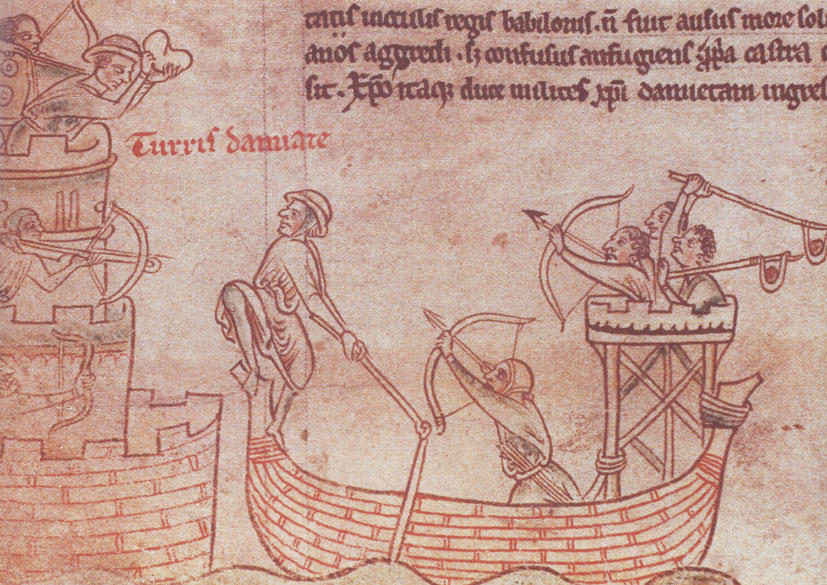
As they acclimatised to their unfamiliar surroundings, the Fifth Crusaders immediately began the investment of Damietta. In autumn 1218, they invented a unique floating siege engine to capture the Chain Tower which blocked the Nile with a massive harbour chain. This contraption was designed by a German schoolmaster named Oliver of Cologne, who drew on ancient military manuals to construct the strange engine: two ships joined together, with a wooden platform on top and a rotating siege ladder protruding from the bow.
After the crusaders took the Chain Tower using the floating siege engine, they were able to cross the Nile and besiege the city. Damietta benefitted from three rings of walls, each higher than the last (imagine a modern three-tiered wedding cake). In their determined defence of the city, the Egyptians made extensive use of Greek Fire – a naptha-based weapon akin to napalm, delivered in ceramic hand grenades.
Fierce fighting lasted for a year and a half before the crusaders were able to starve the city into submission. When they clambered over the great walls to claim their prize in November 1219, they found bodies strewn throughout the streets – victims of famine and disease and evidence of the brutal efficacy of the crusader blockade.
The capture of Damietta was the greatest achievement by any crusade since 1099. Fuelled by belief in books of prophecy, in 1221, the crusaders set their sights on Cairo and the subjugation of the rest of Egypt. With panic breaking out in Cairo, the Christians marched south according to their apocalyptic timetable, just before the Nile began its annual deluge (the crusaders believed the prophecies would protect them from the rising floodwaters).
The army was only two weeks’ march from Cairo when they were surrounded by the Egyptian army, under the command of Sultan al-Kamil, at a fork in the Nile at Mansoura. Using the annual flood to his advantage, al-Kamil opened the sluice gates in the surrounding fields, submerging the crusader camp. Faced with no other option but to attempt a covert nighttime retreat, many crusaders drank their wine stores dry and then set fire to their own tents, alerting the sultan to the withdrawal. After a chaotic engagement in the darkness in which drunk crusaders attempted to flee on overloaded ships, several of which sank, the Christian army surrendered and struck a deal: they would return Damietta in exchange for their lives.
The failure of the Fifth Crusade and the loss of Damietta sent shockwaves throughout Europe. The crusaders’ glittering prize and the dream of establishing a new Crusader State in Egypt were no more.
In the intervening centuries since 1221, the Fifth Crusade has largely been forgotten, but if we strip away the benefit of hindsight and attempt to view the campaign through the eyes of contemporaries, we find not only one of the most vivid adventures of the medieval era but also a war that came very close to changing the fate of the crusading movement and the battle for the Middle East – a story that deserves to be more widely known.
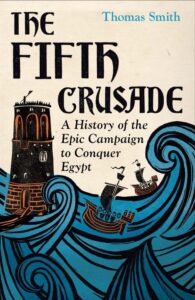
Dr Thomas Smith is a prize-winning historian of the Crusades and the medieval world, and the author of The Fifth Crusade: A History of the Epic Campaign to Conquer Egypt, published by Yale University Press.