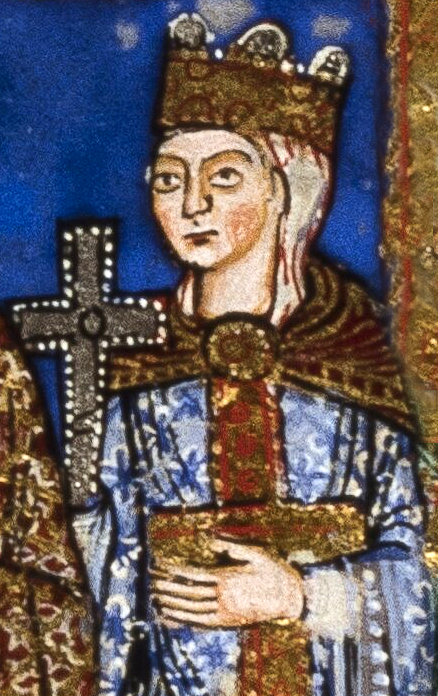
In my new biography of Empress Matilda, I have emphasised Matilda’s capacity for collaboration with the men surrounding her, revealing her concomitant skill of persuasion and negotiation. Nevertheless, it is clear from her life story that there were moments that these skills did not produce the results she hoped for. Self-belief and self-confidence combined with intelligence and knowledge can produce great outcomes, but they were also character traits that at times were perceived as arrogance, intolerance or obstinacy by her opponents. It is significant that her close friends Brian fitz Count and Abbot Gilbert Foliot exchanged views about her character in early 1144 and concluded that Matilda was not arrogant or disobedient, clearly formulating arguments in an unspoken dialogue with her enemies to counter accusations of the empress’ haughtiness. This trait we know from the pages of the Gesta Stephani whose author had witnessed her in action and famously described her as insufferably indignant, sentiments echoed by Henry of Huntingdon and John of Hexham (neither of whom, as far as we know, did know her personally). Her apologists, William of Malmesbury and the Gloucester chronicler, hinted that in dealings with her advisers the empress could be tough by sticking to her line of argument and seemingly unwilling to compromise. Towards the end of her life in 1164 her Rouen adviser-confidant Nicholas of Mont-aux-Malades left us with a portrait of Matilda that in his mind justified his portrayal of her as ‘a tyrant of Norman stock’, playing on the notion of the unbending will of William the Conqueror and his successors. Firmness of mind and self-reliance are in themselves not bad character traits, but rulers needed to be seen to seek advice from their counsellors, weigh up the pros and cons with them, and then come to decisions that all could agree on. At times they thought that Matilda was inflexible in her political stance. It is surely significant to bear in mind that, except for the author of the Gesta Stephani, no one put a gendered slant on her behaviour, and we have to keep in mind that labels such as arrogance, indignation and haughtiness were traits that were condemned in elite men but perhaps implicitly more so in women. In this respect the gendered language used by her opponents allowed them to make sense of their encounter with her, such as at Westminster in late June 1141, to explain what they perceived as a cognitive dissonance between her aims (persuading the Londoners to side with her) and her actions (demanded financial aid), which were perceived as inflexible and uncompromising.
Yet, Matilda could be flexible once she realised that her own stance would not work in the long term. She gave in to her father twice in her life, first when he ordered her back from the empire and secondly when he married her off to the Count of Anjou. On both occasions she had serious misgivings but, eventually, in the case of her return to Geoffrey, after a two-year separation, she relented. During her career in England there were occasions when wisdom prevailed and she acted accordingly. After her flight from Oxford in late 1142, it must have dawned on her that settling within the safe walls of the magnificent castle of Devizes would allow her to ‘sit out’ the war with Stephen until her son Henry reached the age of fifteen and nominal adulthood, and take over from her. Another instance arose when just that moment seemed to have arrived. Prompted by the personal losses of two of her closest supporters, the death of Earl Robert in October 1147 and the retirement from active life of Brian fitz Count, she returned to Normandy where she arrived in time for Henry’s fifteenth birthday in March 1148. She cannot have taken this decision lightly as there was no guarantee that Henry would succeed where she had not. King Stephen, with the steady guidance of his wife Queen Matilda, might still have persuaded their nobles to unite behind them and the clergy to co-crown their son Eustace. The empress’s departure from England was a gamble that only in the long run, and with the benefit of hindsight, paid off.
When in 1127 and again in 1131 the Anglo-Norman nobility swore an oath of allegiance to Matilda, not one person (male or female), as far as is known, objected to the acceptance of her as her father’s heir and successor on the grounds of her sex. Implicitly therefore, there was agreement that none of the alternatives were as attractive as Matilda herself; even if they did not dare to go against Henry I. There was no appetite for any of her half-brothers (on grounds of illegitimacy and non-English maternal origins), nor for her paternal uncle Robert Curthose (d. 1134), securely imprisoned, or his son William Clito (d. 1128), the recent and short-lived Count of Flanders. Nor did anyone propose either of the Blois brothers, Theobald and Stephen, the two sons of Countess Adela of Blois, daughter of William the Conqueror, even though Stephen was a familiar face as a member of the royal court. If throne-worthiness was solely based on royal descent, in the male or female line, these two brothers could have been high on King Henry’s list of favourites. Instead, he chose his daughter Matilda, a childless widowed empress who, until that moment, had spent most of her life in an alien environment that propagated an imperial ideology centred on the projection of imaginary power and authority derived from Rome. The Blois cousins must have paled into insignificance compared with the intellectual acumen and demonstrative government experience at the highest level of the well-travelled and multilingual empress.
Three years later, in 1134, Matilda may have continued to think that all was well. By then a mother of two sons, having guaranteed the future of King Henry I’s dynasty, she was at her father’s court where she re-acquainted herself with his magnates. There was then, as far as we know, no inkling that any of the arrangements for her succession of her father was not as had been agreed. And yet, eighteen months or so later, immediately after her father’s death in early December 1135, the very magnates who had sworn their allegiance to Matilda, boldly bypassed her and in Normandy turned to the male candidates rejected previously: Theobald of Blois, Earl Robert, and even Count Geoffrey, while, at his castle in Boulogne, Stephen of Blois sensed his chance and crossed the Channel. On English soil he persuaded his youngest brother Bishop Henry of Winchester, the Archbishop of Canterbury, William de Corbeil and others in London (all of whom had sworn oaths to Matilda) to accept him as the new king. With the help of the Londoners he achieved his coronation in record time. It seems that when the reality of King Henry I’s death had sunk in, all carefully laid plans for Matilda as his successor evaporated. The male aristocracy did what they always did and turned to male candidates oblivious of their previous oaths. In retrospect, what is astounding is that Matilda (three months pregnant with her third child) acted immediately, by arriving in Normandy, and decisively enough for her half-brother Earl Robert to dither for three months on which way his allegiance should go. Almost certainly Robert bought Matilda time by handing over some of their father’s cash from the Falaise treasury, that enabled her to pay out gifts for those whose loyalty wavered and for troops to begin her fight. What is equally significant is that she rejected Earl Robert’s proposal that she might be accepted as ruler if she accepted to act as regent for her toddler son Henry rather than demand to rule in her own right. Perhaps the stories of the start of her German father-in-law Henry IV’s reign as child king under the regency of his mother Agnes, persuaded Matilda that she herself was the better bet. That was the calculation she made in December 1135 and she stuck to it.
Ultimately, undeterred by the lack of papal support, her calculation led her to England where she remained for nine years, of which seven were as uncrowned queen of England, exercising all aspect of royal government with the support of her half-brother Earl Robert who was her de facto military commander on the ground, though she herself kept the overall military control. She exercised justice, oversaw the defence of the south-west of England, and received the taxes and income from crown lands. She appointed earls and a bishop, and handed out lands and rights. She issued coins and charters. As for her experience with the different customary laws in Germany, northern Italy, Anjou, England and Normandy as well as with Roman law and canon law, she was recognised as an extremely well-educated elite woman with an unusually wide register of legal knowledge. She was financially astute as we know from her dealings with Archbishop Adalbert of Mainz about the treasure she amassed in Germany, with the Norman treasury in Falaise in early 1136 and 1148, the Winchester treasury in 1141 and her discussion with the Londoners about their aid in the same year. Careful management of her financial resources allowed her to become a generous benefactor to the Church especially during her retirement in Normandy.
Eventually, she handed over the challenge of the crown to her eldest son Henry, while in Normandy her husband conquered the duchy. Young Henry then showed himself a true son of his father and mother in two ways. He boldly married Eleanor, the ex-queen of France, the richest heiress in France, whose resources gave him the political confidence for the final push into England, his wife having given birth to a son called William. Meanwhile, King Stephen’s fortune dwindled when his wife and son died in quick succession and with Henry’s heavily armed presence in England his magnates demanded a settlement. By December 1153 all was over for Stephen. He was a lame duck king, who died a few months later. Henry’s accession was the first since Edward the Confessor’ s death in January 1066 that was an uncontested one. Matilda sighed in relief. Her bold actions, tenacity and perseverance had paid off with the English crown gone to her son.
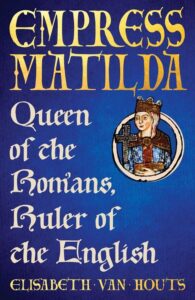
Elisabeth van Houts is a Dutch-born academic, emeritus honorary professor in European medieval history at the University of Cambridge, and the author of Empress Matilda: Queen of the Romans, Ruler of the English from The English Monarchs series, published by Yale University Press.