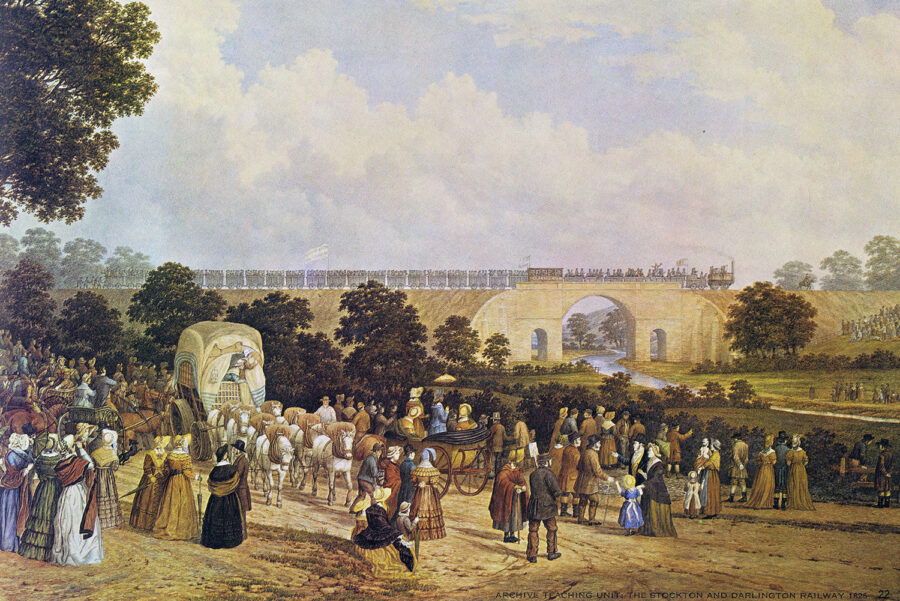
In 2025, the Stockton and Darlington Railway celebrated its 200th anniversary. The bicentenary celebrations were promoted by a multi-disciplinary team from the local authorities, museum partners and other experts, and were a welcome reminder how this innovative system made possible the modern railway. In their own words, the team assumed responsibility ‘for ensuring we all get the story right and how best to tell this unique, transformational story as both a celebration of the past but also as a springboard to the future.’ As they made clear, the Stockton and Darlington changed how the world traded, travelled, and communicated. Television programmes and social media picked up this story, and a series of events stretching over several months brought it home to a wide and inclusive audience. Its organisers deserve every credit for ensuring that social benefits flowed back to the people of the north-east and that the story of what went on locally in the 1820s was fact-based and verifiable, a tribute to the ingenuity and vision of the region then and now.
Their work was made all the more necessary because public perception of the Stockton and Darlington is still to a great extent seen through the lens of the earlier commemorations which took place in 1875, 1925 and 1975. These came with strong corporate messages from its successive operators, the North Eastern Railway, the London and North Eastern Railway and British Rail. Claims about ‘firsts’ appeared in their publicity material, then acquired a life of their own in popular histories and encyclopaedias, children’s educational books, and in cinema and television media, to the extent that it is still difficult to dislodge the widespread conviction that this was, to all intents and purposes, the ‘first railway’. In fact, the total track mileage in the United Kingdom by the time Locomotion No 1 (or Active as it was then named) took to the road in 1825, already ran to many hundreds of miles. Railways were also already being laid in continental Europe and the USA.
Other, apparently more informed, claims which have been made in the past for the Stockton and Darlington also dissolve on inspection. It was far from being the first railway to carry passengers, or to haul them behind a steam locomotive on a regular basis, nor was it the first public railway on which a locomotive operated. Steam haulage on railways in fact dates to the late eighteenth century, experimental locomotive traction to 1804, passenger transport to 1807, and regular operation of trains by locomotive to 1811. Railways under construction in other counties were short-haul industrial systems, admittedly, but plans for national networks were already under discussion in France and Russia, just as merchants and bankers in Baltimore were contemplating a route to connect their east-coast harbour with the Ohio river and the American interior. The Stockton and Darlington’s claim on history is that it brought together a series of incremental technological changes which had taken place over the previous generation, above all the combination of malleable iron rails and locomotive traction. Their success made possible the inter-connected main-line network which began to take shape in England in the 1830s, and influenced the construction of the first significant rail projects in the USA. All these developments reflected growing demand for goods and services, the availability of capital, political support and popular acceptance, and an appreciation that railways were better placed to serve the growing industrial economy than canals or turnpikes.
Technical changes, in other words, are also social processes. Now that 2025 is behind us, we can look forward to the bicentenary of the Liverpool and Manchester and of the Baltimore and Ohio in 2030. A series of informed events focused on community benefit on the lines of 2025 will do much to secure an informed understanding of how the steam railway grew and developed at a remarkable speed in the 1820s and 1830s, to become the defining technology of the Victorian age. The newsworthy ‘firsts’ and the quantum leaps form part of the railway story and deserve to be remembered, but so do the small incremental changes, and the community of engineers, artisans, financiers and sponsors which made them possible.
NB: For railway historical commemorations and their meaning, see Dr Sophie Vohra, Railways and Commemoration (University of York 2020). As Dr Vohra concludes: “Communities remember and misremember, manipulate and change these commemorative narratives as the past becomes both a backdrop and a resource for contemporary needs, obsessions, and fears. Commemorations allow people to claim ownership of the past, both through the transmission of narratives about their history, as well as through whatever physical, ephemeral, and written traces have been left behind.”
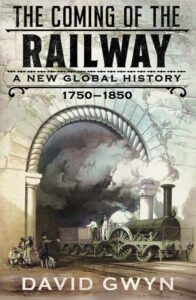
David Gwyn is a historian of the industrial and modern period. He is actively involved in the railway heritage movement, and the author of The Coming of the Railway: A New Global History, 1750-1850, published by Yale University Press.