Philip, welcome to Aspects of History. Congratulations on the upcoming release of Empire’s Witness: A Soldier’s Secret War Diary 1942–45. What were your memories of your grandfather, Corporal Day, prior to beginning this project, and how and why did his “quiet life echo across generations?”
As a little boy, around 4 or 5, I became aware that my grandfather never spoke. Not properly anyway. He just made rough sounds in his throat, as if speech had got stuck in there. In fact, looking back, I don’t remember hearing a single word from him.
As a child I didn’t understand that Parkinson’s had taken hold. I just knew he frightened me slightly. Not because he was cruel. Quite the opposite. He was just distant. Very still and silent. He always sat in the same worn chair in the corner of the room. I can still picture it now. Faded. Tired-looking. His hands trembled slightly. But nobody ever commented on it.
If I’m honest, I mistook the silence for emptiness. I never imagined there was this other life inside him. U-boat infested waters. Africa, India, Iraq, Iran, Palestine and Egypt. Convoys through deserts. Josephine Baker performing in Cairo. None of it seemed remotely possible looking at this old man quietly fading in his chair.
For years afterwards he left almost no trace in my memory at all. There were no stories. No great family memories. Just this distant figure who barely spoke. Then decades later, over tea and my daughter’s wedding plans, my Auntie Kate handed me his wartime diary completely out of the blue. And from the moment I opened it, everything changed.
What qualities in him embodied the “Silent Generation”?
When I read the diary I noticed that even in his prime he remained modest and understated. To brag was simply not done by people of that generation. They rarely saw themselves as remarkable, even after living through remarkable times. They did what was asked of them, came home, went back to work, raised families and carried on quietly.
A lot of them never really explained themselves emotionally. They didn’t sit their children down and tell stories about trauma or heroism. In fact they barely mentioned it at all. My grandfather belonged completely to that world. He carried this enormous hidden history inside him, yet outwardly he was just a quiet Yorkshireman sitting silently in a chair.
Was the family aware of the wartime damage to his lungs and hearing? Often families are not, and perhaps less sympathetic to the soldier. What was your family’s reaction to this?
When he came home, he barely spoke about the war. Not to his wife, or his daughters. When he did mention it, it was just a few words brushing it off. ‘Hot’. ‘Dusty’. That sort of thing. It was only when I pulled his medical records years later that the extent of the damage became clear.
His lungs and his hearing. All of it connected back to the war. But he never gave that away and we never knew to ask. My family’s reaction to the book and exhibition has been emotional. Some of my cousins cried – as I had done when I was writing it. I think what hit us hardest was realising he had this extraordinary story inside him but nobody had really heard it. Nobody had even asked. In a glorious way the book has given him a voice he never really had in life.
Why do you think this incredible diary lay within your family for generations, perhaps without much interest in it?
He gave the diary to his wife Gwen after the war, but by then she had four children, her ageing mother, and a household to run. And the diary itself didn’t read like a war story. It was more like a travelogue. Just fragments, and observations. And without context it didn’t really make sense to anyone. So the diary simply sat quietly in a box for decades waiting for somebody to make sense of it.
What was your reaction when you first saw the diary?
My aunt pulled out this red book and said, “Would this be of interest to you?”
Then I opened it and read the first line: “My journey commences on the 19th of June, 1942, when I stepped aboard HMT Abosso at Liverpool.”
It felt like the beginning of some huge Kipling-style adventure story. Except it was my grandfather. The man I thought I barely knew suddenly came alive on the page. The hairs immediately went up on my arm, and even now, a few years later, it still gives me a shiver thinking about it.
Besides your friend Nancy telling you to “Write it”, what led you to do this?
Honestly, I never intended to write this book at all. I thought I was just creating a small decoder for the family, explaining where my grandfather had been. I realised I was probably the only person in the family who had both the obsession and the background to decode what was actually happening around him. But gradually I realised he wasn’t simply witnessing a war. He was witnessing the beginning of the end of the British Empire.
This book wasn’t driven by any commercial ambition. It was simply something I felt I owed him and owed the family.
How did you go about weaving background history around those events your grandfather experienced?
The research became much bigger than just military history. I wanted to understand the world around him. The smells, the markets, the atmosphere. What did Basra smell like in 1942? What was being sold in the markets of Baghdad in 1943? What languages were being spoken in the streets? What did people wear? What tensions were in the air? Cairo had to feel different from Tehran. Kermanshah had to feel different from Baghdad. I didn’t want the Middle East becoming some generic blur of sand and heat. Every place had its own atmosphere and texture.
To other families who have military ancestry and are hesitant or don’t know how to discover more about them, what would you say?
I’d say it’s not just military families. Any diary or letter matters. It’s important to try to appreciate the story inside the story because not everybody is a natural storyteller. Often the feelings are hidden between the lines. A lot of diaries are simply lists of where somebody went or what happened that day. If you slow down and really sit with them, the human being starts emerging. But most importantly, preserve these narratives. Once they disappear, they’re gone forever.
Given the current world situation, is there anything of interest from his diary on his journey through the Straits of Hormuz and his time in Iran?
Absolutely. You cannot read about the Straits of Hormuz today without realising how strategically important they already were during WWII. When my grandfather travelled through there, the British knew these routes were vital because of oil. When he arrived in Basra, he writes about the smell of oil in the air. You notice very quickly what this whole struggle was partly about. The geography barely changes. The tensions don’t seem to change either.
Do you plan to donate the diary to the IWM or NAM?
Potentially yes. The diary technically belongs to Aunt Kate and another family member, so it isn’t entirely my decision. But we are already in discussions with the REME Museum because my grandfather was among the very first intake when REME formed in October 1942. In his diary he actually marks the date with excitement.
I also want my finished book lodged with museums, archives and libraries because I genuinely believe it has historical value beyond our family.
What is your advice on preserving such documents, medals and letters?
Keep them out of sunlight. Keep them dry. Keep them cool. Store them carefully in airtight boxes if possible.
These things are far more fragile than people realise. Oxidation slowly destroys paper over time. And the more people handle diaries like this, the more damage inevitably occurs. If possible, eventually place them with people who know how to preserve them properly.
And what’s next for you in terms of writing projects?
I’m at a bit of a crossroads to be honest. I’ve started a large historical project involving ancient kingship. But I’m also tempted by another WWII story I’ve discovered, though this one is compressed into only a few days. At the moment I’m waiting to see which story refuses to leave me alone.
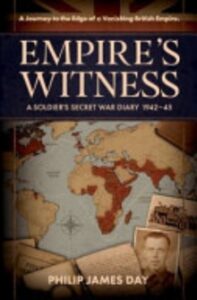
Philip James Day is the author of Empire’s Witness: A Soldier’s Secret War Diary 1942-5, available for preorder now.
Gautam Hazarika is Singapore-based historian of World War 2 and is the author of The Forgotten Indian Prisoners of World War II: Surrender, Loyalty, Betrayal & Hell.