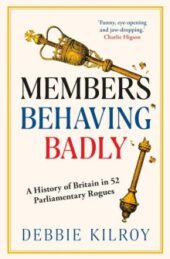

Hello Debbie. Members of Parliament behaving badly is a particularly fruitful topic these days! What was it that led you to write about these historical rogues?
I was researching an academic paper looking at MPs in James I’s first English parliament, to see if you could tell from an MP’s background whether he would be more likely to ‘oppose’ government. And during the research, I kept finding these funny stories. One MP, who was working for the Navy Board, had embezzled more than it cost the government to defend England against the Spanish armadas. Understandably, the Treasury got quite angry about this, but when they started chasing him, he sent them an invoice for £10,000 for expenses incurred. They let the matter drop.
Another time, during the state visit of Christian IV of Denmark, two MPs were so inebriated they fell into the Thames. One was rescued quickly, hoisted out – minus his breeches – with ‘cue and cullions’ on full display. The other took so long to find that the party was beginning to give up hope. Eventually he was spotted holding on to a boat, his hand the only thing visible above the water. Having found himself in no immediate danger, he’d decided to play this practical joke. His name was Hugh Beeston, but from thereon in he became known as Hugh Water-Beeston.
There were so many of these stories, I started jotting them down. It was around the time Partygate happened, and I was watching the news thinking, Crocodile Dundee-style, ‘That’s not a party!’ But it also got me thinking about the relationship between politics and bad behaviour. That was the genesis of the book, which initially focused on the seventeenth century. My publisher asked whether I could extend it, and Members Behaving Badly was born.
In the introduction to Members Behaving Badly you mention that “Hundreds more [MPs] could have been included.” What was it about the stories of these 52 characters that specifically appealed to you?
I had to be harsh in deciding who to include and who to exclude. MPs had to be interesting in and of themselves, and to say something about the times in which they lived: included are representatives of the railway industry and the ‘modern’ press, there are puritans and there is the inventor of the scientific method, among many others. Most of the MPs had particular behaviours in common – they were serial womanisers and involved in financial misconduct –so I often excluded MPs who were guilty of ‘just’ those things. But the main criterium was that their crimes had to be not just shocking today, but in the MPs’ own times.
What are the difficulties of applying modern standards of behaviour to historical characters?
It’s not just fraught with difficulties, it should be considered an impossibility: something that one shouldn’t do. That’s why I was very determined to make sure that as far as reason and logic went, I used the MPs’ contemporary social mores to judge them.
When we judge the past by our own standards, we’re often patting ourselves on the back and saying, ‘Aren’t we so much more enlightened now’. Or we’re doing the opposite and holding up a mirage of a golden age. Garbled versions of history are too often used for political ends, and we need to stay as far away from that as possible. Furthermore, the joy of history is understanding people in the past – working out what made people tick, what inspired them, what scared them. We can’t do that if we’re pushing our own morality on them. It shows a disrespect for the past, and an arrogance, inverted or not, about our own times. As the quote goes, ‘The past is a foreign country: they do things differently there’. Applying modern standards of behaviour to historical characters is like going abroad and only speaking, loudly, in English. It’s tacky, disagreeable, and should be avoided.
Do you have a favourite from this selection of miscreants?
There are many that I like, perhaps a bit too much, because although the MPs were deeply flawed in some respects, most had redeeming features. There are people like Lord Thomas Cochrane. He was a superb sailor; he was a great man to serve under; and he was the inspiration for the likes of the Master and Commander series. But he also considered blowing up Piccadilly to save a friend from arrest; he was very good at gaol breaks, and he did spend time in gaol – he was another one implicated in a financial scandal.
I could go on! In many ways, it would be easier to list those MPs I don’t like, such as James Brudenell, Lord Cardigan. He’s known for the Charge of the Light Brigade, but he was also foul to those serving under him: he was an extreme disciplinarian, putting hundreds into prison and through courts martial; he was cruel to animals; he had a completely irresponsible streak of machismo; and he cheated in a duel – he got off a charge of attempted murder on a technicality. He was reprehensible, and there aren’t many things I can find to like about him.
How did you research all these remarkable stories?
Many of the characters are well known and, indeed, really mattered to the course of history: Lloyd George, Gladstone and Disraeli, George Monck. They were therefore easy to research. I was also lucky that I had been studying seventeenth-century MPs for a long time, so I knew where to turn. For the bits I knew less well, I went to the wonderful resource that is History of Parliament. They are brilliant. They have a huge collection of everything you want to know about parliament up until 1832: biographies on every MP, information on every constituency and election, and information on the business of each parliament. It is an astounding resource, and has taken – is taking – decades to compile. From there, I did the usual: do the reading, follow the footnotes, and find more out as I go along.
In the book you ask: “Does being an awful person mean you can’t be a brilliant politician?” Does it? Does someone’s personal behaviour inevitably colour our public view of them and should it?
These are questions I wanted to put to the readers. As I say in the conclusion, I don’t have a manifesto, I don’t have the answers. My aim is to encourage people to think. Some badly behaved MPs have done very well in politics – for themselves and for their countries. Take Lloyd George: he could be creepy and was another womaniser – he kept a ‘second wife’; he played the stock markets; he sold honours to some very undeserving people. Yet, during the First World War, he was what the country needed. So, one can be a ‘complex’ person, to put it delicately, but still be a good politician – and it’s true vice versa. The last fifty years is littered with ‘good backbenchers’.
If a politician is running the country well, the country is more likely to be forgiving of indiscretions. Bill Clinton, for example, was considered – at least on this side of the Pond – as a ‘cool’ politician who was doing a reasonable job. He played the saxophone; he smoked but didn’t inhale. Because he was competent, and played the game well with his public and his peers, he survived a scandal that a less able or well-liked politician would – or should – fall for. When MPs are brought down, it’s usually because the tide’s turning against them anyway.
In an ideal world, this shouldn’t be the case. But given the caveats I’ve already said, and given that we’re all human, can we expect – or want – anyone to be superhuman? We all know someone so supremely wonderful that we can only manage them in small doses. A holier-than-thou politician would be the same.
You also make the observation that being a career politician is a modern concept. What do you think motivated MPs historically?
Sometimes it was part of a gentleman’s education, like a stint at the inns of court or university. A lot of parliamentary business was private bills: bills on inheritance, or a land dispute, or naturalisation, or divorce. If you had a private bill to pass, being in parliament was useful. MPs also, up until quite recently, used parliament as a means of escaping pursuit for debt. Sometimes, it might be a case of one-upmanship if, for example, there were local feuds. There was a certain kudos in being elected, but it wasn’t the be-all and end-all. It was a means to an end, and that end was something else: gaining power locally, worming one’s way into the good graces of the crown, protecting a monopoly, furthering other business interests, as insurance.
As a public historian, you strive to make history accessible to everyone. What do you feel is the best approach to get people to engage more with history?
I personally engage with history by reading, a lot. But that’s not for everyone: neither of my sons would pick up a history book unless under sufferance. They enjoy more visual or tactile experiences, like visiting historic places, going to museums and exhibitions, or to talks and festivals. Technology has helped as well. There is a brilliant museum in France, in one of the former V2 bases, that uses augmented reality to make the visitor feel as if they were there eighty-plus years ago. These things fire the imagination, and that’s what good public history should do. Regardless of the medium, we all like stories, so popular history should seek to tell true stories that will make people stop and think. The stories should be interesting, they should be engaging, they should make people connect with the past. That’s what I’ve tried to do with Members Behaving Badly.
And what’s next for you? Any other books on the way?
People have asked whether I’m going to bring Members Behaving Badly up to the present day, but I’ve politely declined! As I’ve said, we all have foibles and faults, so digging up old dirt on someone who’s still alive feels cruel. Furthermore, I’m a historian, not a political commentator. I like to have perspective, to see cause and effect, whereas writing about current affairs will inevitably make me subjective. It’s difficult enough being totally objective about the consequences of the Second World War, so I certainly wouldn’t consider straying beyond it: we haven’t seen its full impact yet.
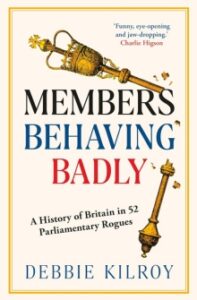
Debbie Kilroy is a writer, historian and the author of Members Behaving Badly: A History of Britain in 52 Parlimentary Rogues.
Nicola Cornick is the author of over 40 novels including the forthcoming The Fourth Queen, published in May 2026.