

Mickey Mayhew, your new book covers the final days of the Romanovs, focusing on their imprisonment in the Alexander Palace. What drove you to dig into these few months specifically?
I have been fascinated by the Romanovs since picking up a biography on Rasputin in 2018; that led to a research trip to Russia and from there the interest blossomed into a passion. My first book on the Russian royal family concerned Alexandra’s relationship with Rasputin – ‘Rasputin and His Russian Queen – although the irony of the title (inspired by the famous Boney M song) went over the heads of your more pedantic historian; yes, I know the correct title is ‘Tsarina’ or ‘Tsaritsa’! But after that was published, well, I still wanted to write more about her; I’m really drawn to Alexandra; I love strong but what some may consider ‘flawed’ women in positions of great power.
The Alexander Palace itself was a secluded spot, around 15 miles south of St Petersburg. What did this residence mean to the family prior to the upheaval of 1917 and did that change when it became a place of imprisonment?
The Alexander Palace was always the primary residence of the last ruling Romanovs, despite the abundance of properties on offer. Alexandra decorated it in the style of a chintzy Victorian cottage, and therein they actually led – if it can be believed – pretty austere lives. The Grand Duchesses, for instance, slept on camp beds and had cold baths and wore hand-me-downs. The family’s attitude to the place didn’t change after it became their prison, although I can’t imagine the sight of so many muddy-booted revolutionaries tramping about the place did much to lift their spirits.
It’s made plain in the book that you admire the way in which Empress Alexandra managed the household in spite in the absence of her husband dealing with the Revolution and WW1. Tell us a bit more about how she adopted this role and ‘wore the trousers’?
Alexandra once telling told an ambassador – possibly the English one, I can’t recall – that ‘…my husband is weak. I am not.’ And that sums her up. She was Queen Victoria’s steely granddaughter. Oh, she was pious and priggish and judgemental, but – as is so often the case – there was also a soft, compassionate heart underneath that unyielding exterior. I think the reference to actually ‘wearing the trousers’ came from a point early on in World War One, when the Tsar had effectively put her in charge of the country whilst he provided morale-boosting support for the troops at the front. She basically said it in one of their many missives in a sort of jokey fashion, but you could tell she meant it and you could also tell that he damn well knew it!
How conscious were the members of the household of what was happening in Petrograd and how much of a mental strain was put on them because of events between February and August 1917?
Often they knew more than the royal family; some of the first whisperings of revolution came from staff members who were in Petrograd at the time and who then made their way back to the Alexander Palace. There are no precise records of what they thought – the lives of the servants weren’t considered terribly important in that regard – but of Alexandra’s friends, such as Anna Vyrubova and Lily Dehn, well, there is considerable testimony and I put as much of it as I could into my latest book.
How much research was there to do concerning the experiences of the staff and domestic workers who were working in the palace?
Again, not a great deal, because the records were so scant. We know the names of the most prominent members of staff but there are countless other nameless, faceless individuals whose stories have for the most part gone unrecorded. The staff at Tsarskoe Selo were as helpful as they could be, but even they admitted that they had – at a certain point – reached pretty much what we call a ‘brick wall’ in regard to these testimonies.
Grigori Rasputin had died only months before in December 1916. Did his shadow loom large over the family dynamics within the imperial residence?
Oh yes, both before and after his death. He had the ear of the Tsarina but the Tsar less so. Alexandra and Nicholas held seances after his death wherein they tried to contact him; they believed he could reach from beyond the grave to help them and to help their haemophilic son. Sadly, revolutionaries found his grave and desecrated it; his body was then taken away and incinerated, but not – as is traditionally said – in a pyre in some secluded, snowy Russian wood. To be honest, his murder pretty much broke Alexandra, but she kept going for her family.
Lenin returns to Russia in the spring of 1917, an attempt by Germany to ‘destabilise’ their enemy around the same time that George V is said to have refused his cousin, the Tsar, refuge. Was it these decisions abroad that sealed the Romanovs’ fate?
Pretty much; if the Romanovs had made it to England they’d have been fine. As it was, Lenin was pretty much determined to do away with them. Had Lenin not returned, and the Provisional Government remained in power then – even with George V’s refusal – the Romanovs would probably have survived. Likely, they’d have seen out their days on their estate in the Crimea.
Talk us through the whereabouts of the Tsar and his family that led up to their execution the next summer?
After being removed from the Alexander Palace they were taken to Tobolsk in Siberia, where they spent a relatively pleasant winter; then, when the Provisional Government fell, revolutionaries managed to get them to Ekaterinburg. From there, the staff was whittled away to just a few extra pairs of hands and then the lot of them were, well, liquidated.
What’s next for you in terms of new projects?
I’m focusing more on true crime – historical – rather than the Romanovs or the Tudors. I feel that certainly where the Tudors are concerned, the primary sources have been gutted like a fish, and the stuff emerging now is really starting to be of poorer quality; you know, ‘The secret life of Anne Boleyn’s toenail clippings’, and all that. Whereas with historical true crime, well, it is a burgeoning field, in comparison. But I plan to return to the Tudors fairly soon, once I’ve travelled to Italy again…
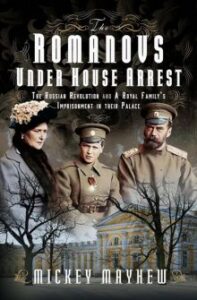
Mickey Mayhew is an historian and the author of The Romanovs Under House Arrest: The Russian Revolution and A Royal Family’s Imprisonment in their Palace.