What first attracted you to the period or periods you work in?
I have always been interested in postwar history, particularly the Cold War-era in my own country, Sweden. It was a dangerous time, marked by pragmatic and secret cooperation with Nato to protect the country. It was also marked by many strange events, some still unexplained: submarine intrusions in our archipelagos, spy affairs, and assassinations.
Can you tell us a little about how you research? Has the process changed over the years?
Like Robert A. Caro, the biographer of Lyndon B. Johnson, I “turn every page”––to exhaust the available material.
The common phrase is that history is written by the victors. Do you think this is true?
Not always. The history of the defunct communist systems, for example, is still––despite everything––written by the losers.
Are there any historians who helped shaped your career? Similarly, can you recommend three history books which budding historians should read?
Andrew Roberts, Niall Ferguson and Peter Englund—three of my role models—have all encouraged me. Timothy Snyder also took an interest when I engaged with his work on the Holocaust. For an emerging historian, such support matters. Three books I would recommend are Timothy Snyder’s Black Earth: The Holocaust as History and Warning and The Swedish Theory of Love: Individualism and Trust in Modern Sweden by Henrik Berggren and Lars Trägårdh for overturning received ideas – and Robert A. Caro’s Working, for how to do the craft properly.
If you could meet any figure from history, who would it be and why? Also, if you could witness any event throughout history, what would it be?
I have already met my first choice: Margaret Thatcher, one of the most consequential figures of postwar history. I would witness the still-unsolved assassination of Sweden’s prime minister Olof Palm, on a cold night in February 1986––and see what really happened.
If you could add any period or subject to the history curriculum, what would it be?
More nuanced accounts of national histories are still lacking––almost everywhere.
If you could give a piece of advice to your younger self, either as a student or when you first started out as a writer, what would it be?
Keep writing.
Can you tell us a little bit about the project you are currently working on?
I’m launching The Stay Behinds: Sweden’s Cold War Guardians this September. My next nonfiction project is a biography of Olof Palme as a security thinker, titled The Realist.
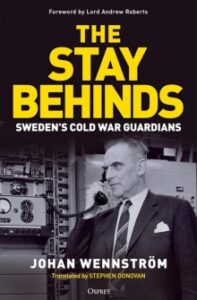
Dr. Johan Wennström is a research fellow at the Swedish Defence University and author of the forthcoming book The Stay Behinds: Sweden’s Cold War Guardians (Osprey/Bloomsbury 2026).