
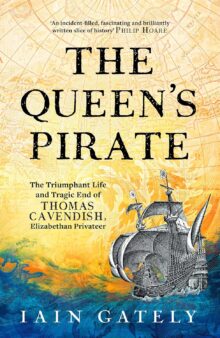
Elizabethan England was hardly short of colourful characters, particularly when it came to those who took to the high seas in search of adventure, glory and, perhaps most importantly, other people’s money. Francis Drake and Walter Raleigh have long dominated the popular imagination, but what of Thomas Cavendish, a man whose exploits were every bit as extraordinary, yet whose name has largely slipped beneath the historical waves?
In The Queen’s Pirate, Iain Gately sets out to restore Cavendish to a more prominent place among the great Elizabethan adventurers. It is a compelling proposition, not least because Cavendish’s story possesses all the ingredients of a historical thriller: fabulous riches, breath-taking ambition, betrayal, disaster and an ending worthy of the darkest Shakespearian tragedy.
Born into the world of Elizabethan enterprise, Cavendish belonged to a generation for whom the oceans represented both opportunity and danger. England’s rivalry with Catholic Spain provided ample justification for activities that, stripped of their patriotic trappings, amounted to piracy. The distinction between a heroic privateer and a common thief was frequently little more than a royal blessing; on that note, it is worth mentioning that his sister Anne was a maid of honour to Elizabeth I.
Cavendish’s greatest achievement came in 1588, when he completed a remarkably swift circumnavigation of the globe. Therein, he captured the Spanish treasure galleon Santa Ana, securing an astonishing fortune. Returning to England aboard his ship Desire, he was able to celebrate his triumph in suitably extravagant fashion, even entertaining the Queen herself. But his triumph proved fleeting. In 1591, Cavendish embarked upon another expedition, hoping to repeat his earlier success. Instead, the voyage became a nightmare of disease, discontent and mounting catastrophe. By the time the battered Desire limped into an Irish harbour in 1593, only 16 men remained alive. Cavendish himself had perished somewhere in the South Atlantic, aged just 31. The contrast between the two voyages gives the biography its dramatic centre. Here was a man who had seemingly conquered the world, only to discover how swiftly fortune could slap him about the face.
But Cavendish’s story also raises questions extending far beyond one man’s extraordinary career. The Elizabethan seafarers helped establish patterns of commerce, exploitation and imperial ambition whose consequences still resonate. Their adventures were celebrated as patriotic achievements, even when their methods were considerably less honourable. There is also the question of historical reputation, of why some figures become household names while others, equally remarkable, fade into obscurity. Gately’s determination to recover Cavendish offers an opportunity to reconsider the mythology surrounding England’s maritime golden age.
Ultimately, The Queen’s Pirate promises something more substantial than a straightforward tale of swashbuckling adventure. It places an overlooked Elizabethan within the wider, frequently uncomfortable history of England’s emergence as a maritime power. Cavendish’s rise and fall provide a reminder that the men who helped shape an empire were often driven as much by personal ambition as by patriotic duty.
And often, the sea had the final word.

Mickey Mayhew is an historian and the author of The Anne Boleyn Bible; his most recent work concerns Catherine of Aragon and is due to be released by Sharpe Books in November 2026