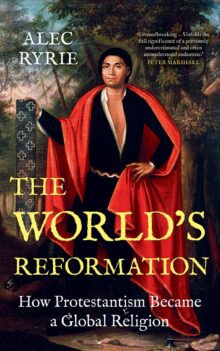
In a secular age, religious history can feel slightly tangential and recondite, particularly when set against the commercial and colonial designs of fledgling empires in the early modern age. Very well, except that is missing the point. Reformation Europe remains a field that is rife with opportunity to understand the present, far beyond theology. Expand that further to include an understanding of how Protestantism began to spread across the continents and you end up with as ambitious and readable an account as Alec Ryrie’s The World’s Reformation, which dismantles that more familiar, Jesuit-dominated image of a mission by revealing the jumbled and perhaps overlooked Protestant attempts to convert the world.
A globe-trotting, era-jumping record of mission history, the reader is taken from South America to Taiwan within the space of a paragraph, from Luther’s antisemitic writings to the American Revolutionary War at the turn of a page. Ryrie outlines how Protestant missionary efforts were not inevitable or unified, that expansion should be reframed as part of the Reformation itself rather than a later by-product of empire. As with the fractious state of play across Europe, Protestants would often disagree among themselves over the need for global conversion. Papist competition continues to act as both an inspiration and an anxiety, and Protestant structural disadvantage is demonstrated in light of their Catholic counterpart’s well-oiled religious orders.
Conscientious at all times in his own defined mission, namely to not stray toward moralising verdicts, the Professor of the History of Christianity at Durham University is neither demanding of, nor sympathetic, towards his subjects. Instead, he remains unprejudiced in discussing their ‘templates’ of conversion and the successes and misunderstandings that arise, specifically the tension between persuasion and coercion, and delusions of the ‘civilising’ approaches for indigenous peoples, including, fascinatingly, those closer to home within Europe like the Sámi of Lapland and the Celtic peoples in Britain. The nuanced narrative takes an even-handed and up-front outlook when tackling the topic of slavery and the countless missionaries who operated within imperial systems, whether complicit, critical or conflicted, the aim always to assess the actors from what can be observed in the source material without descending into identification of heroes or villains.
Straddling that intersection of topics such as imperialism and slavery that have come to the forefront of the historical agenda today, The World’s Reformation is as frank in its approach as it is important to understanding the transition that came after the late 18th century in terms of American independence, abolition and missionary movements that followed within more formalised colonial structures. This is Protestant missionary history presented not as an exultant march of conversion, but as a sometimes ragged, occasionally untidy, and imperfect effort to engage with a growing global community – one that often altered the missionaries themselves as much as the societies they tried to convert.
Zeb Baker-Smith is a Classics teacher based in Malawi, a freelance journalist and Editor at Aspects of History.
You can listen to a full conversation between Alec and Zeb here via the Aspects of History podcast feed.