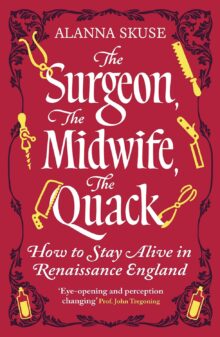
Renaissance medicine isn’t quite my strong point.
Fortunate I was, then, to have this book to take me by the metaphorical hand and guide me into a world far removed from the heart murmurs of Alexandra Feodorovna or the particulars of Nicholas II’s piles (leeches were apparently considered quite beneficial in this regard, in Renaissance England). This book dives in at a period of history when the sort of quackery highlighted in the title was fast being replaced by a more rigorous – but occasionally still eye-watering – approach to the curing of the various of humankind’s woes. That said, Skuse manages to pay considerable attention to the familiar travails of Henry VIII and his ulcerated leg, with particular reference to the careers of Thomas Linacre and also Thomas Vicary; the work also takes a little time to note quite what the tempestuous Tudor tyrant’s break with Rome did for the health of his hapless subjects.
The 300 or so pages are peppered with various contemporary illustrations, not to mention a nice little dramatis personae, although those hoping for a book almost entirely concerned with the 16th century and its various Tudor travails are going to be somewhat disappointed; most of the players in this particular medical drama all hail from somewhere around the end of that particular epoch, with Skuse taking around 1580 or so as her rough starting point (Linacre and Vicary aside). Of all the chapters, No.7 – ‘Those they called quacks: unauthorised healers’ – was a precise favourite, although even that particular piece left me a little uncomfortable at times; one wonders if, in say several hundred years’ time, readers will be sniggering away at the content of their holographic iPads as they read accounts of how futilely people fought against the scourge of cancer in the 21st- century, using treatments that made people’s hair fall out and turned them almost into living cadavers. I say this simply because Skuse does inject a certain amount of wry humour into her work, which led the serious side of me to start somewhat, this whilst the irreverent aspect of my nature was applauding it all the way. Meanwhile, it’s also something of a comfort to know that – some several hundred years on – the same sort of shame and stigma still surrounds a wide variety of sexually transmitted diseases. Whether childbirth is concerned, meanwhile, one can only cringe and turn the page with sweaty fingers as one reads of the dreaded ‘crochet’ and – thankfully – the innovation of what we now think of as the forceps.
At the end of the work, Skuse is ready to remind the reader that the most pioneering breakthroughs were those which were accomplished by the men and women ballsy enough to take risks; and of course, those innovations would have been worthless without the consent – and, often, the agonising need – of the patients on whom their experimentations were performed.
Enjoyable.
Mickey Mayhew is an historian and the author of The Anne Boleyn Bible.