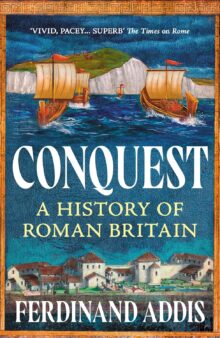
There is a lot that has been said, written and mulled over when it comes to Roman Britain, and, consequently, a reader glimpsing Ferdinand Addis’ Conquest on the shelves might be forgiven for thinking it another interpretation of those well-trodden stories and a landmass that has been dug up more than any other imperial province. Except that reader would be wrong. There is ambition from the contents pages – a challenging story retold through physical features, scenery, landscape, as much about what came before and after Rome as it is about headliners like Caesar, Claudius and Boudicca and those familiar dates of landings and invasion.
Addis’ work offers vast chronological sweep, ranging from prehistoric Britain to the current legacy of Rome which we as Britons today might be prone to overlook, and he steers clear of unambiguous military history. Early efforts at diplomacy, burgeoning trade, constant patterns of migration across the Channel and persistent cultural exchange are stationed plausibly in the vicinity of warfare. His titular theme is always framed as a process rather than a moment in time, interwoven intelligibly with the aid of literary sources and recent discoveries courtesy of advances in ancient DNA analysis.
For a self-confessed ‘creature of the library’, the author has a sublime, Macfarlane-esque touch when it comes to the recreation of the milieu and environment, the rivers, forests, coastlines in his chapter ‘Earth’ becoming characters in themselves. The old stereotypes of Iron Age Britain are pulled apart, the uncivilised tribal societies living in isolation one might naturally fall back on are, in actuality, connected communities to whom Rome had reached out too and influenced long before Claudius’ invasion. The wider point of conqueror-versus-conquered narrative and its permanence is addressed. Of course, martial capability is a prime focus, but Conquest is at its best when it is determining that Roman imperialism also hinged upon negotiation, collaboration and commerce.
Literary sources on the province may be relatively scarce, but the insight and authority provided on the agendas at play and the Roman world into which Caesar and Tacitus were circulating their testimony from the campaigns concerning Britannia is valuable and never arduous. Addis’ Roman Britain is conceived as a portion of the empire in its totality, never simply a stand-alone part or an obscure backwater. Happenings across vast expanses of Roman territory across continents and regions are skilfully related to figures and feats, like Agricola and his efforts to push the frontier of imperial dominance further north before being rolled back as the realities of occupation of the entire island dwindled.
Conquest exemplifies the kind of history we all ought to aspire to, an accessible, dextrous type which insists that there is research being done and scholarship being published to prompt a rethink about Roman Britain. The final pages afford a would-be reader the opportunity to reimagine the landscape Caesar stepped onto the coast near Deal, the still-lived consequences of Claudius’ invasion, and questions concerning a national identity shaped by both occupier and occupied over the last two millennia.

Zeb Baker-Smith is a Classics teacher based in Malawi, a freelance journalist and Editor at Aspects of History.