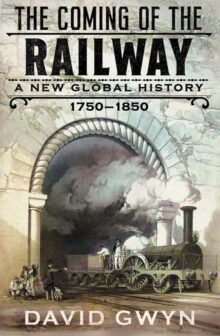
When Britain’s history is told, the railway is usually suddenly introduced in the early to mid-19th century. Yet long before this, it was quietly developing, shaping the future of transport. This early period of rail development is the subject of David Gwyn’s latest book,The Coming of the Railway: A New Global History, 1750-1850.
Gwyn guides readers through the early evolution of rail technology with chapters devoted to the transition from wooden to iron rails and the development of the locomotive engine. He also explores how these vast projects were funded and traces the contributions of the period’s great engineers, including George and Robert Stephenson, Richard Trevithick, and Timothy Hackworth. But it was not the minds of these men alone that put Britain at the forefront of railway innovation. It was also due to a number of structural factors outlined by Gwyn, such as political stability, an effective banking system, firm patent laws, wealth from colonial trade, and vast supplies of coal needing transport to waterways.
As Gwyn’s title suggests, the book’s scope is much broader than Britain. The reader is taken to Eastern Europe, a land of reactionary rulers uneasy about railways. The Austrian Chancellor, Klemens Metternich, initially condemned them as ‘the extravagances of a morbid age’, and Nicholas I of Russia feared they would lead to his subjects ‘entertaining dangerously progressive notions’. But both leaders dismissed their fears after understanding the political and commercial advantages that railways could bring to their empires. Yet in Western Europe, its rulers were more active rail promoters. The Napoleonic Wars delayed its arrival, but by the 1830s, the kings of the Netherlands and France gave their full support to rail expansion, as they ‘identified with the commercial interests of their subjects’.
The greatest event in Gwyn’s book is undoubtedly the opening of the Liverpool to Manchester Railway, the first intercity railway and the first to rely solely on steam power to transport passengers and goods. Gwyn captures the public excitement the project brought, as over 10,000 spectators arrived in 1829 to watch the country’s leading engineers audition their latest designs. He also shows how its opening on 15th September 1830 attracted interest from across the continent, bringing together ‘a gathering of European nobility such as had not been assembled since the Congress of Vienna’. Chief amongst its guests was the Duke of Wellington, the then prime minister, there to ‘give a Tory endorsement to a whiggish and philosophical enterprise, and a soldier’s salute to a trade venture and capital speculation’. It was just a shame that the day was ruined when the ‘physically clumsy’ Liverpool MP, William Huskisson, was struck and killed by a moving carriage.
Gwyn’s early history is an authoritative guide to the railways before 1850 and provides a great background on how they developed into key pillars of modern transport. It is also filled with useful images, diagrams, and maps and is completed with an extensive bibliography for readers wanting to learn more about the subject.
Michael Mccomb is an Editorial Intern at Aspects of History.