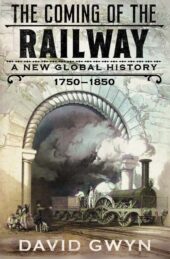

Welcome to Aspects of History, David. Could you provide our readers with an outline of your latest book, The Coming of the Railway: A New Global History 1750-1850?
The book sets out to trace the transformation of a mechanical handling system into the main overland transport technology of the 19th century. Until 1750, railways were made of wooden components, were powered by human or animal muscle, and carried minerals over a short distance, as they had done for hundreds of years. By 1850, railways were long-haul systems crossing national borders, using iron rails and mechanical traction, carrying a wide variety of goods as well as passengers.
You’ve commented that “there has been no attempt [previously] to write a global history of the early iron railway”. Why has this period been so neglected by railways historians?
Knowledge of early railways within and beyond the United Kingdom has been greatly augmented by a series of dedicated conferences held since 1996 at which experts have presented papers; so the knowledge base was already there when I began to put the book together. Furthermore, the availability of early technical journals and full-length books online has greatly helped research. It is now possible to read German, French, Russian and Swedish sources for the coming of the railway without leaving the study.
Could you tell us about early railway developments in Britain: the German miners using rail in Cumberland, and the railways built by entrepreneur Huntingdon Beaumont?
Knowledge of railways certainly reached England in the mid-sixteenth century, and archaeological survivals in a Cumberland copper mine confirm a hand-propelled ‘hund’ system (one which operates with a guide-pin between the rails) such as were already widespread in continental Europe. Sadly, we know little of the form that Huntingdon Beaumont’s coal-carrying railways (1604 onwards) took, but we know that one operated from Strelley to Wollaton in Nottinghamshire in 1604 and another at Blyth in Northumberland a year or two later. Railways were at work in the Shropshire coalfield by 1606; we are only aware of them because of law-suits, and it is quite possible that others were at work of which we know nothing where there was no need for litigation.
Can you explain why Britain was so far ahead of other European countries in rail development during the 18th century?
The need to move coal to navigable water drove technology but Britain also benefitted from a stable political order and the availability of capital during the 18th century.
You suggest that the transition from wooden to iron rails was the most important development of this period. Why was this more important than other key improvements to rail, like the development of the locomotive engine?
Although locomotives can be made to run on wooden rails, systems such as these are only possible for short distances and low speeds. The iron rail was crucial to further development. The great achievement of the period 1814 to 1825 was synthesising track and traction – but the track was the most important development, as horses and fixed engines could also operate trains.
Could you explain the impact that the French Revolutionary and Napoleonic Wars had on British railways?
The wars called for iron and for coal to smelt it. New industrial areas like South Wales developed to meet this demand, and themselves required rail systems in ironworks, collieries and limestone quarries, and to connect them with navigable water. The price of iron came down, the price of wood and horses went up. Though canals and turnpikes were effective, the long-term answer to the problem of transport was iron railways and, ultimately, steam power.
George Stephenson and his son, Robert, are key figures throughout your book. Could you tell us who they were and why they were so important?
Father and son had a difficult relationship, but both were able and charismatic men. Heirs the innovative engineering traditions of the north-east coal-field, they benefitted from a regional culture which recognised raw talent and which saw in them the possibility of taking this evolving transport system to the next level. The reconceptualisation and reconfiguration of locomotive design which Robert carried out in the late 1820s made possible the innovative Rocket type, the ancestor of all following steam locomotives, and a significant advance on the first generation designs of Trevithick, Hedley and his father.
You occasionally touch upon the politics surrounding the railways in Britain. To what degree did the governments of this period encourage their development?
Governments all over the world mostly welcomed the new railways and passed legislation which made them possible, but the most proactive was Belgium, which saw that railways could offer nation-building and trading benefits to this newly-formed kingdom.
Much of your previous work has been focused on Wales. How have you found the challenge of writing more broadly about railways across the world?
Similar social processes were operating throughout the United Kingdom and beyond – the same combination of growing demand, artisanal skill, technical progress, entrepreneurial capital and aristocratic encouragement shaped South Wales just as it did the north-east coalfield in England. These two areas were both home to many hundreds of miles of track by the time the Stockton and Darlington opened in 1825.
Could you tell us what you are currently working on?
Current plans include a world-history of the slate industry and also some book-length meditations on the industrial revolution – then, who knows? Maybe The Railway in the Age of Steam, 1830-1950, to take the story forward from the opening of the Liverpool and Manchester to the time when war-battered and exhausted systems began to adopt diesel and electric traction and to examine different ways of moving people and goods – whilst retaining many of the elements that George and Robert Stephenson had put in place in the 1820s.
David Gwyn is an historian of the industrial and modern period. He is actively involved in the railway heritage movement, and the author of The Coming of the Railway: A New Global History, 1750-1850, published by Yale University Press.
Michael Mccomb is an Editorial Intern at Aspects of History.