
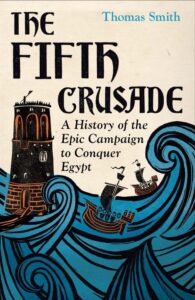
For those who say that lessons cannot be learned from historical experience, my advice would be to study in some considerable detail Thomas Smith’s The Fifth Crusade. For some of us who studied medieval Europe many decades ago, and are familiar with the activities of Pope Innocent III, Emperor Frederick II and the more famous crusades, this fascinating and detailed assessment is very revealing.
Thomas Smith has researched new sources of data, which are very transformative for how we might approach and understand the Fifth Crusade. His sources range from Oliver of Cologne to delightful references to Dunstable Priory. Oliver of Cologne was a clergyman who became a critical participant in how this campaign was waged – he even designed a special attack vessel for an assault on a Moslem defensive position in the River Nile – but he has now become important as a detailed source of everyday information about the campaign because of his detailed notetaking and his correspondence with papacy and Germany. The delight of the Dunstable references are because Smith reveals that the purposefully engaged scholar can unearth remarkable relevant information in the most unlikely and remote locations, in this case the fact that the Priory was actively responding to papal requests for funding to support this Crusade.
The specific purpose of the Crusade is revealed: the idea was that if the crusading force could capture Egypt, that this would give them a strong foundation for a sustained campaign in Palestine. The reasoning was that the Nile estuary and delta was an extremely fertile region and control of this would give them the resilience for a sustained campaign to the north. The early stages when they captured Damietta at the mouth of the River Nile was successful but the overall intention of capturing Cairo, and substantially taking political control of Egypt, floundered.
There were various reasons for this. By this stage in crusading history the available troops arrived and departed on a seasonal basis, rather than being available for a sustained period of time, and that introduced uncertainty into how the campaign should proceed. The fact that the campaign was, in effect, comprised of a coalition of political and religious leaders meant that there were difficulties in agreeing tactical priorities: some just favoured holding Damietta and strengthening their position there, whilst others were ambitious to proceed to Cairo. There were rivalries because King John of Jerusalem, although he seemed secure within his own state, felt insecure in relation to some of the European leaders who had more political and military experience. The dispute between Frederick II and successive popes over his coronation as Holy Roman Emperor, which had implications for the governance of Sicily, meant that his arrival was long expected but did not occur. On top of this the inadequate understanding of the seasonal variations of River Nile folding possibilities meant that their eventual attempt to proceed to Cairo floundered almost immediately because their delay meant that they basically encountered the worst of flooding, leading them to retreat and the abandonment of the campaign.
This analysis is extremely well presented and is a case study in how difficulties will occur where collaboration, distant management with mixed messages, uncertain funding and lack of care in understanding the geomorphological conditions of a campaign area may affect an outcome. It could almost be a guide to modern-day challenges in the Near East! This assessment is supported by excellent diagrams which really did add to my understanding of this excellent interpretation.
Trevor James was the editor of The Historian from 2006 to 2019 and is the author of Patterns in Local History; Five Case Studies.