Back in the (late) 1980s when I was at university, it was the period leading up to and following AD 410 that most filled me with trepidation. Almost nothing in the way of contemporary written sources, combined with archaeological findings that were only really just beginning to shed more light on an otherwise darkened room.
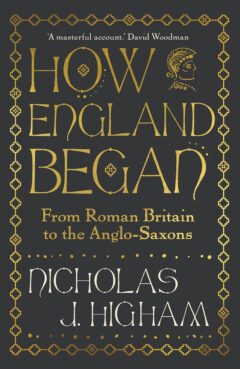
Had I been able to reference Nicholas Higham’s How England Began, the task would have been – whilst not easy – certainly much more approachable. Like Alfred having a marked, safe path through the Athelney marshlands.
Right from the beginning, the author sets out his stall with great clarity: that rather than a rewrite of his earlier work, it is a fresh look – newly informed by a generation’s worth of historical, archaeological and scientific developments. That is not to say that Higham’s views have significantly changed in that time, rather they have become more nuanced, sophisticated and informed.
Too often in the past, historians looked for historical ‘facts’ that they could cling to, on which they could then hang their complex theories. Just like someone sinking in quicksand will grasp at any branch in reach, only for them to find, a bit further down the line, that their lifeline is not securely anchored.
Higham’s work steers us away from such one-dimensional approaches, focussing on exploiting multiple sources of information, without necessarily giving one more priority or credence over another. What we are left with is a detailed, yet accessible analysis of the years from the late 4th century to the 6th century.
It is an analysis that argues for a gradual evolution over a number of generations, starting with the arrival of ‘barbarian’ foederati imported by the Romans to defend Britain’s coastal regions, a policy which continued into the mid-5th century under the ‘proud tyrant’ Vortigern. If nothing else, this suggests a still-functioning Roman-style hierarchy two generations after the last Roman soldiers had departed these shores.
That there would have been conflict between the incomers and the indigenes cannot be denied, but not on a scale previously thought and certainly nothing that could suggest genocide or wholesale replacement. Instead, Higham argues for ethnocide in the sense that the incomers, though relatively small in number, became the dominant culture in the south and eastern regions with the locals, over time, either integrating, leaving or – more tantalisingly – becoming almost invisible in the archaeological record (as a subclass of natives whose role was to feed the warrior farmer ‘elite’).
All of which is delivered in Higham’s erudite, confident and – above all – clear prose. Well-researched and intensely detailed as it may be, I never once felt like it was heavy going. Yes, I am an enthusiast of this period, predisposed to look favourably on any new account, but I would have no hesitation in recommending this book to anyone with an interest in things historical. That said, for those who wish to lose themselves in the broad depth of work that has gone into this tome, you have almost 100 pages of notes and bibliography to play with. What’s not to like?

Paul Bernardi is the author of The Reckoning, the last volume in the Rebellion Trilogy, published by Sharpe Books.