
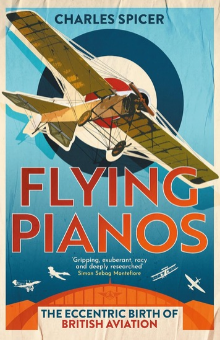
The story of early aviation is one of extraordinary ambition, extraordinary personalities and, at times, extraordinary foolishness. In Flying Pianos, Charles Spicer charts the remarkable development of flight from the pioneering work of the Wright brothers through to the emergence of military aviation during the First World War and the years following. It is a story of technological progress, rivalry, courage, and perhaps most surprisingly (well, to me at least), institutional reluctance to recognise what the aeroplane might ultimately achieve militarily.
When the Wright brothers made their historic flights, powered aviation (or “heavier than air flight”) was very much in its infancy. Spicer shows that, in the years that followed, France quickly established itself as the centre of the developing aviation world, attracting inventors, engineers and daredevil aviators. Figures such as Louis Blériot, Charles Rolls (of Rolls-Royce fame, who died way too young), Claude Grahame-White and the remarkable Harriet Quimby feature prominently, illustrating how early flying was as much a sporting and publicity spectacle as it was serious technological endeavour.
That distinction is important to Spicer’s story. For many years, flying was regarded as something of a novelty – an exhilarating but dangerous pastime for wealthy adventurers and sporting personalities. Even within military circles, there was considerable scepticism about the usefulness of aircraft. It is remarkable, with the benefit of hindsight, to see just how long some senior officers remained unconvinced that the aeroplane would have a significant role to play in future warfare. The outbreak of the First World War changed everything.
Almost overnight aviation ceased to be merely a sporting spectacle and became a military necessity. Aircraft design, engines, armament and production methods developed at a breath-taking pace, while the men who had once flown for sport increasingly found themselves flying for their countries. Spicer brings to life the pilots of the RFC and RNAS, including many of the men who would become celebrated aces, while explaining how their experiences helped shape the future of military aviation.
The book also examines the Zeppelin raids on Britain and the gradual realisation that with the advent of powered flight, the horrors of war would now extend far beyond the battlefield. The formation of the Royal Air Force, under Hugh Trenchard, represents another important stage in this evolution, as the lessons of war began to influence how air power would be organised and employed in the futures.
What makes the book a particularly enjoyable read is the balance between the technology and the people behind it. Spicer clearly understands that the story of early aviation is not simply one of machines – it is a story of personalities, rivalries, ambition and remarkable courage. The amazing and in-depth research is evident throughout, yet the book remains accessible and easy to read.
Ultimately, Flying Pianos is a fascinating account of one of the most rapid technological transformations in history. In little more than thirty years, humanity progressed from the Wright brothers’ fragile aircraft to an aviation industry capable of producing thousands of sophisticated military machines. Spicer captures that extraordinary journey while reminding us that technological revolutions are not always immediately recognised by those who are living through them.
For anyone interested in the pioneers of aviation, the development of air power, the First World War in the air, or just looking for an enjoyable and informative read, then you can’t go wrong with Flying Pianos. Highly recommended.
John McKay is a novelist and the author of several novels set around and during the Second World War.