
55BC, as Sellar and Yeatman knew, is “the first date in English history”. Caesar led his legions across the sea and gave the Britons a thrashing. This, of course, was “a Good Thing, since the Britons were only natives at that time.”
Caesar could hardly have put it any better himself. Indeed, this almost is how he put it himself. It is from Caesar, ultimately, that we have our abiding image of Britons as woad-covered savages. The Britons, as described in Caesar’s Commentarii de Bello Gallico, grow long moustaches, live on meat and milk and dress in animal skins. They even share their wives! What could be more alarming than this, for respectable Romans, these blue-painted swingers in their barbarous polycule?
Modern Britons have long been accustomed to accept what Caesar tells us about our distant predecessors. Caesar’s account is the only one we have. And Caesar is such a confident and vigorous protagonist (and writes such good crisp Latin). The superstar Caesar dazzles. We are blinded by his afterglow.
Still, if we squint a little, we can make out some of the human debris that floats in Caesar’s orbit as he streaks across the firmament. And it is there, in a few peripheral flashes of Caesar’s narrative, that we find one of the most mysterious and compelling figures from that opening chapter of Britain’s history: the man known as Commius the Atrebatan.
When we first meet Commius, he is already a king, albeit of a rather curious kind. He is ruler, Caesar tells us, of a people known as the Atrebates – one of the “Belgic” tribes that occupied the coastal plain of Northern Gaul. But if he rules the warlike Atrebates, he does so because Caesar put him there, installing him as a sort of Gaulish Quisling.
In Caesar’s telling of the story, Caesar is the only active principle. Commius is passive, plucked from obscurity by Caesar to be raised above his countrymen. He is a man Caesar can bend to his will – a man who will be loyal to Rome.
Caesar is always slow to acknowledge the agency of those around him and that goes double for barbarians. But we can guess, perhaps, at the kind of exertions by which Commius brought himself to Caesar’s notice. The Atrebates, after all, were a defeated tribe, beaten by Caesar at the Battle of the River Sabis in 57 BC. Where was Commius when the lords and chieftains of the Belgae gathered to oppose the Romans? The answer, probably, is that he was already in the Roman camp, a Gaulish soldier in Caesar’s service.
This is the thing that’s easiest to forget about Caesar’s wars, and the Gauls and Britons who fought against him. When we remember the Britons as an undifferentiated mass of blue barbarians we miss the infinite complications of identity that divided them. Where we see peoples, we ought to try instead to see people – each person with his or her own set of hopes and fears. Who knows what slights Commius had suffered from which neighbours, what thwarted ambitions caused him to take his fate into his hands? All we know is that where the established powers among the Belgae saw Caesar as a threat, Commius saw opportunity.
Caesar conquered Gaul with Gauls. His legions, marching north and west, were screened by Gaulish cavalry. Gaulish kings rode in his entourage. Again and again he proved the ancient principle that a distant enemy is often preferable to a hated neighbour – the same principle that gave Philip of Macedon victory over the Greeks and led Cortés into Tenochtitlan.
No surprise then that he tried the same trick against the Britons. The first of Caesar’s agents to make landfall in Britain was Commius the Atrebatan, Caesar’s tame Gaul, sent ahead of the invasion fleet to suborn British kings.
The mission was not a success. Commius was seized as soon as he put ashore. And Caesar, approaching the White Cliffs of Dover, found an army of hostile Britons waiting for him. Caesar’s part of the ensuing drama is familiar: battle on the beach; the aquilifer of the tenth legion throwing himself into the surf – one giant leap for Romankind. Poor old Commius is left to sink or swim offstage.
But Commius was a survivor. By some combination of threats and promises, he persuaded his captors to keep him alive. And once Caesar had forced his way bloodily ashore, the Britons released Commius as a human peace offering. Who better than this half-Roman Gaul to serve as a go-between? This was a service he performed again and again. When Caesar returned to Britain in 54 BC it was Commius who brokered the final peace deal.
Commius had been created by Caesar – so Caesar thought – but he wasn’t Caesar’s man through and through. He had his own pride and his own ambitions, and they were beginning to show. The winter after Caesar’s second British expedition the Gauls began to stir in revolt, and though we don’t know if Commius joined them it certainly looked as though he might. The former mercenary was now a great lord, ruling over the Atrebates and the Morini of the Channel coast. Caesar’s legate in the area, fearing treachery, sent an officer named Gaius Volusenus to neutralise him. Volusenus called Commius to a diplomatic meeting; grasped the Gaul by the hand, friendly as can be. But when Commius tried to withdraw his arm he saw, from the corner of his eye, a centurion raising his sword for the fatal blow.
Commius had been Rome’s tool. Now Rome tried to discard him. But the Romans found that their tame Gaul had powers of his own – most importantly the power to inspire loyalty. Commius’s sworn men, when they saw their lord in trouble, rushed in and dragged him out from under the assassin’s blade.
Would Commius have turned against Rome without this bit of Roman treachery? He certainly turned now. When the Gaulish leader Vercingetorix was encircled by Caesar’s legions at Alesia, it was Commius who led the force that tried to relieve the beleaguered rebel, hurling his men against the Roman siege works.
Even after Vercingetorix was taken, Commius and his followers carried on the rebellion, living rough on supplies plundered from Roman caravans. Sent against him was his former assassin Gaius Volusenus, with a cavalry force. Commius and his riders were harried through the forests. But the fox still had his teeth. When he saw Volusenus coming for him, Commius wheeled his horse and charged back at his pursuer to drive his spear through the Roman’s thigh.
The debt of honour had been repaid. And that, apparently, was enough for Commius’s pride. While the treacherous Volusenus hovered between life and death, Commius sent a messenger to seek terms. He would live quietly wherever he was told, he said, so long as he never had to meet another Roman.
That’s the end of Commius’s story, so far as Caesar’s Commentarii are concerned. But we may be able to follow him a little further. A few years after the suppression of the revolt in Gaul, coins with the inscription “COMMIOS” start showing up in southern Britain.
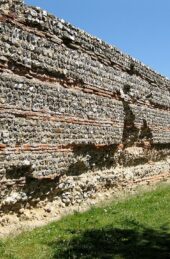
A coincidence, perhaps, but it’s not the only one. In Gaul, Commius had been king of the Atrebates. And the part of Britain where the COMMIOS coins start showing up was later described as belonging to a tribe of that very same name whose capital, Calleva Atrebatum, stands out among Late Iron Age population centres for its early and extensive Romanisation.
Many historians have found it both tempting and plausible to guess that the Commius of Caesar’s campaigns and the COMMIOS of the British coins are one and the same man. Did he arrive in Britain as a fugitive? This has been the most common supposition, but as John Creighton pointed out twenty years ago, it runs counter to what we know from the Commentarii de Bello Gallico. Just as likely, Creighton argued, he came to Britain because Rome put him there.
So ended, perhaps, one of the strangest careers recorded in ancient history, the mercenary turncoat who went from king to rebel to fugitive and back to king, who fought for Caesar and against him, and lived to tell the tale. One can’t help but admire him, a little, ruthless and bloody though he may have been. He was caught up in a maelstrom of macro-historical currents that overwhelmed whole peoples, left a million Gauls dead or enslaved, transformed the Roman Republic into an empire and initiated a new chapter – the first chapter, per Sellar and Yeatman – of British history. It was sink or swim in those days, and against all odds Commius somehow swam, keeping his head above the raging waters. We should all hope to do as well as he, in these interesting times.
But perhaps not quite so well. Commius’s story has a last posthumous twist. Kings in southern Britain liked to claim on their coins that they were “Comi F.” – sons of Commius. And on later coins, there are signs of a dynastic ancestor cult. Just like his old master, Caesar, Commius, on his death, appears to have been promoted one last time: from ruler to god.

Ferdinand Addis is a journalist, historian and the author of Conquest: A History of Roman Britain, published by Head of Zeus.