
In August 1944, a special forces unit, including five men from the SAS, dropped into the Vosges mountains to harass German forces as they retreated through eastern France.
They found themselves fighting alongside a shambolic network of Resistance groups in valleys and ravines which were quickly flooded with Germans. On September 1, 2 SAS commander, Brian Franks, parachuted in with reinforcements.
Desperate weeks followed of hit-and-run actions on Jeeps, bitter fighting, and terrible retribution taken by German units on local civilian populations.
The Germans put Hitler’s ‘Commando Order’ into ruthless practice, too: 28 of the 31 men killed in Operation Loyton were shot after they had been captured.
In the months to come, Franks set up a war crimes team which continued its hunt after the war ended and eventually discovered the circumstances of all the executions and led to the capture of all but one of the perpetrators.
By that time, few people knew more about the creation and training of small teams to operate behind enemy lines than Franks.
But, while the SAS has intrigued writers and readers for decades, Franks has somehow attracted little attention.
The man who David Stirling described as one of the five founding fathers of the SAS, who fought the disbandment of the unit after WW2, and who in 1947 became the first CO of 21 SAS, remained in the shadows – until now.
Having come across the story of LOYTON on a trip to France and being introduced to a relative of Franks very soon afterwards, Tim Spicer – himself a distinguished former army officer – decided it was time to shed light on this ‘famous man you’ve never heard of’.
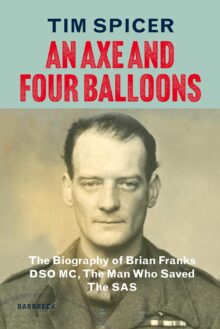
The result is An Axe and Four Balloons, Tim Spicer‘s biography of a man born into a conventional military and upper-class Edwardian family who developed a career which was anything but stuffy and conventional, and became the post-war saviour of the SAS.
Courage was in his blood. In October 1918, his father, George, led a cavalry charge on the Western Front, his horse leaping a barricade before it and he were cut down by machine-gun fire. It was, one brother officer noted, possibly the last time ‘a trumpet call has been sounded in action’.
George had been killed within five weeks of the end of the First World War in a battle to pursue the retreating Germans. His son would face their guns as they retreated across France again 26 years later.
One of the things that intrigued Spicer about Operation Loyton was the ‘unusual’ detail that the CO of 2 SAS had parachuted in to take command. But then, as he goes on to explore, Brian Franks was a man who did not always take the obvious route. On leaving Eton, with all the opportunities that afforded him, he went to work in the kitchens of the Dorchester Hotel, planning to work himself up. By the time war came, through hard work and connections, he had become manager of the Hyde Park Hotel.
An officer in the Middlesex Yeomanry in 1939, he quickly sniffed out opportunities for more esoteric military operations, joining the commandos and then the Special Service Brigade, with which he served with distinction during the invasion of Italy.
He would also command the SAS on operations in Germany and Norway. Despite returning to work at Hyde Park Hotel after the war, his connections to clandestine operations continued and, in the 1960s, he ran missions in Britain’s controversial and bloody secret war in Yemen.
What emerges from An Axe and Four Balloons is a portrait of a man who fought for his country, his regiment, and for every single man in his unit. His story will fascinate those who wish to study the history and practice of special forces soldiering because, as one former comrade of Franks observed, without him ‘there would be no SAS today’.

Greg Lewis is a writer with a keen interest in resistance, evasion, and escape, and the author of The Nazi Ghost Train, his most recent book.