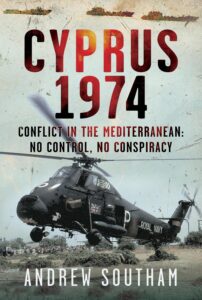
As a young soldier I served in Cyprus in 1981, only seven years after the Turkish invasion of the northern half of the island, and the subsequent partition of the country. Sadly, at the time my 18-year-old self had only a transitory understanding of the conflict. When in later years I taught War Studies my focus was on the earlier Greek EOKA campaign, rather than on 1974, so it has been a particular pleasure to read Andrew Southam’s account of a very confusing period of recent history.
Southam gives away his central thesis in his sub-title. What a cock up! The book is an argument about causation. He sets out successfully to demonstrate the intractable nature of nationalist cultural imperatives (something we Brits know only too well from calls on our small islands for various kinds of Celtic separatism) and highlights the absurd human follies that so often act as the causus belli for war.
It’s a fascinating story. Southam tells it well. The basic story is that on 15th July 1974 the Cypriot National Guard staged a coup d’état against president Archbishop Makarios III. Cyprus had received its independence from Britain in 1960, which retained, as it does today, a number of Sovereign Base Areas on the island. The rebels installed a pro-Greek government which had the ultimate objective of enosis, or union with Greece. This was too much for Turkey, which was concerned that this would prejudice the rights of the Turkish Cypriot minority (180,000, or 18% of the population) as well as undermine its own strategic position in this part of the Mediterranean. Turkish troops invaded, and the country was cut in half. Over 150,000 Greek Cypriots fled or were forced from the north to the south, and about 50,000 Turkish Cypriots moved from the south to the north.
The journey to war is always inherently interesting. Southam’s central proposition is that the catastrophe of 1974 was the result of a succession of misjudgements, competing national objectives, inadequate intelligence and institutional distraction. Despite there being many external actors playing on the Cypriot stage, there was no outside master plan (i.e. from NATO, the UK or the dastardly CIA) for the partition of Cyprus. Hence the ‘no control, no conspiracy’ sub-title. Southam demonstrates that once the genie was out of the bottle, it could not thereafter be controlled. On Cyprus, the very worst of Cypriot and Turkish cultural, political and religious exceptionalism collided and no one, not NATO, nor the Greeks, nor the Turks, nor the Brits or Americans were able to control the outcome. The result was chaos. The UK, as the old colonial power and with security commitments on the island, did not want to get involved in a war with two fellow members of NATO. The UK in fact had far less influence on events that some have subsequently alleged. If there were an upside to the debacle, it was the collapse of the Greek military junta and a return in that country to democracy. But it came at a huge cost: Turkey retains control of 37% of what should have been a Greek island. For the Greek hotheads demanding enosis (the real culprits of disaster) the lesson has to be, once again, to ‘be careful what you wish for.’ The coup overthrew the legitimate Cypriot government, created enormous uncertainty, provided Ankara with a justification for intervention and destabilised Greece. The junta therefore produced the very strategic crisis it was trying to avoid. The coup represented an existential threat to Turkey, which accordingly acted to assert its prerogatives, not merely to protect those on the island of Turkish heritage. This was, for Turkey, a war of national interest. Aren’t they all?
This is a fascinating account of a long forgotten war with geographical, national and strategic implications that remain in play today. I still remember patrolling the Green Line in 1981 wondering at the fact that the Turkish conscripts on the other side of the wire were from a country that was part of NATO, just as were those whom we, on the Greek side, were attempting to protect. Just how complex can international relations get? Very.
Robert Lyman is a historian and the co-author, alongside Richard Dannatt, of Korea: War Without End.