
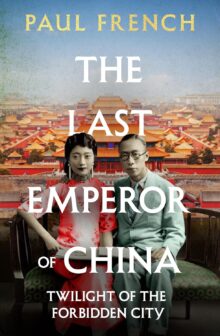
One of the delights of book reviewing is to encounter a work that is so compelling that the reviewer reads it continuously rather than in stages; and another is that it often introduces one to entirely new perspectives. In The Last Emperor of China: Twilight of the Forbidden City, Paul French draws us into what is a remarkable story.
Having studied modern Chinese political history as part of my A Level course in 1963-65, the reality that the last Qing emperor, Puyi, remained in Beijing until 1924, after having continued to live in the Forbidden City by arrangement with the leaders of the Chinese republic since their seizure of power in 1911, was a revelation. We had studied Dr Sun Yat-sen and Chiang Kai-shek and the Kuomintang, and the emergence of Mao Zedong and the Communists, but we had not been introduced to this perspective. Indeed, we did not know that Puyi was subsequently manipulated by the Japanese in the 1930s to be a ‘puppet’ figure as ‘emperor’ of the putative state of Manchukuo in what had been Manchuria.
This carefully researched and painstakingly referenced work gives us a strong understanding of what it was like to live in the rarified atmosphere of the Forbidden City, surrounded by relatives who conspired against each other, due to traditional rivalries between the different noble or royal elites within historic Chinese society. There are obviously Chinese sources but the richness of this book is strongly derived from the writing and notations of both Reginald Johnston, a British tutor and confidant of the Emperor, and Isabel Ingram, an American tutor to the young Empress Wanrong.
What becomes quickly apparent is the illogicality of the expectation that a young person, or indeed a young couple, can assume a royal or imperial role automatically and successfully. The behaviour and interests of these two young people – to cite photography, cycling, tennis and indeed the Emperor’s preoccupation with the study of ants – meant that they could never have fulfilled the dynastic expectations of the Qing family, even if they had been able to be restored to traditional power. The discovery of Western ways, and his desire to go to Oxford reinforce that proposition.
There is another perspective to this book. The fact that the nationalists who seized power in 1911 and declared a republic, did not eliminate him, and indeed financed his continued sojourn in the Forbidden City until 1924, is in stark contrast to the Soviet treatment of the Romanovs in 1918. It is more akin to modern times when, for example, Vyacheslav Molotov fell out with the Communist leadership in Moscow in 1957 and was dispatched to be ambassador to Mongolia; or when Alexander Dubcek was displaced in as Czechoslovakian leader during the ‘Prague Spring’ of 1968 and was dispatched to fulfil a minor role in the forestry commission in Bratislava. To put a wider context to this scenario, Puyi was still alive when I studied my A Level History, and I failed to hear about him at all, and yet, similarly to Molotov and Dubcek, he was employed within China as a gardener at the Botanical Gardens in Beijing, with a photograph provided of him in that role in 1959. As long as they have not been implicated with terror or bloodshed, the Chinese treatment of Puyi is how displaced political and dynastic leaders are generally treated in modern times,
This very engaging book has another important quality. It has left me wishing to learn more about the later life of Emperor Puyi, both during his imprisonment and the re-education programme to which he was assigned, and indeed his last few years working inconspicuously in the Beijing Botanical Gardens. There is so much more for us to know.
Trevor James was the editor of The Historian from 2006 to 2019.