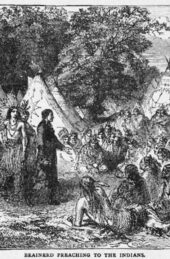

That word, mission, might make you think of Robert De Niro or Jeremy Irons, perhaps a young Liam Neeson, in Jesuit robes clambering up the Iguazu Falls in deepest South America, but, forgotten and less-documented as their efforts may be, there was a Protestant expansion too, a clear, not-so-Papist will to propagate the Gospel to the world, that challenges those preconceptions.
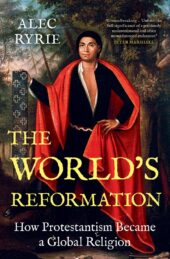
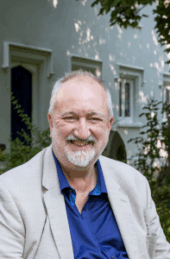
That was the starting point for Professor Alec Ryrie, whose latest book, The World’s Reformation, examines these attempts to globalise Protestantism across several continents and over three centuries: “It seemed to me that there was an untold story there of this first phase of Protestantism spreading itself around the world – or trying to.
“At first I thought I’d be writing a short article about something that didn’t happen. The more I dug into it, the more those handful of exceptions grew and grew. I had to look this thing in the eye and say, ‘Hang on a second, we’ve got this wrong!’ If nobody’s told this story, then I’d probably better do it myself.”
Uncovering the history hidden in plain sight, absence transforming into proof, a detective story of sorts that captures the perilous life of an academic! There was indeed some theological hesitancy limiting missionary urgency: in 1651 the University of Wittenberg’s theology faculty opposed sending missionaries to the heathen. Ryrie explains: “They’re saying it’s not time. The whole world will be converted, but at the end, in the last days. God’s great business between Christ and Antichrist must be concluded first.”
This notion of due process within apocalyptic frameworks and end-times thinking is just one part of understanding the early attitudes to the prospect of conversion. Equally compelling for this interviewer is the language at play, particularly the aversion to the hierarchical connotations of the word mission and exactly what can be assumed from seemingly benign metaphors: “The Protestants often prefer terms like ‘propagation’, ‘cultivation’ or ‘plantation’. They are trying to plant the good seed of the Gospel into the wild soil of the world, the heath. A heathen is a wild and uncultivated person and gardening can be, from the point of view of the weeds, quite a violent process.”
Competition with, and obsession over, their rivals from Rome shape much of the Protestant thinking abroad, a paranoia that broadens the religious conflicts back in Europe, informing and distorting their priorities. Ryrie describes: “They really do regard this as an extension of the Reformation project on behalf of the rest of the planet. Protestant missionaries are fearful that there are Catholics lurking under every rock. Tamil converts in Sri Lanka are being drilled in learning how to refute Catholic doctrine. That obsession dominates this whole process.
“The Catholic Church is just better equipped to do this kind of thing though. The Jesuits, the Franciscans, the Benedictines, the Dominicans – these are beautifully structured for missionary work. For Protestants, a more front foot approach is just structurally much more difficult. All of the funds and resources that their churches were basically nicked by the kings and princes that supported them.”
It is that lack of comparable institutional structure after the Reformation which lends itself to the idea that established trade routes and early colonial protection offered Protestants better reach, that mission and empire are difficult to separate. Slavery cannot but rear its ugly head in this conversation, and provides one of the most pronounced moral tensions in Ryrie’s study: “The missionaries generally don’t want to challenge slavery for various reasons, but they also regard themselves as helplessly caught up in it. This is not a case of cackling villains though; rather it’s the road to hell being paved with good intentions. It ends up not just undermining their efforts, but giving them a tendentious model for converting people in a colonial context.”
Encounters with enslaved Africans were frequent, and attempts to Christianise them while remaining complicit in the system proved the deepest contradiction and compromise in missionary thinking and its credibility.
Ryrie explores the idea that the issues also lay close to home. Previous encounters with Jews, Muslims, the Sámi of Lapland, and the Irish, Welsh and Scots shaping the templates, coercive or ineffectual or both, that were damaging when applied abroad: “These are the models they’ve got in the backs of their heads. The Protestants simply imposed the structure of a Christian church onto these people and forced them to comply. Repeated failures demonstrate that those experiences may not have been the best lessons from which to learn.”
Failure is a word that crops up a lot in our 45-minute discussion, particularly failure of imagination: “So many just tended to assume that their perspective was correct, that the self-evident superiority of their religion would draw people to them like bees to honey. There was genuine surprise when this doesn’t happen. We might ask ‘Could you not see how self-centred this is?’ No – the answer is they couldn’t.”
That inability to grasp an alternative worldview, many of the sources indicating surprise when indigenous peoples resist conversion, leads a reader to feel that it was all a doomed enterprise from the start. Why does the book end in the 1790s? What exactly changes at that point?
“There really is a step change. The long-standing Protestant willingness to work within the slave system breaks. If they’re going to convert these people, it is not possible working within this system.”
But more than that: “The decisive event of this whole story was the American Revolution.” A combination of imperial upheaval and abolitionist thinking reshaped Protestant mission into something more recognisably modern. This went along with Dutch imperial collapse, revolutionary goings-on in France, and the shift from the Atlantic to the Indian Ocean regarding British colonial concerns. Ryrie also points to indigenous Christian voices like that of Samson Occom starting to have an influence on missionary methods.
A new mindset then; something Ryrie wants to bring out when he mentions a possible future project looking at the interplay between religion and the British Empire. Similar to his intention to dig deeper into Protestant global expansion, not as a triumph but as a tangled story of ambition, contradiction, failure and eventual self-correction, he finishes by outlining a desire to get beyond “villains vs. heroes” tropes to a more nuanced kind of history: “I hope we’re at the point where we can get past those sorts of narratives. Without trying either to lay blame or excuse from blame, it is always better to understand the messiness of the situation within which these people were working.”
Alec Ryrie is a professor at Durham University and the author of The World’s Reformation: How Protestantism Became a Global Religion.
Zeb Baker-Smith is a Classics teacher based in Malawi, a freelance journalist and Editor at Aspects of History.
You can listen to the full conversation between Alec and Zeb on the Aspects of History podcast feed.