

Hello Simon. Your book, Death to Order, suggests that assassination is as much about signalling as it is about elimination. How important is the message sent by a killing compared to the actual removal of a target?
It depends on the kind of assassination campaign. The removal of political leaders is usually about signalling. The killing of police and intelligence officers receives less public attention but has practical consequences. The current Israeli assassination campaign against Iran encompasses both.
It is interesting reading in Death to Order that many assassinations, attempted or otherwise, fail to achieve policy changes, e.g. Margaret Thatcher over Northern Ireland. In other words, does assassination work?
Rarely, in the sense that the assassins achieve their political goals. However, one of the main arguments of the book is that assassinations do change political behaviour, despite the claims of some politicians to be unaffected. The security structure around Margaret Thatcher, and subsequent prime ministers, changed very significantly after the Brighton bomb. It’s the 1980s security structures which still define the world of the political élite, not just in Britain but in nearly all developed countries. The consequences have been serious. Political leaders in democratic have become distanced from their own citizens. Instead, they are reliant on a security bureaucracy. This is not a matter of finger-wagging: the need for security was palpable. However, assassins have not been good for democracy.
The word assassin appears in English in the mid-16th century, deriving from French, the medieval Latin word assassinus, and, from there, the Arabic ḥašīšī which means ‘hashish-eater’. Have you any explanation for this baffling etymology?
No idea. The word was already well established by the modern age. In practical terms, few cared where it came from. The modern argument tended to be about the term’s legal applicability, e.g. in extradition treaties. The lawyers have tended to dispense with term because of its very fungibility. One might argue that it’s mainly the US presidential executive order against assassination which keeps the debate about precise meaning alive.
Can one draw a distinction between Western powers employing assassination as a tactic, compared with totalitarian or revolutionary regimes?
Yes. The western powers are democracies and totalitarians powers are not democracies. The result of an assassination is the same: a dead individual. There are some differences in targets. Totalitarian and revolutionary regimes put a lot of effort into eliminating or terrorising émigrés and ‘traitors’. Both Britain and the US have killed their own citizens overseas in recent years, but this is a relatively rare target choice. The US had publicly assassinated one of its own citizens in 2011. President Obama then reined in the CIA on this front. President Trump removed the restrictions in 2017. The British started attacks on its own citizens in about 2015. Of course, one could argue that the British had assassinated its own citizens in the 1980s. The Secretary of State for Northern Ireland, Hilary Benn, has recently ordered an inquiry into the Finucane case. However, the British government seems surer of its legal grounds with regard to current operations than it does about historical actions.
And is Archduke Franz Ferdinand’s assassination the most calamitous of all?
It’s hard to argue against that conclusion. However, Death to Order does seek to show that it depends where one sits. China was certainly affected by the Great War, but probably the most consequential assassination was the Japanese army’s assassination of Zhang Zuolin in 1928. The assassination undermined Japan’s own fragile democracy, paved the way for the Japanese army’s war in China and undermined the warlord system. Again, central Africa was affected by the First World War and the collapse of the German empire. Nevertheless, the assassination of Sir Lee Stack led to the creation of a free-standing Sudan. Geopolitically, that probably had a greater impact on the future organisation of the African continent. Some Africanists would argue that the assassination of Patrice Lumumba in 1960 disastrously changed the direction of African development. Personally, I doubt that, but one can see the point.
You highlight the vast intelligence and logistical infrastructure required for modern assassinations – does this mean that only a handful of states can now operate effectively in this space?
Yes, in terms of high-end assassinations – decapitating a government with guided missiles, for instance. There are many more primitive means of assassinating opponents which less-than- full-spectrum powers can deploy. This means that less well protected targets are chosen. In 2023, for instance, the Ukrainians assassinated a number of pro-Russian Ukrainian politicians whom they regarded as traitors. They do assassinate senior Russian military officers too, but their targets are often at deputy level. In 2026 the Russians announced that as a result they would need to review their security system.
And following on, we’ve seen AI involved in the 2019 Mossad killing of an Iranian scientist. Will this new technology simply make ops more successful, or is there even more sinister potential for assassination?
It’s hard to imagine how assassination could get any more sinister: the deliberate stalking of a victim with murder in mind, for political advantage.
If assassination has become normalised as a tool of statecraft, do you think there is any realistic path toward international limits or norms governing its use?
The type of limitations which might apply are the same as for wielding other forms of international power. State leaders will strive to make themselves less vulnerable (more protection, better intelligence) whilst trying to erect a deterrent. Deterrence is not necessarily about tit-for-tat killings but rather some form of cost for the procurers of assassination. However, violence is endemic to the international system. There is always an acceptable level of assassination. See Canada’s recent volte-face in its relations with India.
And, just for curiosity’s sake, who exactly did kill JFK… (joking… not joking…)…?
Lee Harvey Oswald with an old Italian rifle. The US government lied about a lot of things to do with the assassination but that bit has remained unchanged by generations of evidence-gathering. The most interesting cache of documents turned up in the declassification process has been the records of the CIA’s penetration of Soviet facilities in Mexico City. Since Oswald visited the Soviet embassy in Mexico the evidence is germane but does not change the assassination picture. Such revelations are, however, important for anyone studying the history the Cold War in the early 1960s.
How does one begin to follow up a book on such a topic? Any similar books anticipated or projects to keep an eye out for?
I’m currently working with a network of international scholars based in Padua on the impact of civilian small arms on western political culture. My bit is called ‘Pistols and Panic’.
More can be found here – https://www.dissgea.unipd.it/eu-guns-globarms-joint-workshop
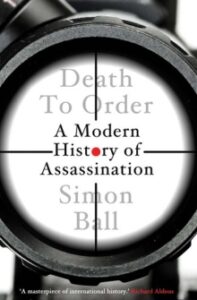
Simon Ball is a professor at the University of Leeds and the author of Death to Order: A Modern History of Assassination, published by Yale University Press.
Oliver Webb-Carter is the Co-Founder and former Editor of Aspects of History.