What first attracted you to the period or periods you work in?
As a student of German literature, I wrote my PhD thesis on the dramatist Gerhart Hauptmann, whose life and work spanned the decades from the 1860s to the 1940s. It was a period dense with momentous transformations and cataclysmic events – one to which I have returned repeatedly over the years, and which still holds me in its grip. What continues to fascinate me is the tension between great hopes and impending doom, and how thinkers, writers and artists from Central Europe responded to the pressures of a world in constant cultural and technological flux, as well as to political extremism, profound moral uncertainty, displacement and exile. Their attempts to navigate these forces remain a source of insight and inspiration. I still remember devouring the novels of Thomas Mann, Rilke’s poems and Kafka’s short stories as a teenager and feeling an immediate sense of intellectual and emotional belonging. Later on, my engagement with the German-speaking world widened to embrace the cultural complexity of London – where I have lived for the past thirty years and where the protagonists of my last two books left their mark – and the charged, creative atmosphere of postwar Rome, the city where I was born and raised. In part, my interest in the exile experience and in multicultural identity reflects something personal – a life lived with three languages and three countries I call home.
Can you tell us a little about how you research? Has the process changed over the years?
I’m completely at home – and very happy – in libraries and archives, as well as in big cities. These are the places where most of my research happens, and always has. My process has changed mainly because of the internet: resources like Google Books, JSTOR, archive.org and online newspaper archives have made so much material more accessible and research more efficient. I wonder whether, at some point, I’ll also begin to use AI – so far, I’ve only approached it with caution.
The common phrase is that history is written by the victors. Do you think this is true?
No, I don’t (think of Primo Levi…)
Are there any historians who helped shaped your career? Similarly, can you recommend three history books which budding historians should read?
When I was at school and later at university, I was most deeply struck by those historians, literary historians, and historians of culture whose work could reframe an entire period or way of thinking. What set them apart was not only the scope of their insight, but the quality of their prose: clear, elegant, capable of conveying both cultural complexity and historical precision. They were, in different ways, scholars for whom culture and mentality – rather than events alone – formed the true substance of history. Among those whose books I read and loved were figures as diverse as Jacques Le Goff, Karl Kerényi, Jean-Pierre Vernant, Bruno Snell, Erich Auerbach, William Empson, and Philippe Ariès.
Three history books I would recommend (tough question!) are:
- Jacob Burckhardt – The Civilization of the Renaissance in Italy
- Marc Bloch – The Historian’s Craft
- Judith Herrin – Byzantium: The Surprising Life of a Medieval Empire
If you could meet any figure from history, who would it be and why? Also, if you could witness any event throughout history, what would it be?
I would like to meet Frederick II, Holy Roman Emperor and King of Sicily, to uncover the man behind the extraordinary legend – and to see the marvel of natural and artistic beauty that was southern Italy under his reign.
As for an event I’d like to witness, it would be the Dionysia in ancient Athens, preferably when one of the great tragedians’ plays was performed. Failing that, I would like to spend some time in Berlin in the late 1920s, making sure to leave well before the Nazis arrived.
If you could add any period or subject to the history curriculum, what would it be?
My first answer to this question was Late Antiquity, the often-overlooked yet crucial era between Rome and the Middle Ages. But since I’m writing in the spring of 2026, a time when the world feels poised on the brink of catastrophe on multiple fronts, I would probably choose the 20th century approached as lived experience, with a focus on the ordinary within extraordinary conditions: life under dictatorship, war as a daily reality, and the dislocations of exile.
If you could give a piece of advice to your younger self, either as a student or when you first started out as a writer, what would it be?
I’d tell myself to be more confident, light-hearted and, above all, to work more freely on whatever I felt most passionate about.
Can you tell us a little bit about the project you are currently working on?
I’ve only just begun exploring a range of ideas I’d like to develop into books – mostly biographies of 20th-century women writers. I’m still deciding which one to focus on next, so I can’t say for certain yet.
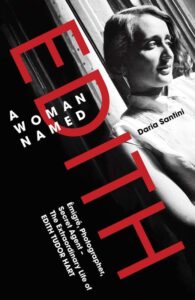
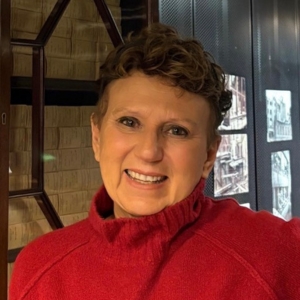
Daria Santini is an independent scholar and the author of A Woman Named Edith: Emigre, Photographer and Secret Agent – The Extraordinary Life of Edith Tudor Hart.