
Hello Brian, and welcome back to Aspects of History. A year on from its publication, Marshal Ney: Fall from Glory is your first book, but your fascination with the Napoleonic Wars goes back to childhood. What was it about Ney in particular that made you want to tell his story?
I was very young when I first watched the 1970 film Waterloo on a rainy Saturday afternoon on BBC 2. It depicted Ney, played by Dan O’Herihy, and his role in Napoleon’s first abdication, his fatal ‘iron cage’ boast when Napoleon returned from exile, his subsequent defection, leading the spectacular charges of the French cavalry against Wellington’s squares. Finally, there is that scene with him rallying the retreating Old Guard with “Don’t you know me? I’m Ney! Ney! Marshal of France!”
Reading about Russia and a host of other campaigns, Ney became transfixed in my mind as a man of extraordinary courage and indomitable spirit. And tragedy – my dad telling me of his end at the hands of a firing squad as a condemned traitor. From then on writing a book on Ney became an ambition, one displaying his strengths and his flaws. I hope I have done him justice.
Ney rose from the son of a barrel-maker to become one of Napoleon’s marshals. How important was that prodigious rise from the ranks of the Ancien Régime army to the highest reaches of imperial France in shaping the man he became?
Ney, like Napoleon, was a product of the Revolution. Before it, advancement in the French Royal Army was strictly limited by social class. A common soldier could look only forward to the slow climb up the non-commissioned ranks to sergeant major. The removal through emigration of much of the Army’s aristocratic officer corps opened unheard opportunities for promotion to the highest ranks. Ney was proud of his rise to Marshal but always sensitive of his origins and defensive of his status, always watchful of slights. The treatment he received, and his wife Aglaé, from the Bourbons enraged him. The defiance he displayed in his trial, and before the firing squad, was because he believed, to quote Shakespeare’s Othello “I have done the State some service and they know it”.
Ney is remembered as ‘The Bravest of the Brave’, and his conduct during the retreat from Moscow has become the stuff of legend. What do you think his courage tells us about him as a soldier – and at what point did that courage become a liability?
Ney was a true warrior. It is not an overstatement to describe him as Homeric; he could have stepped out of the pages of the Iliad. He believed that a soldier’s true place was in the front rank of battle ‘where men win glory’. Wounds and death were part and parcel of a soldier’s life and ‘Glory in the service of France’ was his reward. To a modern audience that attitude is incomprehensible even abhorrent, but Ney believed in it heart and soul. Ney’s courage could be a liability when he was expected to behave as a senior commander. At Jena you see him being fearless and inspiring, but, by charging without orders and getting cut off, half his command become casualties. At Waterloo, Ney led the grand cavalry charge from the front but, by doing so, he was reduced to being a troop captain. He was unable to direct the attack to coordinate the cavalry with horse artillery and available infantry. At Ney’s level of command a sword and brave heart was less effective than a writing pad, pencil and telescope.
You make a clear distinction between Ney the superb commander on the battlefield and Ney when asked to operate at army level. How could a leader so effective in the chaos of battle be unable to make the transition to higher command?
Every commander has his ceiling. Ney could not fight a battle on a map. He was too narrow in his thinking, too impetuous, too impatient. He was brilliant as commander of a formation whose movements he could direct first hand, out front on his charger. As a corps commander he was at his most hard-hitting when given clear orders and a clear objective. But, temperamentally, he could not direct two or more corps fighting on two or more fronts. At the Battle of Dennewitz, Ney commanded over 60,000 men. There he reverted to the leadership style he was most comfortable with, leading charges and inspiring the troops. But, by performing the role of a brigadier, Ney failed to act as a commander of an army. In the thick of the action he had no overview of how the battle was progressing. The result was a disastrous rout.
Waterloo might have come to define Ney’s reputation, particularly the repeated cavalry charges. To what extent has he been made a scapegoat for Napoleon’s failures during that campaign?
Napoleon mismanaged Ney at every stage of the Waterloo campaign. Ney’s last minute call to arms seems to have been driven by the absence of any alternative. So many of the marshals had either excused themselves or had been incapacitated. Napoleon made no effort to repair his fractured relationship with Ney before appointing him as his key field commander. He did not take Ney into his confidence, he had no role in strategy, or planning. Ney had no staff, he did not know his commanders, his units. Yet he suddenly was in command of an entire wing of the army.
The charges of the French cavalry at Waterloo have been blamed on Ney misreading the movement of stragglers and wounded to the rear as a general retreat. He then supposedly acted on his own initiative in launching a charge that eventually consumed all the army’s cavalry. The reality is that the French cavalry charged because Napoleon had decided to try and break Wellington’s line with a grand cavalry attack. It failed and Napoleon typically passed responsibility for the failure onto Ney. If the squares had broken then Napoleon would have claimed the credit and lauded Ney’s brave leadership like he did with Murat at Eylau. Instead Ney became the hothead who got the flower of France’s cavalry slaughtered and lost Waterloo.
Ney’s political naivety seems to be crucial in understanding his tragic final months: he helps persuade and force Napoleon’s first abdication, promises Louis XVIII that he would bring Napoleon back in an iron cage, and then defected to Napoleon during the Hundred Days. How did his understanding of loyalty to France differ from loyalty to the men who ruled it?
Ney’s history is the political history of post-1789 France. As a private trooper he serves the King of France. As an officer he serves the French Republic in its various governments – the National Convention, the Directory. As a general he serves the Consulate. As a Marshal he serves the Emperor. He serves the King. He serves the Emperor again. He always believed that he was serving France rather than a form of government. In 1814 he recognised that the military situation facing Napoleon was beyond retrieval. That Napoleon’s refusal to face reality was costing the lives of France’s soldiers and people. His loyalty to the Emperor was overtaken by a greater loyalty to France.
Likewise, when Napoleon returned from Elba, Ney believed that avoiding a civil war was of a higher virtue than his oath to the King. He was genuinely bewildered that he would be anything other than applauded for his actions. Instead he found himself in a position of being regarded as a turncoat by Bonapartists and Royalists alike – and with mistrust by everyone else. He could have taken the route taken by the other marshals of pleading illness, of retiring to his estate to await events. Instead he felt that he needed to make a dramatic public display. Tragically, he failed to understand that this made him a target.
Ney’s execution has acquired an quasi-mythical quality, not least through the famous last words (that there is no evidence he actually spoke). Talk us through those final months, and why did his execution become such a charged moment in post-Napoleonic France?
Post-Waterloo Ney is a physical and mental wreck. That outburst in the Chamber of Peers which torpedoed Napoleon’s efforts to fight on led to his second abdication. Ney remains in Paris although he is frozen out by the Provisional Government. He appears paralysed to the very real danger he faced from the returning Bourbons. He had ample time to make a run to the frontiers or take a ship to America. Instead he lingers on. It was only on the eve of the Allied occupation of Paris that he leaves the capital. Again, rather than make haste, he appears to wander aimlessly across France. By the time King Louis signed the decrees that placed him on a list of those to face court martial, it was too late.
The trial of Ney and his execution was a disaster for the Bourbons. It was seen as a blatant and vindictive settling of scores – a judicial murder. Perhaps Louis believed that the marshals would acquit him or, if guilty, then give him a mild sentence citing extenuating circumstances. Ney’s refusal to recognise the legitimacy of the court martial gave the presiding marshals an easy get-out. The ultra-dominated Chamber of Peers had no compunction to spare a man who was a symbol of everything they hated. I believe that however unwise and naive Ney’s demand to be tried before the Peers, it was motivated by a desire to be judged by the highest court, to have his name and reputation cleared of taint.
Louis could have pardoned Ney, commuting the sentence to imprisonment or exile. Instead ‘The Bravest of the Brave’ was taken out, placed against a wall and shot. Shot by French soldiers serving a French king in a Paris occupied by foreign armies. As Talleyrande said of Napoleon’s execution of the Duke of Enghien it was “worse than a crime”, it was “a mistake”.
Whispers that Ney survived his execution and escaped to America persisted for generations, despite the absolute improbability of the story. Why do you think the rumour proved so contagious – and how was it put to bed?
It is a testament to Ney’s legend that people wanted to believe that the Duke of Wellington and other sympathetic officers engineered a plot to save a brave and honourable opponent from an unjust execution. Unfortunately Wellington was not a man of sentiment and Ney was incapable of the guile required to hide his identity under the guise of an obscure schoolmaster.
Ultimately DNA has proven that whoever Peter Stuart Ney was, he was not Michel Ney, Prince of Moscow, Duke of Elchingen and Marshal of France.
You have mentioned that the legacies of the French Revolution and Napoleonic Wars still endure. Having finished Marshal Ney: Fall from Glory, are there any other figures or events that you would like to explore in a future title or project? What’s next?
I am drawn to writing about another Marshal of France who was put on trial after his country was defeated in war – Francois Bazaine. He rose from the ranks, made a Marshal by Emperor Napoleon III, and was a very brave man who was raised beyond his capabilities. The rout of France in 1870 was placed at his door and he was made a scapegoat.

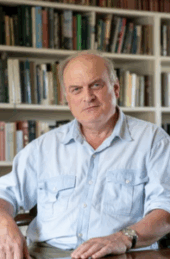
Brian Williams is an historian and the author of Marshal Ney: Fall from Glory.
Zeb Baker-Smith is a freelance journalist and Editor at Aspects of History.