

Great to have you back in the Book Club hotseat, Barney. A year on from the publication of Nations in Arms, what first drew you to the idea of comparing these five armies, separated by such vast swathes of time, and what did you hope a comparative study would reveal that individual military histories might miss?
What I find strange – irritating even – is that contemporary commentators make out that we could be facing Armageddon and that even if we are spared such a fate then the lessons of current wars, especially in Ukraine, place militaries in an impossible situation. My point is that many regimes have faced similar challenges over the centuries but revolutionised their armies to master them. Drones, which seems to be the term now applied to all the remote weapon systems employed so effectively in Ukraine, have dramatically changed the battlefield and how armies must re-organise themselves to both use and defend against them. Yet there are endless historical parallels – the mounted knight, the use of gunpowder, infantry musket fire, the percussion cap, the machine gun – the list goes on. Taking five armies that were restructured to deal with these innovations helps us understand that we face similar challenges to our ancestors and that, if they overcame them, then so can we.
Across Constantine’s army, Mehmet II’s forces, the New Model Army, the Prussians and the US Army of the Second World War, you identify this recurring pattern of armies having to reform and innovate in the face of existential threats. Can you put a finger on what it is that makes some military reforms succeed and others fail – and how important is it to overcome the conservative instincts of military institutions?
A difficult question, but essentially it seems to be the urgency of the political/military situation. When faced with a fracturing empire, as Constantine was, or defeat and execution by the King, as Cromwell was, or subjugation to Napoleon as Scharnhorst was, then the threat demands that reforms are made to work. Armies reorganised without external pressure tend not to be so successful because the reforms are not immediately tested on the battlefield. A lot of it also comes down to the personality and political power of the instigators. Mehmet could execute his restructuring of the Ottoman armies because he exercised absolute power, although had he not reformed his army after the disastrous Ottoman defeat at Ankara then arguably he would have lost it. Contemporary armies tend to fail to reform themselves effectively as they do not face the pressures that nations fighting wars do and because inevitably reorganisations become budgetary exercises. Take Ukraine, where the army has almost completely reorganised itself to be most effective and Estonia and Poland, both of which I discuss in the book, who see an existential threat if their armies are not revolutionised. Much also depends on public support which tends to emerge if the threat is real. So the question is how immediate is the threat to Western Europe now? Severe enough to demand full reform or can governments continue to fudge it by tinkering? It is a genuinely difficult question to answer.
Your picks also provide contrasting examples of the relationship between soldiers, the state and wider society. Has that relationship changed as armies become increasingly professionalised, and what does history tell us about the responsibilities of the citizen in defending the state?
Yes – it has, but armies have been largely professional for some time. There is inevitably a marked change when nations are mobilised, although that happens but rarely in history. The issue now is more that citizens have got used to absconding responsibility for their defence, in its widest sense so including defence against environmental threats, to a diminishing professional force. Again Ukraine has shown that mobilisation can work, but the lesson, as also exemplified by Israel, is that nations need to look at their reserves. Certainly the leading western nations, with the notable exception of the USA, have badly neglected the reserve. Reserve forces have two functions being both to reinforce the professional army and also to carry out many of the tasks which do not warrant full time resources such as intelligence, logistics, medical etc. Increasingly nations now also need a force to deal with environmental threats.
You deliberately left Napoleon’s army out of the book, despite its extraordinary battlefield successes, because you argue that an army must serve national interests rather than a ruler’s ambitions. How important is that distinction to the book’s argument about what makes an army truly successful?
Crucial. The reason I chose the armies I did was because they were examples of how the interest of an army, and its commanders, coalesce with national interest, whether establishing the late Roman empire, the Ottoman empire, democracy in Britain, a German nation etc. There are too many examples of where an individual or an oligarchy subvert a nation’s military effort for their own ends. I didn’t choose Napoleon because he left France weakened and unstable, arguably for a century; nor did I choose Julius Caesar’s army which was ultimately engaged more in civil war than furthering Roman interests. I chose the Prussian army under Scharnhorst rather than the Nazi Wehrmacht, undoubtedly a fine fighting machine but one which served a regime that did not further German interests and which was arguably out of sympathy with the population which it represented.
Readers on the outside of military circles will often hear of technology transforming warfare, but you argue that many of the fundamentals remain. Does the war in Ukraine – from drones to the return of large-scale attritional fighting – reinforce that argument, or has anything about modern conflict made you reconsider it? And is there a case that the Ukrainian army’s mobilisation and resistance would feature in a similar book written a hundred years from now?
Technology transforms warfare – certainly – and a major factor in choosing the armies I did was because they took emerging technologies and harnessed them to their advantage. But technology is, to state the obvious, a constantly changing parameter and the lesson is that armies who keep abreast or even ahead of technological advances will succeed. But the point is that technologies must be harnessed to a set of organisational principles, which I hope I have identified, which are timeless and which apply equally to the 4th century as they do to the 21st century. Ukraine most certainly reinforces that argument and their army would make a very strong claim on inclusion in many future military works. They have adapted to the changing technologies but the issues they face are how to organise their army to use those technologies effectively – issues such as who to recruit, the relationship between army and government, domestic defence industry and manufacturing capacity, stockpile management and use of reserves. These are exactly the same issues that Constantine and Mehmet faced.
When you wrote Nations in Arms, the return of war in Europe was already reshaping defence policy; since then, governments across the continent continue to rethink their armed forces. Looking at your historical examples, what do you think governments today most risk getting wrong as they rearm?
Ensuring that defence is seen as a national issue with every citizen having a role to play from the most sophisticated professional unit, via a rejuvenated reserve to the local force who can help confront those threats of flooding, fire, epidemic, drought and, probably quite soon, migration. Governments also need to look at instilling a sense of civic duty whereby it is seen as incumbent on citizens to help each other. It is absurd to say that such plans are unaffordable. Given the imminent threats we should look at some of the models I examine – national service as true service to the nation and community as opposed to the corrupted bootcamp version so beloved of back bench politicians.
You write that successful armies are often created during crises, when time is of the essence and careful thought is difficult. But is there a danger that the rush to rebuild military capacity could lead governments to expand existing structures and perpetuate the issues rather than undertake the kind of fundamental reform you identify in the five case studies?
I think I have answered this above. Yes, inevitably there is a danger in that and arguably history is littered with examples of armies structured to fight the last war. But more relevant is that crises force reform and without that impetus governments take the more leisurely route of defence reviews which are dressed up as being far sighted plans but which are in reality both savings exercises and generally never fully implemented. Would the UK, for example, have developed its drone capability were it not for the example of Ukraine?
Having spent so much of your career as both a soldier and a military historian, what are you working on next – and are there any forthcoming projects or titles that you can tell us about?
Definitely. I am fixated by Constantine the Great, a man who was both deeply flawed but a visionary and possessed of an unparalleled competence as both military commander and emperor. Look at his record – rebuilding the Roman army after decades of neglect; reuniting the empire under single rule and overseeing a period of remarkable economic and social development; moving the capital from a Rome that was rapidly becoming irrelevant to a new capital focussed on the empire’s new centres of population and wealth; converting the empire to Christianity as a means of ensuring effective civilian government although it is unlikely that he ever became a Christian himself; finding the True Cross, an inspired idea even if he didn’t actually do so. The trouble is that there are but few reliable contemporary sources to draw on for biography and those there are tend to eulogise of vilify him – so perhaps a venture into historical faction as opposed to fiction.
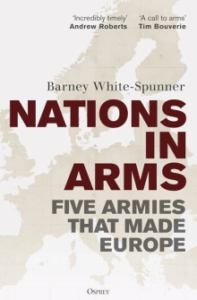
Barney White-Spunner is a former British Army soldier and the author of Nations in Arms: Five Armies That Made Europe.
Zeb Baker-Smith is a freelance journalist and Editor at Aspects of History.